Chemical Giant Duc Giang Corporation Faces Severe Profit Contraction in Q3 2026 Amid Rising Costs and Operational Hurdles

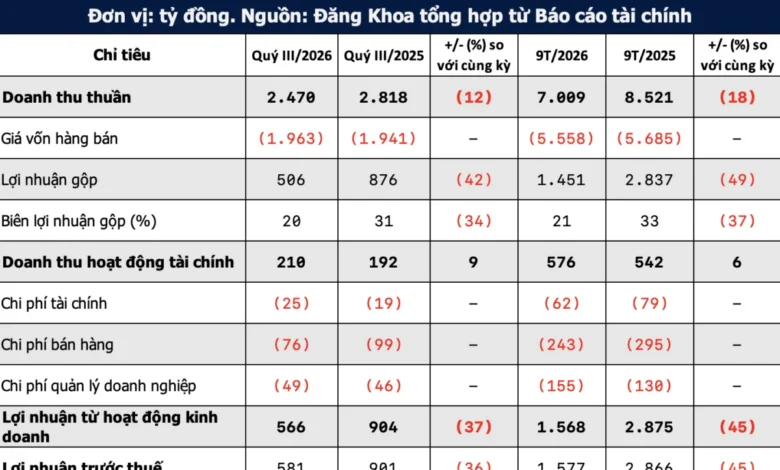
The Vietnam Chemical Corporation, widely recognized as Duc Giang Chemicals Group (HOSE: DGC), has released its consolidated financial statements for the third quarter of 2026, revealing a challenging business environment. During the period, the chemical giant reported net revenues of nearly VND 2,470 billion, marking a 12% decline compared to the same period in the previous year. More notably, profitability experienced a sharp downward correction, with net profit after tax plummeting by 37% year-on-year to approximately VND 507 billion.
The primary catalyst behind this earnings contraction was a significant escalation in production costs. Cost of goods sold jumped to VND 1,963 billion during the quarter, heavily squeezing the company’s profit margins. Consequently, gross profit dropped by 42% to roughly VND 506 billion, while the gross profit margin narrowed drastically from 31% down to 20%. Industry analysts note that this compression highlights the vulnerability of chemical manufacturers to volatile international raw material markets and unforeseen domestic supply chain disruptions.
Detailed Financial Breakdown of Q3 2026
A closer examination of Duc Giang Chemicals’ financial statements for the third quarter highlights mixed performances across various operational segments. Financial revenue offered a minor cushion, reaching nearly VND 210 billion, which represents a 9% increase compared to the corresponding period in 2025.

However, operational expenses and cost pressures offset these financial gains. Financial expenses were recorded at VND 25 billion, while selling expenses and administrative expenses accounted for VND 76 billion and VND 49 billion, respectively. Pre-tax profit stood at nearly VND 581 billion, and net profit after tax settled at approximately VND 507 billion, reflecting year-on-year declines of 36% and 37%, respectively.
Management attributed the weakened financial performance to two primary factors: falling net revenue and surging input costs. Expenses related to essential production inputs—such as sulfur, electricity, metallurgical coke, and ammonia—witnessed substantial upward spikes globally and domestically. Furthermore, the mandatory temporary suspension of 25 mining operations to facilitate ongoing local investigative procedures forced the company to alter its procurement strategy. Duc Giang Chemicals was compelled to rely entirely on imported and externally sourced rock phosphate, significantly inflating the cost of manufacturing yellow phosphorus compared to previous quarters.
Nine-Month Performance and Annual Target Trajectory
Looking at the broader picture for the first nine months of 2026, the downward trend remains pronounced. Duc Giang Chemicals accumulated net revenues of VND 7,009 billion, down 18% from the same timeframe last year. Gross profit took a heavy hit, dropping 49% to VND 1,451 billion, while the nine-month gross profit margin compressed from 33% to 21%.
Financial revenue for the nine-month period reached VND 576 billion, representing a modest 6% growth. Cost controls yielded some positive results as financial expenses and selling expenses decreased to VND 62 billion and VND 243 billion, respectively. Conversely, administrative expenses rose to VND 155 billion. After accounting for all operational deductions, the company reported a pre-tax profit of VND 1,577 billion and a net profit of VND 1,369 billion, representing decreases of 45% and 46% compared to the first nine months of 2025.

For the full year of 2026, Duc Giang Chemicals established a consolidated revenue target of VND 10,100 billion and a net profit target of VND 1,600 billion. This ambitious yet conservative planning represented the lowest profit target set by the enterprise since 2020, dropping nearly 50% compared to the actual results achieved in the 2025 fiscal year. Despite the hurdles faced in the third quarter, the company has successfully completed approximately 69% of its annual revenue objective and roughly 86% of its yearly profit milestone after nine months of operations.
Balance Sheet Stability and Asset Quality
Despite the operational headwinds and margin compressions, Duc Giang Chemicals maintains a robust financial foundation characterized by substantial liquidity and conservative leverage. As of the end of the third quarter, total assets stood at VND 16,514 billion, reflecting a reduction of VND 2,750 billion compared to the close of the second quarter of 2026.
A standout feature of the balance sheet remains the company’s massive cash and short-term deposit reserves, which amounted to an impressive VND 9,761 billion. Total debt obligations remained manageable at VND 1,391 billion. Meanwhile, owner’s equity reached nearly VND 13,475 billion, bolstered by undistributed post-tax profits sitting at a formidable VND 6,253 billion. This strong liquidity buffer provides the conglomerate with the financial resilience needed to navigate regulatory hurdles, temporary supply chain shifts, and capital-intensive operational adjustments without relying heavily on external credit financing.
Market Reaction and Broader Industry Implications
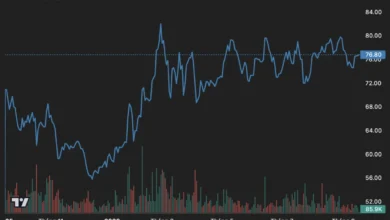
On the stock market, investor sentiment has reflected the broader challenges facing the chemical sector. Shares of DGC closed a recent trading session at VND 33,300 per share, placing the company’s market capitalization at approximately VND 12,647 billion.

Market experts suggest that the situation at Duc Giang Chemicals serves as a case study for heavy industrial manufacturers operating in emerging markets. When primary domestic resource extraction is abruptly halted due to administrative or investigative mandates, companies face immediate margin compression if they lack diversified supply alternatives. The reliance on imported rock phosphate protected production continuity but drastically altered the cost structure, highlighting the critical importance of supply chain localization and regulatory compliance in maintaining long-term corporate valuation.
As Duc Giang Chemicals navigates the final quarter of 2026, market watchers will closely monitor the resolution of the mining suspensions and the stabilization of international commodity prices. Achieving the remainder of the annual business plan will largely depend on the management’s ability to optimize input procurement, control operational overheads, and resume domestic mining activities as soon as regulatory clearances are granted.
Related posts: