Global Gold Surges Past $4,348 Per Ounce Driven by Market Anticipation Ahead of Fed Rate Decision

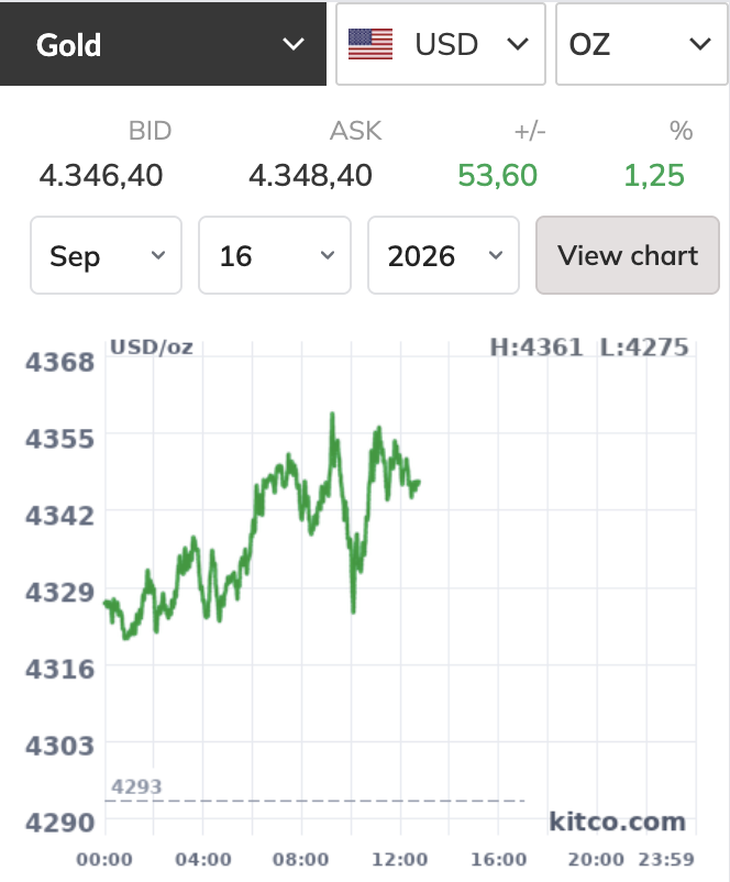
Global gold prices staged a dramatic and unexpected rebound during today’s trading session, climbing by $53.60 to touch a notable intraday peak of $4,348 per ounce. This sudden upward trajectory defied widespread consensus across major financial institutions and analytical firms, which had largely forecasted that the United States Federal Reserve (Fed) would implement another interest rate hike during its upcoming monetary policy announcement.
When converted using current commercial bank exchange rates, international gold prices hover at approximately 137.2 million Vietnamese dong per tael. This strong recovery arrives on the heels of a sharp market contraction that occurred just a day prior, driven by escalating crude oil prices and stubbornly hot U.S. inflation data that significantly outperformed prevailing economist projections.
Market Dynamics and the "Buy the Rumor, Sell the Fact" Phenomenon
Before today’s sharp rebound, international gold prices had tumbled to their lowest level in over a month during yesterday’s trading sessions. In a span of less than 24 hours, spot gold twice breached a crucial technical support level, touching $4,260 per ounce. Compared to its recent historical peaks, yesterday’s lowest valuation represented a staggering correction of $410 per ounce, roughly equivalent to 12.9 million Vietnamese dong per tael.
Explaining the underlying drivers behind this sudden market reversal, commodities expert Tran Duy Duong noted that the prevailing sentiment in precious metals trading often aligns with the classic market adage: "buy the rumor, sell the fact." This principle dictates that asset prices frequently price in anticipated macroeconomic events well before official disclosures occur.
For several weeks leading up to this point, both gold and silver markets had actively digested the likelihood of an aggressive Federal Reserve rate hike, fully pricing this expectation into daily valuations. As a result, market participants grew increasingly accustomed to the prospect of monetary tightening, treating the anticipated rate adjustment as an inevitable reality rather than a speculative shock.
"If the Federal Reserve ultimately proceeds with a rate hike, there remains a strong probability that gold prices could pull back toward the $4,260 per ounce threshold—or potentially dip even lower—before establishing a solid foundation for a sustained upward trend," Duong projected. "Conversely, in the alternative scenario where the central bank opts to keep interest rates unchanged, both gold and silver prices are expected to experience a powerful, aggressive rally during tomorrow morning’s trading session."
Domestic Market Divergence and Regional Premiums
While international markets experienced high volatility, domestic Vietnamese gold markets maintained a distinct trajectory, widening the gap between local retail prices and global spot valuations.
At major domestic enterprises, such as the Saigon Jewelry Company (SJC), SJC gold bars were publicly listed with a selling price of 146.5 million Vietnamese dong per tael and a buying price of 143.5 million Vietnamese dong per tael. This reflected a substantial increase of 1.2 million Vietnamese dong per tael across both acquisition and retail brackets.
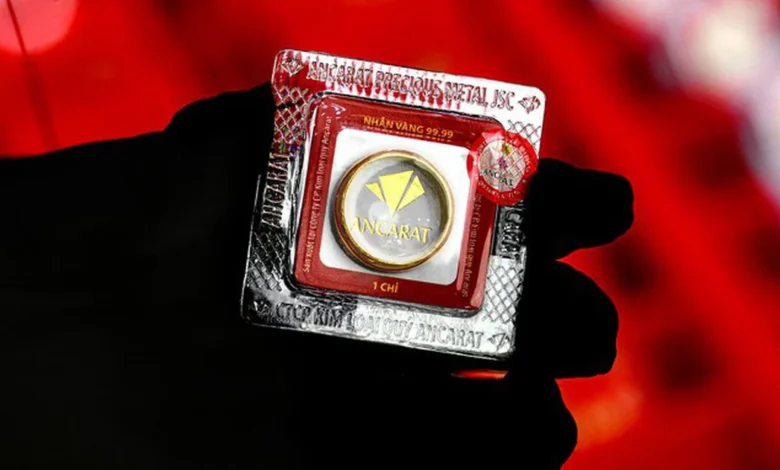
Similarly, 9999 pure gold rings mirrored this upward momentum, climbing to a retail benchmark of 146 million Vietnamese dong per tael, while acquisition bids settled at 143 million Vietnamese dong per tael. Private gold and jewelry brands reported even higher valuations; Ancarat listed retail gold at 151.5 million Vietnamese dong per tael, with buy-in rates anchored at 148 million Vietnamese dong per tael. Mi Hong similarly adjusted its priceboards, quoting a selling price of 146 million Vietnamese dong per tael and a buying rate of 144.5 million Vietnamese dong per tael, marking a firm increase of 1.5 million Vietnamese dong per tael.
When benchmarked against converted global spot prices, domestic gold in Vietnam currently trades at a significant premium, resting approximately 9.2 million Vietnamese dong per tael higher than international equivalents. This persistent domestic spread highlights localized supply-and-demand imbalances, regulatory constraints on gold bar production, and strong domestic consumer hedging preferences.
Parallel Movements in the Global Silver Market
Precious metals markets extend beyond gold, with silver demonstrating comparable resilience during today’s volatile trading environment. International silver spot prices climbed alongside gold, testing a robust level of $64.38 per ounce, which translates to roughly 2.03 million Vietnamese dong per tael under current currency conversions.
Domestically, Vietnamese precious metal distributors adjusted their silver portfolios to reflect the shifting international landscape. Ancarat positioned its domestic retail silver offerings at 2.252 million Vietnamese dong per tael, with acquisition values set at 2.184 million Vietnamese dong per tael. Meanwhile, SBJ quoted retail silver at 2.265 million Vietnamese dong per tael and buy-in rates at 2.193 million Vietnamese dong per tael. Phu Quy rounded out the sector by listing retail silver at 2.286 million Vietnamese dong per tael, supported by a competitive buying price of 2.217 million Vietnamese dong per tael.
Macroeconomic Implications and Federal Reserve Watch
As global financial markets brace for the official Federal Reserve announcement, economists and institutional strategists are closely analyzing the broader implications of persistent inflationary pressures and energy market shocks. The recent surge in crude oil prices has complicated central bank efforts to anchor long-term price stability, forcing policymakers to weigh the risks of premature monetary easing against the dangers of prolonged economic restriction.
Historically, precious metals have served as a traditional hedge against currency devaluation and inflationary erosion. However, in an elevated interest rate environment, non-yielding assets like gold and silver often face headwinds as capital shifts toward high-yielding fixed-income instruments and a strengthening U.S. dollar. The resilience demonstrated by gold above the $4,300 per ounce threshold suggests that institutional investors and sovereign entities continue to accumulate bullion as a strategic buffer against geopolitical instability and systemic financial risks.
Market participants remain laser-focused on the upcoming central bank statements, which will provide definitive guidance regarding the trajectory of U.S. monetary policy for the remainder of the fiscal year. Whether gold maintains its newfound momentum or retreats toward previous support levels will depend heavily on the specific verbiage utilized by Federal Reserve officials regarding future rate paths, balance sheet management, and macroeconomic growth forecasts.