Heroic Race Car Driver Loek Hartog Abandons Podium Push to Rescue Rival Ollie Millroy from Blazing Wreck at China GT Championship

The spirit of sportsmanship and the preservation of human life triumphed over championship glory at the prestigious China GT Championship held at the Shanghai International Circuit. During a high-stakes race weekend that promised fierce competition and strategic battles on the asphalt, a horrifying multi-car collision turned the race track into a scene of immediate danger. Amidst the chaos, Porsche driver Loek Hartog made a split-second, life-altering decision to abandon his pursuit of a podium finish, pulling his race car to a halt to rescue his competitor, Ollie Millroy, from a rapidly engulfing inferno. The incident has since reverberated throughout the global motorsports community, serving as a powerful reminder that human life takes precedence over any checkered flag.
Anatomy of a High-Speed Disaster on the Shanghai Circuit
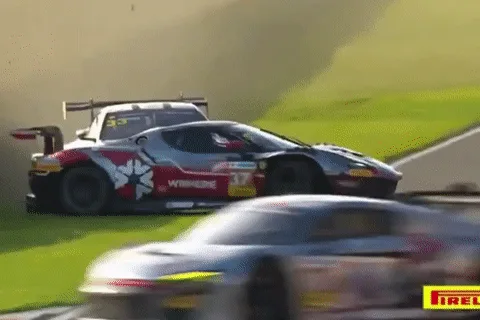
The dramatic sequence of events unfolded approximately twenty minutes into the endurance race, a critical juncture where tire strategies, fuel loads, and driver rotations begin to dictate the hierarchy of the field. According to motorsport publication Carscoops, Neil Verhagen, piloting a BMW M4 GT3 Evo, was locked in a fierce battle for position, attempting a daring overtaking maneuver against David Chen as the grid approached the notoriously demanding Turn 14.
As braking zones compressed and lateral loads reached their limits, the BMW M4 GT3 Evo drifted wide, clipping the outer grass section of the circuit. The momentary loss of traction compromised Verhagen’s steering control, causing the vehicle to spin violently and collide directly with Chen’s Ferrari. The kinetic energy of the initial impact sent both racing machines careening uncontrollably across the track toward another sharp corner.
At that exact moment, a third vehicle—a Ferrari 296 GT3 Evo driven by veteran racer Ollie Millroy—was navigating the blind corner. With zero reaction time to avoid the stationary wreckage, Millroy’s Ferrari took a devastating T-bone impact on its passenger side. The structural integrity of the high-performance GT3 car was compromised instantly, and within seconds, a fierce fire ignited, feeding on ruptured fuel lines and hot engine components.
A Split-Second Decision: Loek Hartog’s Heroic Intervention
Captured entirely by the onboard camera of the Porsche 911 GT3 R Evo driven by Loek Hartog, the unfolding crisis played out in fractions of a second. Hartog was running directly behind the pack, perfectly positioned to capitalize on the chaos and potentially leapfrog his way into the race lead. However, seeing the catastrophic collision and the flames licking at the passenger compartment of Millroy’s car, the Dutch driver instantly dismissed any thoughts of racing glory.
Hartog slammed on his brakes, parked his Porsche mere feet from the flaming wreckage, and leaped out of the cockpit without a moment’s hesitation. Sprinting across the tarmac toward the burning Ferrari, Hartog initially attempted to access the driver’s side door, but was thwarted by severe structural damage and the intense heat of the spreading fire. Demonstrating remarkable composure under extreme pressure, he rounded the back of the Ferrari, grabbed the driver’s side door handle with all his might, and pulled relentlessly to create an extraction path.
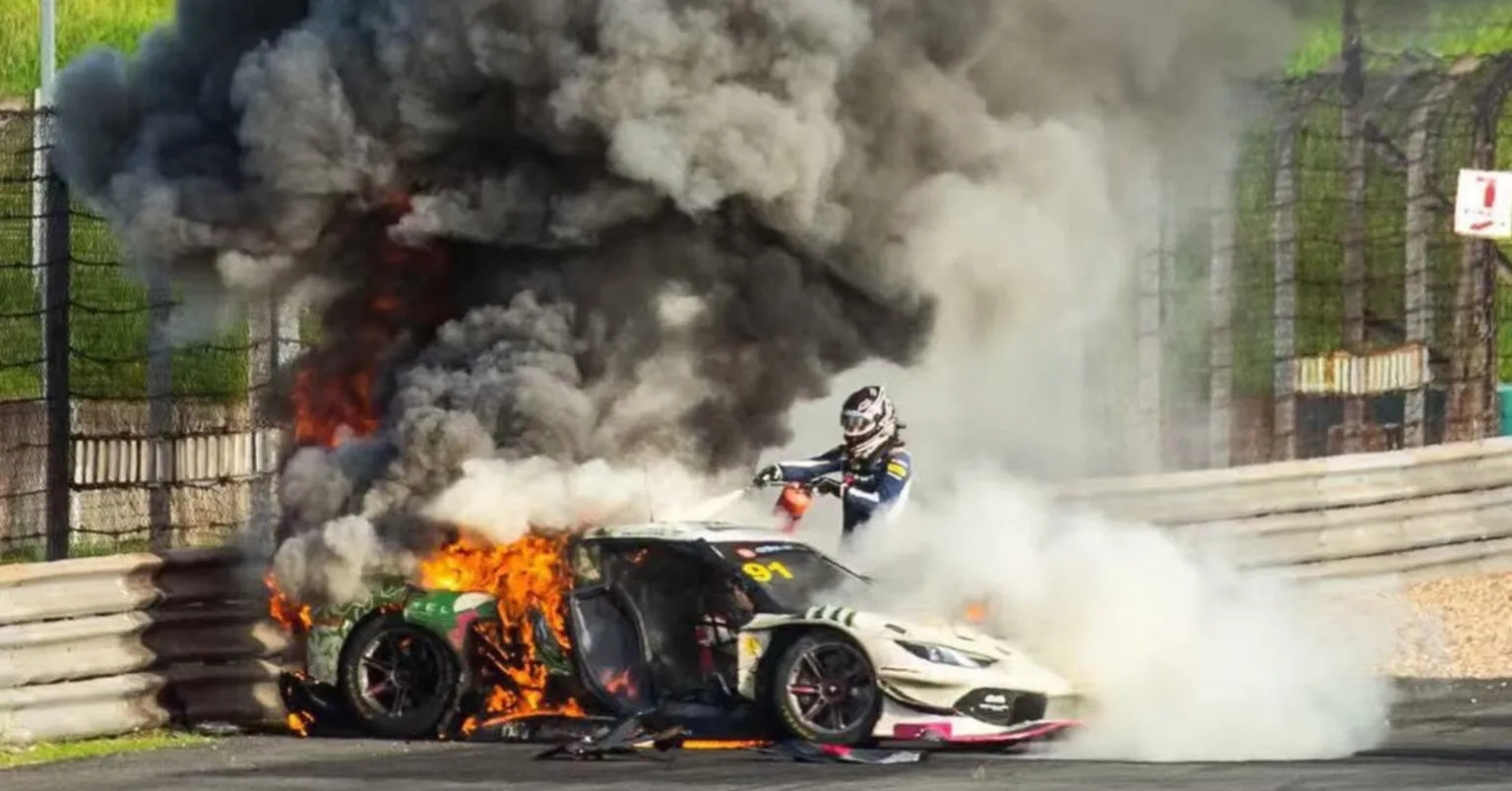
Seconds later, a trackside security officer arrived on the scene, handing Hartog a portable fire extinguisher. Armed with the suppression tool, Hartog pushed back the encroaching flames just enough to reach inside and assist Millroy out of the wreckage. The entire rescue operation—from the moment Hartog abandoned his Porsche to the successful extraction of his trapped rival—took less than sixty agonizing seconds, occurring well before official marshals and emergency fire crews could physically reach the scene.
Reflections from the Cockpit: Trauma, Survival, and Gratitude
In the aftermath of the crash, the severity of the accident became fully apparent. Ollie Millroy revealed that he has virtually no memory of the moments immediately following the impact. The sudden deceleration and structural shock caused complete retrograde amnesia, blanking out approximately thirty seconds prior to the collision and extending nearly an hour afterward.
Medical evaluations later confirmed the heavy toll of the crash: Millroy sustained five fractured ribs, a broken collarbone, a fractured arm, broken fingers, and severe pulmonary contusions. Despite his extensive injuries, the British driver expressed profound gratitude toward Hartog, explicitly acknowledging that his life was saved by the quick-thinking actions of his competitor during those crucial moments when safety crews were still en route.
"When you see a car burning right in front of your eyes, there really is no other choice," Hartog remarked when recounting the harrowing event. The Dutch driver steadfastly rejected the label of a hero, insisting that any driver placed in the exact same emergency scenario would have taken the identical course of action.
Broader Implications and the Code of Motorsport Safety
The incident at the Shanghai International Circuit highlights the inherent dangers of GT endurance racing, where speeds regularly exceed 250 kilometers per hour, and car-to-car contact carries catastrophic risks. While modern GT3 regulations mandate rigorous safety standards—including advanced roll cages, carbon fiber survival cells, flame-retardant racing suits, and onboard fire suppression systems—rapidly spreading fuel-fed fires remain one of the most perilous hazards in motorsport.
Furthermore, Hartog’s actions underscore an unwritten, yet deeply ingrained, code of ethics among professional racing drivers. While commercial stakes, sponsorship obligations, and championship points drive competitors to push the absolute limits of machine and physics, the fundamental brotherhood of the racing community dictates that human safety supersedes competition. When a driver’s life is directly threatened, the fierce rivalry of the track dissolves instantly into a collective duty to preserve life.
As the motorsports world reviews the footage from Shanghai, the event serves as both a sobering reminder of the dangers inherent in professional racing and an inspiring testament to human empathy. Loek Hartog’s willingness to sacrifice his race position to pull a fellow driver from a burning car will undoubtedly stand as one of the most defining moments of sportsmanship in modern motorsport history, ensuring that the true victory of the day was measured not in championship points, but in a life saved.