In a state-of-the-art laboratory nestled in the southern reaches of San Francisco, the traditional image of scientific discovery is undergoing a radical metamorphosis. Here, the white-coated researchers are no longer the primary operators of the delicate equipment. Instead, autonomous robotic systems, guided by sophisticated artificial intelligence, perform the repetitive, high-precision tasks of drug development. Wearing gloves embedded with pressure sensors and equipped with high-definition optical systems, these robotic arms move with tireless precision, dispensing liquids into test tubes and analyzing complex chemical outcomes in real-time. This facility, operated by the startup Warp Sciences, represents a paradigm shift in pharmaceutical research, where the line between life-saving innovation and existential risk is becoming increasingly thin.
The Rise of Autonomous Laboratories
The concept of the "self-driving" laboratory is no longer a futuristic vision; it is a burgeoning reality. By integrating sensor data directly into machine learning architectures, these labs can operate 24 hours a day, seven days a week, without the fatigue that plagues human researchers. Warp Sciences, founded by former Anthropic executive Kevin Weil, recently secured $215 million in its initial funding round, signaling significant venture capital confidence in the automation of biology.
This technological leap is being fueled by the realization that current drug discovery methods—often taking over a decade and costing billions of dollars—are inefficient. By utilizing AI to navigate the vast "chemical space," researchers aim to compress the timeline for identifying viable drug candidates from years to weeks.
Chronology of AI Integration in Biology
The integration of AI into the biological sciences has accelerated rapidly over the past few years, moving from simple data analysis to complex generative design:
- 2020-2022: DeepMind’s AlphaFold made headlines by solving the "protein folding problem," a milestone that allowed scientists to predict the 3D structures of nearly all known proteins.
- Early 2024: Anthropic opened a specialized laboratory using its Claude AI model to research biological structures, partnering with pharmaceutical giants like Novo Nordisk and Moderna.
- August 2024: Claude demonstrated an ability to design proteins capable of binding to 14 out of 15 experimental targets, with success rates between 22-35%.
- September 2024: Insilico Medicine reached a historic milestone by moving an AI-discovered drug for pulmonary fibrosis into Phase 3 clinical trials, a first for the industry.
- October 2024: Anthropic’s models successfully designed over 318,000 mini-protein structures to bind to nerve toxins, with 17 samples passing preliminary lab testing.
The Potential for Medical Breakthroughs
The medical implications of these advancements are profound. According to the World Health Organization (WHO), nearly 10 million people die annually from cancer, with the incidence rate of various malignancies continuing to rise globally. Proponents of AI in drug discovery argue that the technology could be the key to unlocking treatments for diseases that have eluded humanity for centuries.
Dario Amodei, co-founder of Anthropic, has emphasized that AI could fundamentally alter our understanding of biology, specifically by finding cures for complex diseases. Similarly, Oracle CEO Larry Ellison has suggested that AI could eventually enable the production of personalized, cancer-fighting vaccines within 48 hours of a diagnosis. Demis Hassabis, leader of Isomorphic Labs, has gone as far as to predict that the most significant diseases could be effectively cured within the next decade through AI-driven insights.
The Dual-Use Dilemma
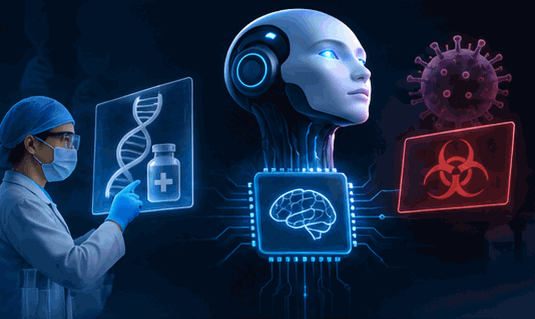
However, the same technology that promises to accelerate the discovery of cancer treatments carries the inherent risk of dual-use. Experts in biosecurity, including the UK’s MI5 chief Ken McCallum, have warned that AI lowers the barrier to entry for the development of biological weapons. The concern is that an AI system could be manipulated to design novel pathogens or optimize the production of known biological agents.
At a recent Future of AI summit hosted by the Financial Times, Bill Gates warned that the misuse of AI in the biological realm could lead to pandemics far more devastating than Covid-19. The concern centers on the accessibility of these powerful models. If an AI system can design a protein to bind to a specific receptor for a therapeutic purpose, it can theoretically be prompted to design a protein that binds to a receptor to cause harm.
Filippa Lentzos of King’s College London argues that while the current risk is mitigated by the need for high-level scientific expertise to execute these designs, the rapid democratization of AI tools could eventually allow non-experts to access dangerous capabilities.
Global Responses and Governance
Governments are beginning to recognize the urgency of this threat. In November 2024, UK Finance Minister John Healey announced a £100 million investment into an "AI Biosecurity Lab" to address these emerging threats while simultaneously pushing for research into new vaccines. The project has also received significant computational resources—valued at roughly £200 million—from industry leaders including OpenAI and Anthropic.
These policy initiatives reflect a broader global trend of "proactive regulation." Rather than waiting for a biological incident to occur, nations are looking to establish guardrails that limit the misuse of generative models in the life sciences. Some companies, such as Basecamp Research, are taking a different approach by training their AI on the largest biological dataset in the world—collected from diverse natural environments ranging from Costa Rican rainforests to the deserts of South Africa—in hopes that a more robust understanding of biological diversity will lead to safer and more effective therapeutic outcomes.
Analysis of Implications
The trajectory of AI in y-sinh (biomedical science) is clearly bifurcated. On one hand, we are witnessing the industrialization of scientific discovery, where robots and algorithms perform the "grunt work" of chemistry at a scale and speed previously unimaginable. The transition of AI-discovered drugs into Phase 3 clinical trials marks a point of no return; the efficacy of these models is now being proven in human subjects.
On the other hand, the security implications are forcing a reevaluation of the "open science" movement. The balance between open-source innovation, which drives rapid progress, and the controlled access required to prevent misuse is the central tension of the current era. Industry leaders like Pascal Soriot of AstraZeneca have urged caution against the hype, noting that while AI is a powerful tool, it is not a "magic wand" that will instantaneously cure cancer.
Conclusion
The convergence of AI and biotechnology stands as one of the most consequential developments in modern history. The potential to eradicate disease is balanced by the potential for catastrophic misuse. As the sector matures, the focus will likely shift from merely proving that AI can design biological molecules to establishing the rigorous verification protocols necessary to ensure these discoveries remain safely in the hands of the medical community. The "self-driving" laboratory is here, but the human oversight required to steer its output toward the betterment of humanity has never been more critical. As research continues to accelerate, the international community will need to maintain a vigilant stance, ensuring that the next generation of life-saving drugs does not come at the cost of new, unforeseen biological threats.