Ba Vi Safari Project Official Boundaries Announced at 299.5 Hectares, Dispelling Rumors of Expansion to 580 Hectares

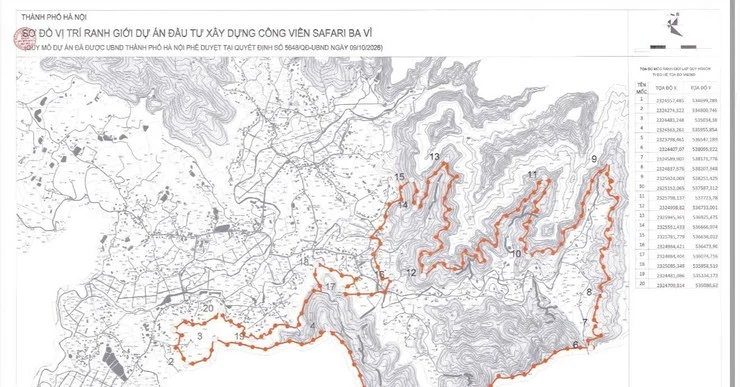
The People’s Committee of Ba Vi Commune has officially publicly announced the spatial mapping, site boundaries, and detailed planning layout for the much-anticipated Ba Vi Safari Park project. Encompassing a precise area of approximately 299.5 hectares under Decision No. 5648 issued by the Hanoi People’s Committee, the formal disclosure serves to firmly reject circulating unverified reports and speculative online rumors that suggested the development footprint had drastically expanded to 580 hectares. Local authorities have emphasized that the transparency of these boundaries is designed to protect local community interests, curb unauthorized land speculation, and maintain strict adherence to municipal urban and environmental planning directives.
Official Boundaries Clarified to Combat Misinformation
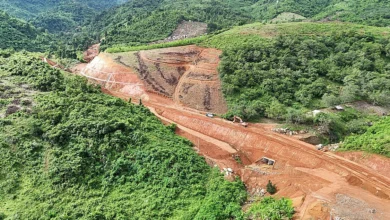
The release of the official maps on October 31 marks a crucial regulatory milestone for the Ba Vi Safari project, which is spearheaded by major private conglomerate Sun Group. Located roughly 60 kilometers west of central Hanoi, the project site sits entirely outside the protected perimeter of the Ba Vi National Park. By establishing a clear physical buffer and spatial separation from the strictly conserved ecological zones of the national park, planners aim to balance regional tourism development with rigorous environmental preservation.
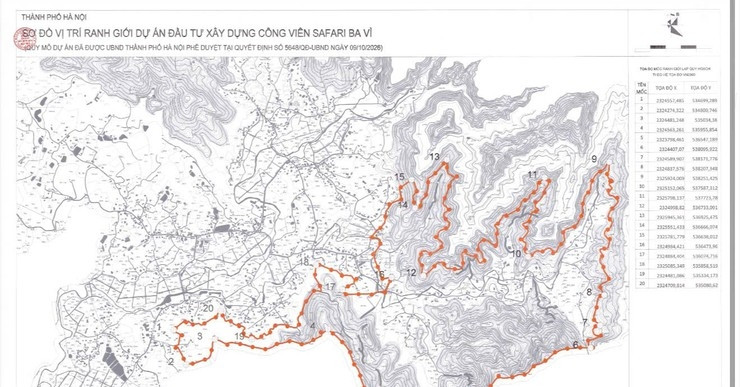
Local municipal leaders acted swiftly to address rumors that surfaced across non-official digital platforms and social media channels regarding an expanded 580-hectare footprint. To ensure absolute clarity, the People’s Committee of Ba Vi Commune formally tasked the commune’s General Service Center with publishing the authenticated site maps, boundary markers, and comprehensive project documentation across official electronic portals and verified municipal social media networks. This digital dissemination ensures that residents, particularly property owners situated within or immediately adjacent to the designated development zone, have direct access to accurate, legally binding information.
Strategic Vision and Ecological Design Principles
Conceived as a multi-functional tourism, conservation, and educational hub, the Ba Vi Safari Park project is structured around an integrated ecological model. According to preliminary design presentations approved by municipal authorities, green spaces and aquatic water features will constitute an overwhelming 81.8% of the total 299.5-hectare area. These natural zones are strategically interspersed among the various functional animal enclosures and visitor corridors to establish continuous ecological pathways and natural microclimates that mimic authentic animal habitats.
Urban planning guidelines strictly dictate that commercial, hospitality, and recreational support functions within the park must remain proportional and auxiliary to the primary safari operations. The municipal government has placed a firm restriction against transforming the development into an independent urban area, residential township, or isolated luxury resort enclave. Any lodging, dining, or retail facilities must demonstrate strict compatibility with the core wildlife conservation mission, ensuring they do not exceed the environmental carrying capacity of the land or overextend local technical infrastructure and transport networks.
Socioeconomic Impact and Local Employment Opportunities
Beyond its environmental and tourism objectives, the Ba Vi Safari project is projected to serve as a substantial economic catalyst for Hanoi’s western rural districts. During the intensive construction phase, the development is expected to generate between 400 and 500 direct construction and engineering jobs. Once fully operational, the park will require a permanent workforce estimated between 700 and 1,000 employees, spanning animal husbandry, veterinary science, park management, hospitality, guest services, and environmental education.
To ensure that the local population directly benefits from this massive capital injection, municipal authorities have outlined targeted community integration programs. These initiatives include specialized vocational training programs tailored to tourism and conservation management, priority hiring quotas for displaced or local landowners, and structured partnerships enabling residents to supply local agricultural produce, traditional crafts, and auxiliary lodging and transport services. This localized economic integration framework is intended to foster sustainable livelihoods and mitigate the socio-economic disruptions often associated with large-scale rural development projects.
Chronology of Planning and Regulatory Milestones
The formal public disclosure of the 299.5-hectare boundary represents the latest development in a carefully managed sequence of administrative and investment milestones for the Ba Vi Safari initiative:
- October 9: The Ba Vi Safari project was formally featured among a select portfolio of 18 signature construction projects and strategic investments highlighted by the Hanoi People’s Committee for accelerated development, groundbreaking, and implementation across the capital.
- Early October: The Hanoi Department of Finance and relevant municipal departments initiated comprehensive reviews of the investment policy proposal, emphasizing the strict necessity of verifying existing land use rights and conducting exhaustive social impact assessments concerning local livelihoods.
- Mid-October: Academic and urban planning experts, including prominent figures such as Prof. Dang Hung Vo, highlighted the synergistic potential of western Hanoi’s expanding administrative boundaries—particularly following recent administrative adjustments integrating neighboring rural zones—noting that the Ba Vi region possesses immense untapped potential for coordinated eco-tourism growth.
- October 31: The People’s Committee of Ba Vi Commune formally published Decision No. 5648 alongside detailed spatial maps, conclusively settling the project boundary at 299.5 hectares and officially dismissing unauthorized rumors of a 580-hectare expansion.
Broader Implications for Hanoi’s Western Tourism Corridor
The advancement of the Ba Vi Safari project aligns with Hanoi’s broader master plan to decentralize tourism pressures from the urban core and develop world-class recreational and ecological complexes in its suburban and rural peripheries. By positioning Ba Vi as a premier destination for wildlife conservation, experiential learning, and sustainable eco-tourism, the city aims to capture growing domestic and international travel demand while reinforcing the ecological integrity of the region.
Financial analysts and urban planning experts observe that the strict regulatory oversight applied to the Ba Vi Safari project reflects a maturing approach to public-private partnerships in Vietnam’s tourism sector. By enforcing rigorous environmental thresholds, limiting commercial overdevelopment, and prioritizing community-centric economic benefits, municipal authorities are setting a precedent for how large-scale ecological attractions can be integrated harmoniously into sensitive suburban landscapes. As the project transitions from the regulatory planning phase toward structural implementation, ongoing transparency and community engagement will remain critical to ensuring that the Ba Vi Safari fulfills its dual mandate of economic vitality and uncompromising environmental stewardship.