Vietnamese Chess Teams Maintain Flawless Record After Dominating Second Round at the 2026 Chess Olympiad in Samarkand


The Vietnamese chess delegations continued their remarkable campaign at the 46th Chess Olympiad in Samarkand, Uzbekistan, concluding the second day of competition with an impressive display of tactical prowess and strategic resilience. Both the Open (men’s) and women’s teams successfully maintained their pristine, unblemished winning streaks, reinforcing Vietnam’s growing stature as a formidable powerhouse on the global chess stage.
Building seamlessly upon their stellar opening-round performances—where both squads decisively swept Lesotho and Saudi Arabia by identical 4-0 margins—the Vietnamese players entered the second round with immense confidence. Facing tougher opposition in Luxembourg and Costa Rica, the national teams once again demonstrated superior board management, clinical precision, and psychological endurance under pressure.
Open Section: Vietnam Masters Tactical Complexity Against Luxembourg
In the Open division, the young and dynamic Vietnamese lineup faced a resilient Luxembourg team determined to disrupt their momentum. The squad—featuring rising talents Đậu Khương Duy, Bành Gia Huy, Nguyễn Quốc Hy, and prodigy Phạm Trần Gia Phúc—exhibited maturity beyond their years to close out the second round undefeated.
Vietnam secured a comprehensive 3.5 to 0.5 victory, showcasing deep preparation in the opening phases and flawless endgame technique. The lone blemish on a clean sweep was a hard-fought draw on one of the boards, where Luxembourg’s seasoned competitor Fred Berend managed to split the point against Bành Gia Huy. Despite this resistance, the Vietnamese contingent’s overall dominance was never in doubt, as they systematically dismantled their opponents’ defenses in the remaining matches.
Team coach and analysts noted that the ability of the younger generation to handle high-pressure situations against more experienced European opposition reflects years of rigorous international training and domestic talent cultivation. This victory not only cements their position near the top of the standings but also serves as a strong warning to upcoming opponents that the Vietnamese squad cannot be taken lightly.

Women’s Division: A Masterclass in Efficiency Against Costa Rica
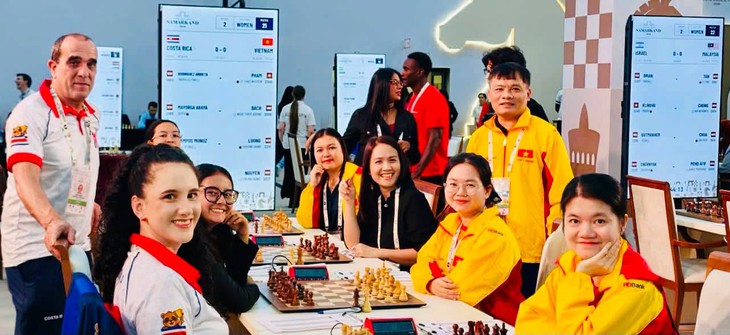
Meanwhile, the women’s division bore witness to another masterclass of tactical efficiency delivered by Vietnam’s elite female grandmasters and international masters. Squaring off against a competitive Costa Rican side, the quartet consisting of Phạm Lê Thảo Nguyên, Bách Ngọc Thùy Dương, Lương Phương Hạnh, and Nguyễn Thị Mai Hưng left no room for error.
Demonstrating why they are considered among the most disciplined teams in the tournament, the Vietnamese women completely neutralized Costa Rica’s attacking threats from the outset. Maintaining relentless pressure across all four boards, they translated positional advantages into decisive material gains, culminating in a flawless 4-0 whitewash.
The victory underscores the depth and balance of the Vietnamese women’s team, combining the invaluable experience of veteran leader Phạm Lê Thảo Nguyên with the sharp, dynamic play of the younger members. Securing back-to-back 4-0 shutouts places the women’s team in an elite tier of competitors who have yet to concede a single individual game, setting a high standard for the remainder of the fortnight.
Background and Context of the 2026 Chess Olympiad
The 46th Chess Olympiad, hosted in the historic Silk Road city of Samarkand, Uzbekistan, represents the pinnacle of international team chess. Organized biennially by the International Chess Federation (FIDE), this prestigious flagship event serves as the ultimate global celebration of the sport, uniting approximately 200 nations and territories in a fierce battle for national glory.
Running from September 16 to September 28, 2026, the tournament in Samarkand has already drawn widespread international acclaim for its meticulous organization and the exceptionally high caliber of play. As the historic crossroads of civilizations, Samarkand provides a fitting backdrop for a tournament where mental endurance, cultural exchange, and strategic brilliance intersect on the 64 squares.
For the Vietnamese chess federation, the Olympiad is not merely a competition but a critical milestone in a long-term strategic vision to produce world-class grandmasters. The current squad blends seasoned Olympiad veterans with prodigious teenagers who have broken numerous national and international age-group records, reflecting a structural evolution in how chess is nurtured in Southeast Asia.
Analytical Outlook: Navigating the Middle Rounds
With two consecutive rounds of flawless victories under their belts, the Vietnamese teams command an enviable position as they transition into the third round. However, coaching staff and analysts emphasize that complacency remains the ultimate adversary.
As the Swiss-system tournament progresses, the pairings naturally grow progressively tougher. In the upcoming rounds, Vietnam will face higher-seeded opponents whose Elo ratings and tactical arsenals pose significantly steeper challenges. The ability to maintain focus, manage energy levels during grueling six-hour sessions, and adapt to diverse playing styles will determine whether Vietnam can sustain its championship aspirations.
Furthermore, the psychological boost of starting the tournament with a maximum score cannot be overstated. Momentum in a team Olympiad often dictates a side’s resilience during mid-tournament fatigue. By securing early, decisive victories, the Vietnamese players have preserved crucial psychological reserves that will prove indispensable when facing traditional European and Eurasian chess giants in the days ahead.
Broader Implications for Vietnamese Chess
The performances thus far in Samarkand resonate far beyond the immediate standings, carrying profound implications for the development of chess in Vietnam. In recent years, the nation has invested heavily in youth training academies, utilizing computer-assisted preparation and international masterclasses to bridge the gap with Western and Eastern European chess superpowers.
The success of players like Phạm Trần Gia Phúc—whose inspiring journey from overcoming neurological challenges to achieving international acclaim has captured the public imagination—highlights the transformative power of sport. When young athletes excel on the world stage, they inspire a new generation of children to take up the game, enriching the national talent pool and ensuring long-term sustainability for Vietnamese athletics.
As the delegations prepare for their third-round encounters, the nation watches with bated breath. The combination of tactical discipline, fighting spirit, and meticulous preparation has positioned Vietnam as one of the most exciting storylines of the 2026 Chess Olympiad. Whether they can maintain this blistering pace against the world’s elite remains one of the most compelling narratives of the ongoing championship in Samarkand.