Novaland Borrows Nearly 30 Trillion VND, Phat Dat Borrows Heavily for Lotte Partnership Amid Severe Financial Strain on Real Estate Developers

The financial reports for the third quarter of 2026 paint a stark picture of the Vietnamese real estate sector, revealing that numerous property developers are shouldering colossal financial debts running into tens of trillions of dong. As liquidity remains restricted and sales velocity sluggish, the data shows an industry grappling with severe restructuring pressures. Most critically, the reports underscore a desperate survival mechanism currently being deployed across the market: some companies have been forced to mobilize emergency capital directly from their executive leadership teams and close relatives simply to maintain daily operations and keep corporate entities afloat.
An analysis of third-quarter financial disclosures highlights a deep divergence within the southern property market. While a handful of corporations manage to report localized profits, the broader reality for many developers is characterized by plunging cash flows, massive short-term debt maturities, and escalating pressure from commercial lenders.
Mounting Debt Burdens Across Major Real Estate Players
At the center of this liquidity squeeze is Novaland, which continues to feature prominently among property enterprises carrying staggering financial leverage. As of September 30, the company’s total financial debt stood at approximately 72.413 trillion VND, accounting for roughly 28% of its total assets.
A closer examination of Novaland’s debt structure reveals a precarious reliance on short-term obligations. Short-term debt alone accounts for nearly 29.750 trillion VND—representing 41.1% of the total debt load—while long-term debt hovers around 42.663 trillion VND. Crucially, the short-term liability profile comprises roughly 12.503 trillion VND in maturing bonds, 9.259 trillion VND in borrowings from third parties, and nearly 7.959 trillion VND in bank loans.
Commercial banks MBBank, VPBank, and TPBank remain the primary creditors for Novaland, holding a combined total debt exposure of approximately 23.361 trillion VND. Despite Novaland reporting a post-tax profit of over 1.102 trillion VND during the third quarter, its cumulative business operating cash flow for the first nine months of the year remained deeply negative, bleeding more than 5.363 trillion VND. Furthermore, overdue loan interest obligations accumulated to over 5.241 trillion VND, demonstrating the heavy friction between paper profits and actual cash realization.
Phat Dat Real Estate Development Corporation (Phat Dat) has experienced an equally dramatic expansion in its debt profile. By the end of September, Phat Dat’s total debt reached approximately 13.638 trillion VND, surging 2.34 times compared to the 5.823 trillion VND recorded at the beginning of the year.
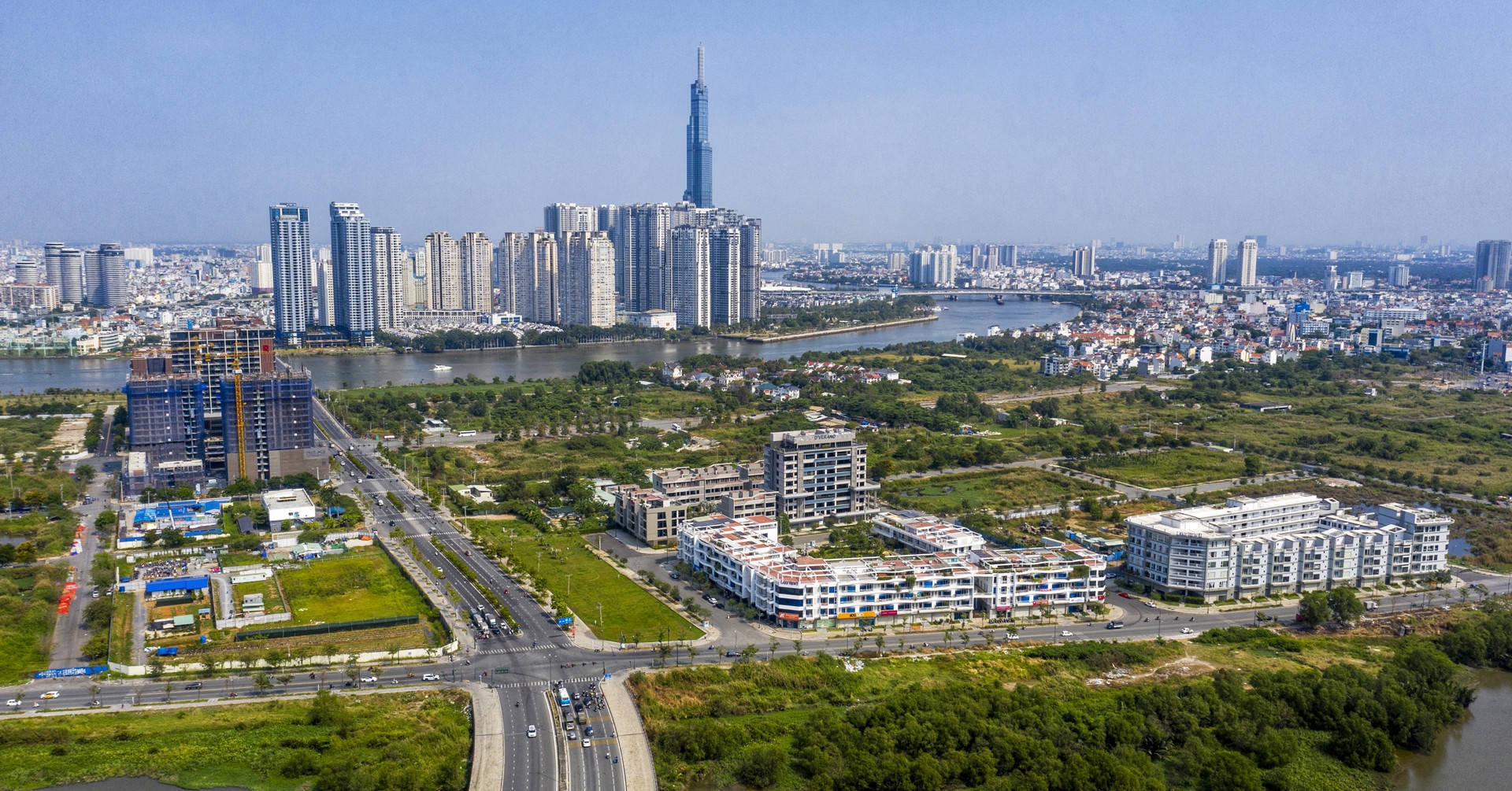
A significant catalyst for Phat Dat’s rising debt is a series of strategic financial maneuvers. Approximately 8.834 trillion VND of Phat Dat’s debt stems from three distinct credit facilities extended by MBBank. This capital was mobilized to fund the acquisition of a 35% contributed capital stake and subsequent capital injections into Lotte Properties HCMC Company Limited—the enterprise tied to the high-profile Lotte Eco Smart City project located within the Thu Thiem New Urban Area.

The repayment terms for these substantial credit lines extend from November 2030 through August 2034, with interest rates pegged to the bank’s benchmark lending rate for large corporate clients plus a margin of 3.37% per annum. To secure these borrowings, Phat Dat pledged not only the economic rights arising from transfer agreements but also 100% of its equity stake in Lotte Properties HCMC, economic rights tied to charter capital adjustment agreements, and rights derived from share transfer transactions involving the Hoang Phu High-Rise Investment and Real Estate Development JSC.
Other notable market participants are experiencing parallel strains. At Khang Dien House Trading and Investment JSC, total short-term and long-term debt reached nearly 17.777 trillion VND at the close of September, representing an increase of roughly 75.1% since the start of the year. During the first nine months, Khang Dien’s net cash generated from operating activities stood at approximately 470 billion VND, while cash outflows dedicated strictly to servicing loan interest exceeded 862 billion VND. Meanwhile, TTC Land reported total financial debt and lease liabilities of approximately 4.716 trillion VND at the end of the third quarter, marking an increase of about 530 billion VND since January, split between 1.876 trillion VND in short-term debt and 2.840 trillion VND in long-term liabilities.
Resorting to Insider Financing and Family Loans
As traditional credit channels tighten and corporate bond markets remain strictly regulated, several developers have turned inward, relying on personal loans from executives, founders, and family members to preserve solvency.
At Hoang Quan Consulting-Trading-Service Real Estate Corporation (Hoang Quan), a prominent developer specializing in social housing, total short-term and long-term debt dropped by nearly 14% to roughly 1.062 trillion VND by the end of the third quarter. Despite this deleveraging, the company’s cash and cash equivalents dwindled to a meager 24.3 billion VND—accounting for just 2.3% of its total debt load. This thin buffer left the company acutely vulnerable when, in early September, HDBank issued notices to seize collateral assets to resolve overdue credit obligations.

Bluemarq Group (formerly Dat Xanh Group) reported total debt and financial lease liabilities of approximately 5.576 trillion VND at the close of the third quarter, an increase of nearly 780 billion VND from the year’s commencement, while its total liabilities climbed from 17.132 trillion VND to over 20.054 trillion VND.
The situation is similarly acute at Quốc Cường Gia Lai JSC. As of September 30, the company’s combined short and long-term debt stood at approximately 910 billion VND, representing a modest 12% reduction from the beginning of the year. However, the enterprise faces severe financial pressure stemming from a mandatory 1.471.4 trillion VND settlement obligation required to fulfill payment terms associated with the Bac Phuoc Kien Residential Area project in Nha Be Commune, Ho Chi Minh City.
Out of its total 910 billion VND debt portfolio, borrowings sourced directly from private individuals accounted for a staggering 557 billion VND. Among these, Ms. Nguyễn Ngọc Huyền My, daughter of General Director Nguyễn Thị Như Loan, extended loans totaling roughly 186 billion VND to the company with a 12-month maturity term and carrying zero interest.
Mr. Nguyễn Quốc Cường (widely known as Cường "Dollar") provided a 30 billion VND loan to the entity, while Chairperson of the Board of Directors Lai Thị Hà contributed 20 billion VND. Additionally, Quốc Cường Gia Lai borrowed nearly 200 billion VND from Mr. Lầu Đức Duy, husband of Ms. Huyền My, and roughly 130 billion VND from Ms. Lai Thị Hoàng Yến, daughter of Chairperson Lai Thị Hà. Such extensive reliance on familial capital underscores the acute scarcity of external liquidity facing specific segments of the development community.

Broader Market Implications and Macroeconomic Context
The systemic debt pressures facing southern real estate developers do not exist in a vacuum; they reflect a multi-year convergence of regulatory tightening, delayed project legal clearances, and elevated borrowing costs. Over the past three years, primary apartment prices in prime locations—particularly within Hoang Quan’s or Thu Thiem’s jurisdictions—have surged dramatically, with some ultra-luxury waterfront properties and penthouses being actively marketed at historic highs approaching 500 billion VND per unit.
However, this primary market appreciation contrasts sharply with secondary market realities. High mortgage interest rates, hovering stubbornly between 12% and 15% per annum throughout the year, have made prospective homebuyers exceptionally cautious. Consequently, secondary investors facing financial distress or holding assets with incomplete legal documentation have been forced to slash asking prices by up to 10% just to generate liquidity.
Financial analysts point out that the widening chasm between nominal asset values on balance sheets and actual cash generation poses systemic risks for mid-tier and large-scale developers alike. While restructuring agreements and asset swaps—such as Phat Dat’s partnership initiatives with Lotte—provide temporary breathing room by deferring principal repayments into the next decade, ongoing operational cash deficits threaten corporate viability.
As regulatory authorities maintain stringent oversight over credit growth into the real estate sector and bond refinancing windows remain narrow, developers are being pushed to accelerate project completions and asset divestments. Industry observers suggest that without a meaningful revival in end-user demand and a broader easing of financing costs, companies heavily reliant on short-term debt and insider loans will continue to navigate a turbulent path toward financial stabilization through the remainder of the decade.