Vietnam Reduces Average Retail Electricity Prices by 2% and Flattens Tariff Brackets to Ease Financial Burden on Households and Businesses

The Vietnamese energy landscape has entered a new phase following a landmark policy implementation by the Ministry of Industry and Trade. Under Decision No. 2892, the country has instituted a comprehensive structural reform of its retail electricity pricing framework. Effective November 1, the average retail electricity price was adjusted downward by 2%, bringing the baseline rate to 2,159.9037 Vietnamese dong (VND) per kilowatt-hour (kWh), exclusive of Value Added Tax (VAT). This overarching price correction, paired with structural overhauls—most notably the transition from a six-tier to a five-tier residential electricity tariff and the introduction of specialized pricing mechanisms for emerging sectors—is projected to save consumers and enterprises over 1.53 trillion VND collectively each month.
The sweeping regulatory modifications mark one of the most substantial adjustments to Vietnam’s public utility pricing models in recent years. By recalibrating how electricity costs are distributed across domestic users, manufacturing hubs, commercial enterprises, and specialized transport segments, the government aims to stimulate economic competitiveness, curb inflationary pressures, and provide tangible financial relief to millions of ratepayers while navigating long-term energy security demands.
Restructuring the Residential Tariff: From Six Tiers to Five
At the core of the regulatory update is the long-awaited simplification of the
residential electricity pricing structure. For over a decade, Vietnamese households operated under a six-tier consumption schedule established by the Prime Minister’s Decision No. 28/2014. Under the previous framework, consumption was broken down incrementally, with the highest bracket applying to usage exceeding 400 kWh per month at a rate equivalent to 159% of the average retail price.
Decision No. 2892 compresses this structure into five distinct tiers, systematically redesigning consumption thresholds to favor low- and middle-volume users. Under the revised schedule, the fourth tier applies to monthly consumption ranging from 401 to 700 kWh, priced at 162% of the average retail price. The fifth and final tier now captures consumption levels of 701 kWh and above, priced at 180% of the baseline average.
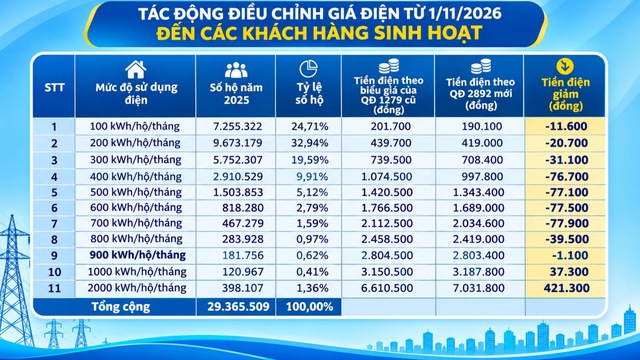
According to impact simulations conducted by Vietnam Electricity (EVN), transitioning from six tiers to five independently results in lower electricity bills for approximately 94% of residential users, while roughly 6% experience marginal increases. However, when combined with the simultaneous 2% reduction in the average retail price, the proportion of households seeing a reduction in their electricity bills expands significantly to 98.23%.
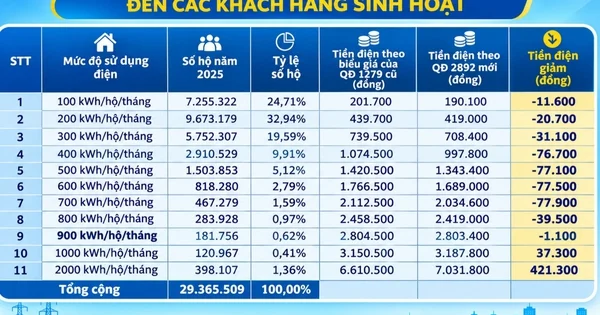
For average consumers, the savings, though modest on an individual basis, accumulate into substantial societal relief. Households consuming 100 kWh monthly anticipate a reduction of approximately 11,600 VND on their monthly bills. Those utilizing 200 kWh will save around 20,700 VND, while consumers at the 300 kWh threshold will see decreases of roughly 31,000 VND. The highest absolute monetary savings—peaking at approximately 77,900 VND per month—accrues to households consuming around 600 kWh monthly.
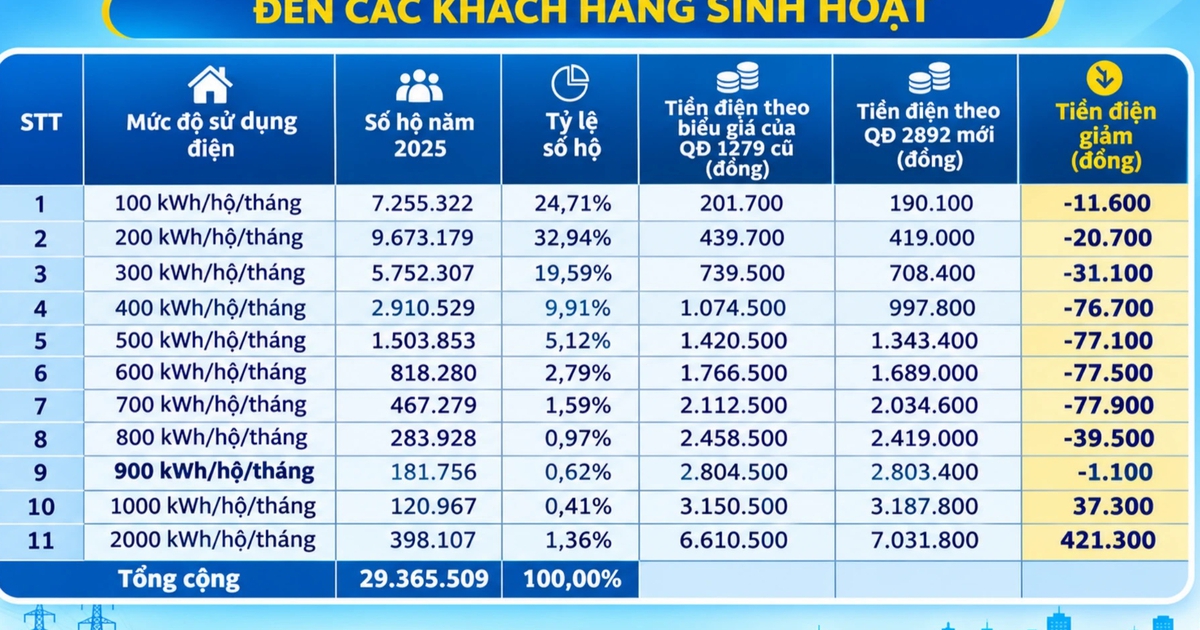
Conversely, high-consumption households exceeding 900 kWh per month—representing about 1.77% of the total residential customer base—face higher utility expenditures than previously recorded. For example, a household consuming exactly 900 kWh per month sees a slight reduction from 2,804,500 VND to 2,803,400 VND due to the baseline price drop, but usage exceeding 903 kWh per month triggers higher cumulative charges than under the former system. Energy analysts note that this graduated penalty for heavy consumption is a deliberate policy tool designed to incentivize energy conservation and discourage inefficient resource utilization among affluent or commercialized residential users.
Broad Economic Impact and Sector-Specific Savings
While residential consumers form the most visible segment of the reform, industrial, commercial, and administrative sectors capture the lion’s share of the financial savings. Nguyen Quoc Dung, Head of EVN’s Business and Power Procurement Department, reported that the total monthly expenditure reduction across all customer groups exceeds 1.53 trillion VND.
A breakdown of these savings reveals extensive support for Vietnam’s productive sectors. Manufacturing and industrial enterprises, which represent a critical input cost category for the national economy, secure the largest aggregate benefit, with production costs dropping by roughly 578 billion VND per month. This direct reduction in overhead provides immediate fiscal breathing room for heavy energy-consuming industries such as steel, cement, and textiles.
Commercial service providers capture approximately 433.02 billion VND in monthly savings, while administrative and public-sector institutions register reductions of around 47 billion VND. Wholesale power purchasers and residential customers account for roughly 49.54 billion VND and 424.13 billion VND in monthly savings, respectively.
Energy experts point out that lowering industrial and commercial input costs plays a vital role in enhancing the macroeconomic stability of the country. Lower utility expenses help compress production costs across key manufacturing pillars, dampening cost-push inflation and maintaining export competitiveness in global markets.
Targeted Pricing Frameworks for Electric Vehicles and Tourism
Beyond standard residential and industrial adjustments, Decision No. 2892 introduces specialized pricing frameworks tailored to modern infrastructure developments, specifically electric vehicle (EV) charging stations and tourism accommodations. These structural inclusions reflect broader state initiatives toward green transition, carbon reduction, and structural modernization of the service economy.
For EV charging operators, the new regulation establishes a clear, three-tier time-of-use pricing schedule encompassing normal, off-peak, and peak hours across different voltage levels. For low-voltage connections at or below 1 kV, the normal charging rate is set at 2,700 VND/kWh, while the off-peak rate drops to an economical 1,626 VND/kWh. However, the peak-hour rate scales up sharply to 4,212 VND/kWh—roughly 2.6 times the off-peak rate.
This pronounced price differential is deliberately engineered to influence consumer and operator behavior, incentivizing fleet operators and private vehicle owners to schedule charging sessions during off-peak overnight hours when grid capacity utilization is low. For medium-voltage connections and above, similar ratios apply, with off-peak rates established at 1,534 VND/kWh and peak rates reaching 3,758 VND/kWh.
Significantly, the specialized EV charging tariffs apply strictly to dedicated commercial charging stations. Individual vehicle owners charging plug-in vehicles at home via standard residential meters continue to settle their utility bills under standard domestic household tariffs, shielding everyday citizens from peak-hour commercial penalties.
Another major structural win in the tariff reform is the decoupling of tourism accommodation facilities—such as hotels, resorts, and commercial lodging providers—from the general commercial electricity tariff. Historically lumped into broad commercial categories, accommodation providers now enjoy dedicated status within the tariff schedule, utilizing a specialized three-tier time-of-use framework at lower baseline rates. For instance, at voltage levels above 1 kV, the normal rate for tourism accommodations is fixed at 1,814 VND/kWh, compared to 2,829 VND/kWh for general commercial enterprises. Peak rates for lodging facilities are similarly discounted, alleviating substantial financial overhead for a hospitality sector recovering from long-term structural shifts.
Expert Analysis: Balancing Immediate Consumer Relief with Long-Term Infrastructure Investment
The implementation of a 2% average retail price reduction alongside tariff flattening has drawn extensive commentary from energy economists, policy analysts, and industry associations.
Nguyen Tien Thoa, Chairman of the Vietnam Valuation Association, emphasized the macroeconomic utility of the adjustment in managing domestic economic stability. By simultaneously lowering direct household expenses and indirect industrial input costs, the policy exerts a downward pull on key economic indicators. Preliminary economic simulations suggest that reduced electricity costs could shave approximately 0.12% off steel production costs, 0.3% off cement manufacturing expenses, and 0.23% off textile production expenditures, collectively contributing to core inflation containment.
However, the policy adjustment has also sparked nuanced discussions regarding the long-term financial health of the national utility provider and its capacity to sustain capital expenditures. Dr. Nguyen Huy Hoach, a member of the Scientific Council of the Vietnam Energy Magazine, raised important questions concerning the trade-off between immediate consumer relief and future infrastructure readiness.
With EVN sacrificing upwards of 1.5 trillion VND in monthly revenue, financial analysts must monitor the utility’s capacity to fund massive capital outlays projected through 2030. Vietnam’s rapid industrialization and escalating domestic power demand necessitate continuous, multi-billion-dollar investments in generation plants, high-voltage transmission backbones, and smart-grid modernization. Lowering retail prices without equivalent adjustments in operational efficiencies risks straining the utility’s balance sheet, potentially impairing its ability to secure financing for future grid expansion.
Dr. Hoach underscored that sustainable national energy management relies on three interdependent pillars: ensuring that citizens and businesses share the financial dividends of efficiency gains; maintaining strict fiscal transparency and operational optimization within EVN; and safeguarding adequate capital reserves for uninterrupted, long-term power system development.
As Vietnam continues to navigate its post-pandemic economic trajectory alongside ambitious carbon-neutrality commitments, the success of Decision No. 2892 will depend heavily on adaptive regulatory oversight. Policymakers must continually calibrate tariff structures to protect vulnerable consumers, stimulate industrial productivity, and maintain robust financial foundations capable of supporting a resilient, modern national power grid.