Tesla Robotaxi Ride Turns 10-Minute Trip into 70-Minute Detour Through Austin Due to Highway Restrictions

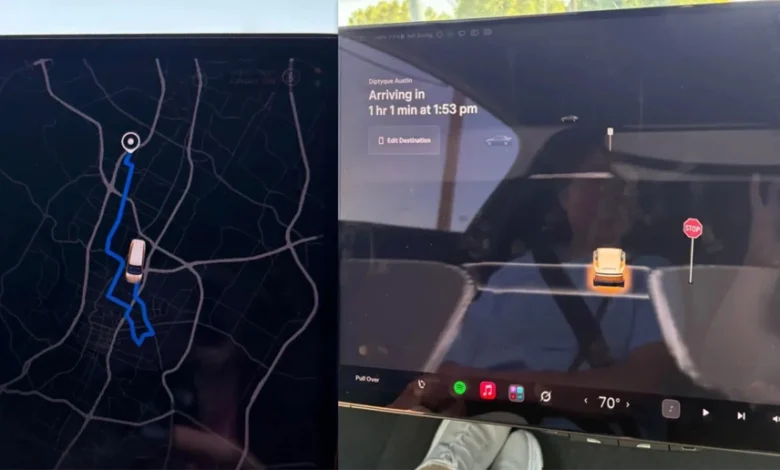
A routine taxi ride in Austin, Texas, turned into an unexpected urban tour recently when a passenger’s autonomous Tesla Cybercab took 70 minutes to complete a journey that typically requires just 10 minutes under normal traffic conditions. The incident, which quickly drew widespread attention after being shared on social media, highlights the current limitations of Tesla’s camera-only Full Self-Driving (FSD) architecture and its operational boundaries in complex urban environments.
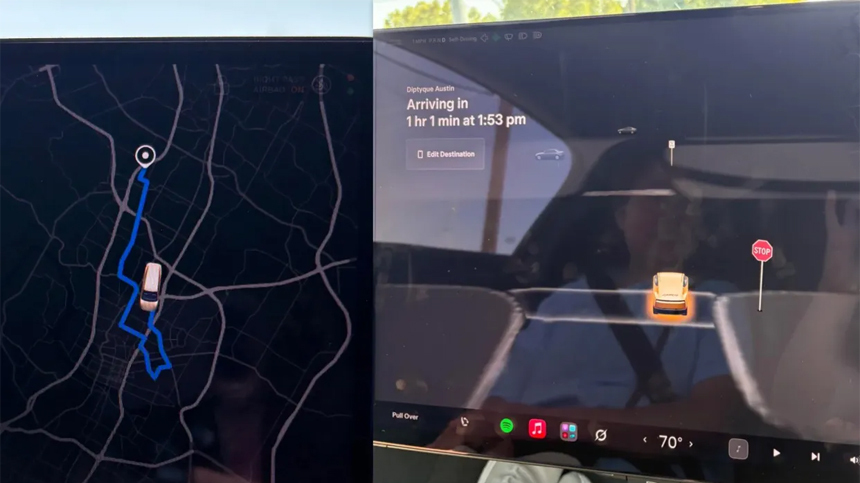
The journey in question originated at a 99 Ranch Market on the north side of Austin and was destined for The Domain, a popular mixed-use commercial and residential hub in the same sector. Under standard conditions, a human driver utilizing nearby high-speed arteries such as MoPac Expressway or US-183 would complete the transit in a matter of minutes. However, because Tesla’s robotaxis are currently barred from operating on high-speed highways, and the software is programmed to avoid complex intersections crossing commuter rail lines, the vehicle was forced onto a circuitous route.
Instead of taking the direct highway path, the Cybercab navigated southward, winding through East Austin and traveling parallel to the Capital Metro Red Line commuter rail before finally locating an overpass to reach its destination. The total transit time stretched to nearly an hour and ten minutes, prompting the passenger to humorously remark on Reddit that they had been "held hostage by a Cybercab for an hour."
Technical Limitations and Navigation Constraints
The root cause of the extended journey lies in Tesla’s deliberate operational fencing. Unlike competitors such as Alphabet’s Waymo, which routinely operate fully autonomous vehicles on major freeways and high-speed corridors, Tesla’s autonomous fleet relies exclusively on a suite of external cameras rather than expensive LiDAR or radar arrays. This camera-centric approach, combined with conservative software programming, currently restricts the vehicles to surface streets with lower speed limits.
In Austin’s street grid, these software restrictions create significant hurdles. Because the autonomous system must avoid highway segments and specific railway crossings, vehicles are often routed through dense, narrow surface streets. For the passenger taking the North Austin trip, this meant traveling parallel to the Red Line for the entirety of the journey until a suitable crossing point could be negotiated.
While the passenger ultimately paid approximately $20 for the fare—a rate comparable to traditional rideshare services—the booking interface on the Tesla application presented notable informational gaps. The app displayed the initial fare estimation upon booking but failed to provide an estimated time of arrival (ETA). Consequently, the passenger only realized the circuitous nature of the route after the vehicle was already underway.
Broader Industry Context and Regulatory Scrutiny
The incident occurred during a sensitive period for Tesla’s autonomous vehicle division. The rollout of the futuristic, steering-wheel-free Cybercab began accepting public passengers in Austin on September 3. Coincidentally, the exact same day marked the announcement by the U.S. National Highway Traffic Safety Administration (NHTSA) that it had opened a formal investigation into Tesla’s regulatory self-certification process for removing traditional controls like steering wheels and foot pedals from the two-seat vehicle.
Furthermore, the navigation mishap is not an isolated programming anomaly restricted solely to the newly introduced Cybercab. Tesla utilizes a unified software stack governing both specialized robotaxis and autonomous-enabled Model Y vehicles operating within the same geographical fence. Consequently, any user hailing a Tesla robotaxi in Austin runs the risk of encountering similar routing inefficiencies as the system struggles to navigate around restricted infrastructure.
Industry analysts note that while the passenger’s "hostage" remark was made in jest, the episode underscores a substantial technical gap between the current state of Tesla’s driverless technology and the sweeping commercial promises made by Chief Executive Elon Musk over the past decade.
Implications for the Autonomous Vehicle Market
The expansion of autonomous ride-hailing services across the United States has accelerated significantly, with cities like Austin, Phoenix, and San Francisco serving as primary testing grounds. However, the regulatory and technical approaches adopted by various market participants vary wildly.
Waymo, backed by Alphabet, has achieved high levels of consumer trust by systematically mapping complex urban environments, integrating redundancy sensors including LiDAR and radar, and securing regulatory approval for high-speed freeway operations. In contrast, Tesla’s stubborn adherence to a vision-only system keeps its vehicles tethered to low-speed surface streets, capping operational speeds at roughly 35 mph (55 km/h) compared to freeway speeds exceeding 65 mph (105 km/h).
This technological divergence introduces distinct safety and utility trade-offs. While operating at lower speeds inherently limits the kinetic energy and potential severity of a collision, it also severely degrades the utility of the transportation service when navigating sprawling metropolitan areas designed around high-speed highway connectivity. Urban planners point out that cities like Austin are structurally dependent on high-speed arteries; bypassing them forces autonomous vehicles to saturate local neighborhood roads, potentially increasing local congestion and traveler frustration.
Future Outlook for Tesla’s Robotaxi Fleet
As Tesla continues to gather real-world telemetry data from its expanding fleet in Texas, the company faces mounting pressure to address these routing inefficiencies before scaling the service to denser or more complex metropolitan areas. Regulatory bodies, including the NHTSA, will undoubtedly scrutinize both the physical safety of steering-wheel-free vehicles and the software logic dictating their path-planning algorithms.
For consumers, the 70-minute journey serves as a pragmatic reminder that autonomous transportation remains an evolving technology. While the novelty of hailing a futuristic, steering-wheel-free vehicle continues to attract curious riders, the friction between ambitious corporate timelines and the messy realities of urban infrastructure will likely require considerable software refinement before robotaxis can reliably match the efficiency of human drivers on complex metropolitan grids.