ASUS Zenbook A14 Snapdragon X2 Elite Versus MacBook Air M5: The Ultimate ARM Laptop Showdown in the Vietnamese Market

The ultra-portable laptop landscape has entered a fascinating new era defined by advanced ARM architecture, where efficiency, artificial intelligence integration, and minimalist form factors take absolute precedence. In the Vietnamese market, two formidable contenders are currently battling for dominance in the premium thin-and-light segment: the ASUS Zenbook A14 powered by the Snapdragon X2 Elite processor and the Apple MacBook Air M5. Both devices boast weight profiles under 1.3 kilograms, promise all-day battery life, and cater to professionals, creators, and students who demand high performance on the move. However, beneath their sleek, highly portable exteriors lie fundamentally divergent philosophies. One runs on the versatile Windows 11 platform with active cooling, while the other relies on the tightly integrated macOS ecosystem in a completely fanless chassis.
This comprehensive comparative analysis evaluates both laptops based on official manufacturer specifications, retail pricing data recorded at FPT Shop, and rigorous real-world testing insights. By examining performance metrics, thermal management, display technologies, connectivity options, and pricing structures, this article provides a definitive guide for consumers navigating the high-end sub-40-million-dong laptop market.

Evolution of the ARM Architecture and Market Context
The race for mobile processing supremacy has accelerated significantly over the past several cycles, moving away from traditional x86 dominance toward highly efficient ARM-based system-on-chips (SoCs). Apple initiated this paradigm shift with the introduction of its proprietary M-series silicon, fundamentally altering consumer expectations regarding thermal management, battery endurance, and sustained performance in thin chassis designs. The response from the Windows ecosystem has been equally aggressive, marked by iterative advancements in Qualcomm’s Snapdragon platforms.
The launch of the ASUS Zenbook A14 featuring the Snapdragon X2 Elite represents a watershed moment for Windows-on-ARM laptops. Built upon advanced manufacturing nodes, these next-generation ARM processors are designed to challenge traditional computing paradigms by offering robust multi-threaded performance alongside dedicated Neural Processing Units (NPUs) capable of handling heavy local AI workloads. Concurrently, Apple’s continued refinement of its silicon architecture with the M5 chip maintains the Cupertino giant’s competitive edge in hardware-software integration, unified memory bandwidth, and power efficiency. The arrival of these two flagships in Vietnam during the final quarter of 2026 highlights the accelerating adoption of next-generation mobile computing solutions among Southeast Asian tech consumers.
Processing Power and Thermal Architecture: 18 Cores Versus Apple Silicon Integration
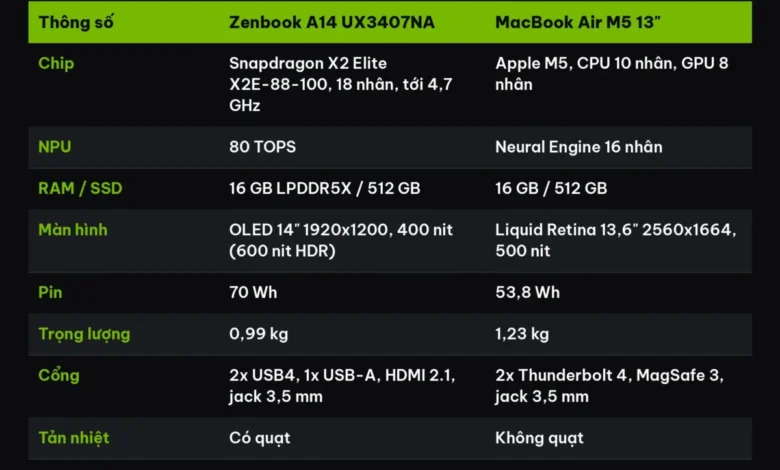
At the heart of the ASUS Zenbook A14 lies the Qualcomm Snapdragon X2 Elite (model X2E-88-100), a powerhouse featuring an 18-core Oryon CPU built on third-generation architecture. This configuration includes 12 Prime cores capable of boosting up to a staggering 4.7 GHz, paired with a powerful NPU delivering 80 TOPS (Tera Operations Per Second) of AI processing capability, alongside 16 GB of LPDDR5X RAM and a 512 GB NVMe SSD. This specific silicon tier represents near-flagship performance within the X2 Elite lineup, designed to handle demanding productivity applications and complex computational tasks effortlessly.

In contrast, the MacBook Air M5 utilizes Apple’s custom M5 chip, featuring a 10-core CPU divided into 4 performance cores and 6 efficiency cores, coupled with an 8-core or 10-core GPU depending on the selected configuration. It similarly starts with a baseline of 16 GB of unified memory and a 512 GB SSD. While Apple does not traditionally disclose explicit clock speeds, its architectural advantage lies in the tight physical integration of the CPU, GPU, and memory architecture onto a single package. This design yields exceptionally high memory bandwidth and low-latency communication between the operating system and silicon.
On paper, the ASUS Zenbook A14 holds a distinct numerical advantage in raw core counts and NPU throughput, fulfilling the stringent hardware requirements for Microsoft Copilot+ PC certification. Real-world evaluations indicate that the Snapdragon X2 Elite delivers formidable single-core and multi-core performance, easily matching or exceeding many contemporary x86 and Apple M-series benchmarks. However, a notable
limitation identified in testing is the capping of RAM at 16 GB for the evaluated configuration, suggesting that power users dealing with heavy data sets or extensive multitasking might find 32 GB to be a more future-proof option. Furthermore, unlike its passively cooled competitor, the Zenbook A14 incorporates an active thermal solution comprising dual fans and a single heat pipe. Real-world thermal tests reveal that CPU temperatures hover steadily around 70 degrees Celsius during standard operations, peaking at approximately 80 degrees Celsius under sustained heavy loads, ensuring that performance throttling is kept to a minimum.

Display Technologies: Vivid OLED Versus High-Resolution IPS Retina
Visual fidelity remains a critical battleground for portable workstations, and the two manufacturers have taken distinctly different technological paths. The ASUS Zenbook A14 is equipped with a 14-inch OLED display boasting a resolution of 1920 by 1200 pixels, a standard 60 Hz refresh rate, a typical brightness of 400 nits peaking at 600 nits in HDR mode, and 100% DCI-P3 color gamut coverage, earning a VESA DisplayHDR True Black 600 certification. OLED technology inherently delivers exceptional contrast ratios, true blacks, and vibrant color reproduction, making the Zenbook an ideal companion for media consumption, cinematic viewing, and color-sensitive creative tasks.
Conversely, the MacBook Air M5 features a 13.6-inch Liquid Retina IPS display with a higher native resolution of 2560 by 1664 pixels, a peak brightness of 500 nits, P3 wide color support, and True Tone technology. While the IPS panel cannot achieve the absolute black levels of the Zenbook’s OLED screen, its higher pixel density yields exceptionally sharp text rendering, and its superior baseline brightness ensures better legibility when operating outdoors or under harsh office lighting conditions.
User preference will ultimately dictate the winning display: professionals who spend long hours reading dense text documents and spreadsheets will appreciate the crispness and high brightness of the MacBook Air M5, whereas multimedia enthusiasts, photographers, and entertainment consumers will likely gravitate toward the striking contrast and vibrant punch of the Zenbook A14’s OLED panel.

Battery Endurance, Portability, and Peripheral Connectivity
Mobility is defined not only by physical weight but also by peripheral versatility and energy autonomy. The ASUS Zenbook A14 achieves an astonishing featherlight weight of just 0.99 kilograms while housing a robust 70 Wh battery. The MacBook Air M5 weighs slightly more at 1.23 kilograms, equipped with a 53.8 Wh battery, yet Apple’s stellar energy optimization yields official ratings of up to 18 hours of online video playback and 15 hours of wireless web browsing. While the Zenbook features a larger battery capacity and undercuts its Apple rival in weight by approximately 240 grams, both machines comfortably deliver dependable, all-day battery life under standard office workloads.
Connectivity options present a stark operational contrast. The ASUS Zenbook A14 is exceptionally well-equipped for a modern ultraportable, offering two USB4 Type-C ports, a traditional USB-A port, a full-sized HDMI 2.1 output, and a 3.5 mm headphone jack, with charging supported via USB-C. This comprehensive array allows users to connect external monitors, legacy peripherals, and storage drives directly without requiring external dongles or docking hubs. The MacBook Air M5, adhering to Apple’s minimalist design ethos, features two Thunderbolt 4 ports, a dedicated MagSafe 3 charging port, and a headphone jack. While MagSafe charging frees up the Thunderbolt ports and prevents accidental drops, users requiring legacy USB-A connections or direct HDMI output will need to invest in external adapters.
Operating System Ecosystems and Software Compatibility
The software environment remains the ultimate deciding factor for prospective buyers. The ASUS Zenbook A14 operates on Windows 11 on ARM, leveraging the rapidly expanding ecosystem of native ARM64 applications. While mainstream productivity suites, web browsers, and cloud services run flawlessly, certain specialized legacy applications, proprietary enterprise drivers, and high-end PC gaming titles may still encounter compatibility hurdles or rely on emulation layers.

On the other side of the aisle, the MacBook Air M5 runs macOS, seamlessly integrating into the broader Apple ecosystem alongside iPhones, iPads, and wearables. The vast majority of professional creative software suites, audio production tools, and office productivity packages have been fully optimized for Apple Silicon, ensuring smooth, highly responsive performance. However, buyers must remain mindful that both laptops feature soldered RAM and storage configurations that cannot be upgraded post-purchase, necessitating careful consideration of hardware requirements at the time of initial acquisition.
Retail Pricing and Market Positioning in Vietnam
Evaluating the pricing structure as of mid-November 2026 at major Vietnamese electronics retailers such as FPT Shop reveals clear market positioning strategies. The ASUS Zenbook A14 UX3407NA-QD132WS, configured with the Snapdragon X2 Elite X2E-88-100 processor, 16 GB of RAM, 512 GB of storage, and bundled pre-installed Microsoft Office software, commands a retail price of 39,990,000 VND. Concurrently, the MacBook Air 13-inch M5, equipped with a 10-core CPU, 8-core GPU, 16 GB of RAM, and a 512 GB SSD, is retailed at 33,090,000 VND.
When comparing models with identical RAM and storage capacities, the MacBook Air M5 holds a significant price advantage, undercutting the ASUS flagship by approximately 6,900,000 VND. This substantial price differential places the Zenbook A14 in a fiercely contested ultra-premium tier, where consumers must weigh the value of Windows compatibility, a lighter chassis, an OLED display, and expansive port selection against Apple’s cost-effectiveness and ecosystem synergy.

Strategic Buying Recommendations
Choosing between these two cutting-edge ARM laptops ultimately depends on individual workflow requirements and operating system preferences. Consumers should select the ASUS Zenbook A14 if they prioritize an ultra-lightweight Windows machine weighing under one kilogram, require a high-contrast OLED display for creative media work, demand extensive physical I/O ports without the hassle of dongles, and value the AI processing capabilities of an advanced NPU-equipped Copilot+ PC.
Conversely, buyers should opt for the MacBook Air M5 if they are already deeply embedded within the Apple ecosystem, require a reliable, fanless laptop optimized for mainstream office productivity and creative workflows, appreciate superior outdoor display brightness, and prefer a more cost-effective entry point for equivalent memory and storage configurations. With both machines occupying the 33 to 40 million dong price bracket, the Vietnamese consumer market is presented with two exceptionally refined visions of modern mobile computing.