When a household refrigerator experiences an unexpected power outage, the primary concern for most consumers is the safety and viability of the perishable goods stored within, particularly frozen meat. The dilemma of whether to refreeze items that have begun to thaw or discard them entirely is a common challenge that carries significant implications for food safety and the prevention of foodborne illnesses. According to experts, the decision to salvage or dispose of food should not be based on guesswork, but rather on a systematic evaluation of temperature thresholds and the duration of the power failure.
The Science of Temperature and Microbial Proliferation
The safety of meat during a power failure is governed by the growth kinetics of pathogens. Bacteria, such as Salmonella, E. coli, and Listeria, thrive in the "danger zone"—the temperature range between 4°C (40°F) and 60°C (140°F). When a freezer stops operating, the internal temperature begins to rise. If the ambient temperature of the food reaches or exceeds 4°C for an extended period, the rate of microbial reproduction increases exponentially.
Nutritional expert Mai Thuy Thuy from the Department of Nutrition at Xuyen A General Hospital in Ho Chi Minh City emphasizes that the decision-making process must be anchored in empirical evidence rather than sensory indicators. "Consumers often rely on the color or the smell of the meat to determine safety," Thuy notes. "However, these are unreliable metrics. Pathogenic bacteria that cause severe food poisoning do not necessarily change the appearance, texture, or odor of the meat until the decomposition process is already well underway."
Three Scenarios for Decision-Making
To assist households in navigating power-related food spoilage, experts have categorized the state of frozen products into three distinct scenarios, each requiring a specific course of action.
1. Meat Retaining Ice Crystals
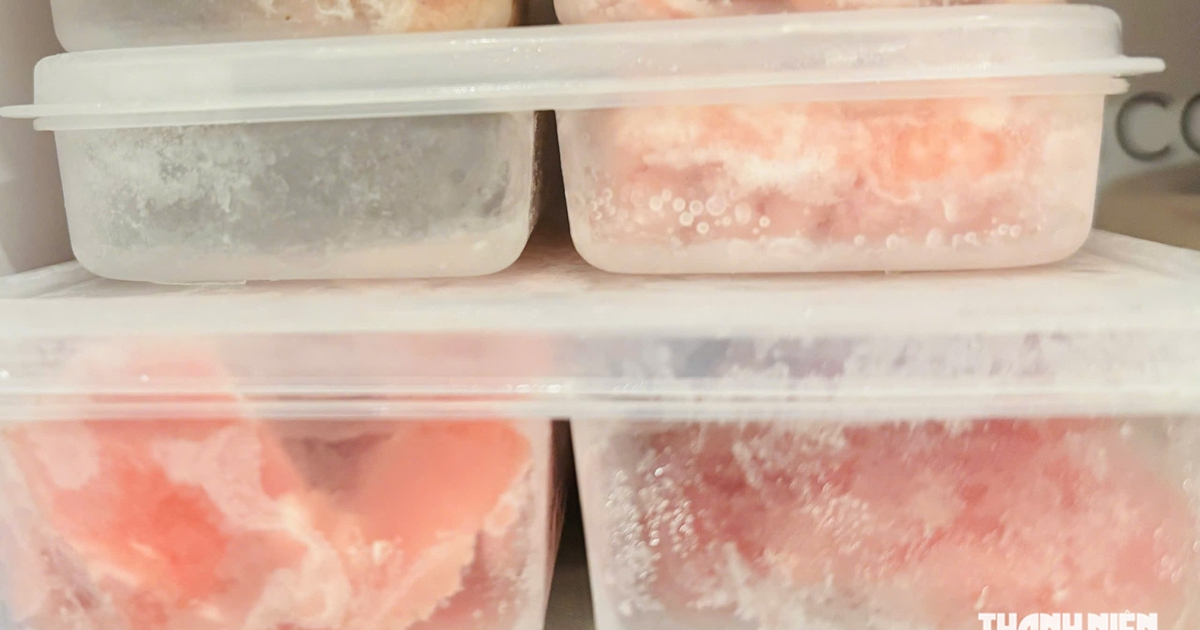
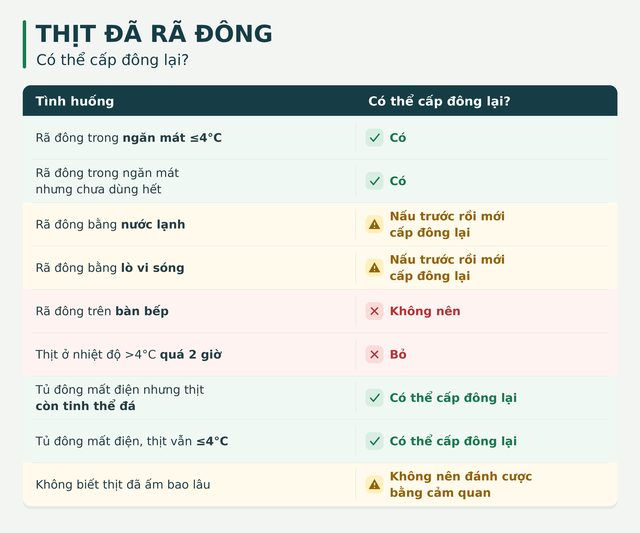
If the meat still contains visible ice crystals or remains firm to the touch, it is generally considered safe to refreeze. In this state, the core temperature of the food has likely remained below 4°C, preventing the proliferation of harmful bacteria. While the quality—specifically the texture and moisture content—might slightly degrade due to the formation of larger ice crystals during the refreezing process, the product remains safe for consumption.
2. Fully Thawed but Below 4°C
If the meat has completely thawed but has been kept in an environment where the temperature has not exceeded 4°C, it is technically safe to refreeze. However, this carries a caveat: the organoleptic quality of the protein will be significantly compromised. The thawing process releases cellular fluids (drip loss), which are then lost during the second freeze-thaw cycle, resulting in drier, tougher meat upon cooking.
3. Unknown Duration and Temperature Exposure
This is the most critical and hazardous scenario. If the duration of the power outage is unknown or if the freezer has been exposed to ambient temperatures above 4°C for more than two hours, the risk of pathogen growth is high. In such cases, the Ministry of Agriculture and Rural Development and relevant food safety authorities advise against attempting to salvage the food. If there is any doubt regarding the duration of the outage, the safest course of action is immediate disposal.
Chronology and Holding Capacity of Modern Refrigerators
Understanding the limitations of cooling equipment is essential for effective disaster mitigation in the kitchen. Under standard operating conditions, a fully stocked, unopened freezer can maintain safe temperatures for approximately 48 hours. If the freezer is only half-full, this capacity drops to about 24 hours.
The chronology of a power outage dictates the safety timeline:
- 0–2 hours: Minimal risk. Keep the door closed to maintain the cold seal.
- 2–24 hours: The window of opportunity to assess contents. If the door has remained sealed, food quality is likely preserved.
- 24–48 hours: High-risk period. Items should be inspected immediately upon the restoration of power.
- Beyond 48 hours: High probability of spoilage. Unless a backup power source (such as a generator) was utilized, the risk of foodborne illness is significant.
Official Guidelines and Regulatory Recommendations
The Department of Food Safety and Drug Administration consistently reinforces that food safety is not merely about the state of the product, but about the total time-temperature exposure. Their guidelines state that any perishable food item kept at temperatures above 4°C for two hours or more should be discarded.
The reliance on a dedicated refrigerator thermometer is highly recommended. Unlike built-in digital displays, which may reset or fail during a power outage, an analog or independent battery-operated thermometer provides an accurate reading of the internal climate at the moment power is restored. This allows the consumer to make a data-driven decision rather than one based on speculation.
Best Practices for Long-Term Food Management
To mitigate the impact of future power interruptions, professional food management strategies should be adopted at the household level. The practice of "bulk freezing"—placing a large amount of meat into the freezer as a single unit—is discouraged.
Instead, consumers are encouraged to partition meat into individual portion sizes before freezing. This approach offers several advantages:
- Reduced Thawing Time: Smaller portions reach the target temperature faster during the thawing process.
- Minimized Exposure: By only removing the required amount of food, the remaining stock stays frozen and protected.
- Controlled Drip Loss: Thawing in the refrigerator section, rather than at room temperature, preserves the integrity of the protein structure.
- Traceability: Labeling packages with the date of freezing allows for a "First-In, First-Out" (FIFO) system, ensuring that older stock is consumed before it reaches the end of its optimal storage life.
The Broader Impact on Public Health
Foodborne illnesses caused by improper handling of frozen goods represent a substantial burden on public health systems. The economic and physical costs associated with bacterial infections—such as Listeria monocytogenes or Campylobacter—are preventable through education and adherence to standardized safety protocols.
When power grids fail, the focus often shifts to immediate comfort, but the hidden danger lies in the slow degradation of the household food supply. By treating the freezer as a controlled storage environment and maintaining a disciplined approach to inventory management, households can minimize the risk of waste and potential health hazards.
In summary, the rule of thumb remains: "When in doubt, throw it out." While the loss of food items can be financially frustrating, it is incomparable to the health risks associated with the consumption of compromised protein. By monitoring temperature, minimizing door openings during outages, and utilizing portion-controlled packaging, consumers can ensure that their food supply remains both safe and nutritious, regardless of the stability of the power grid.