Tragic High-Speed BMW Crash on Mumbai Coastal Road Leaves Three Students Dead and One Fighting for Life

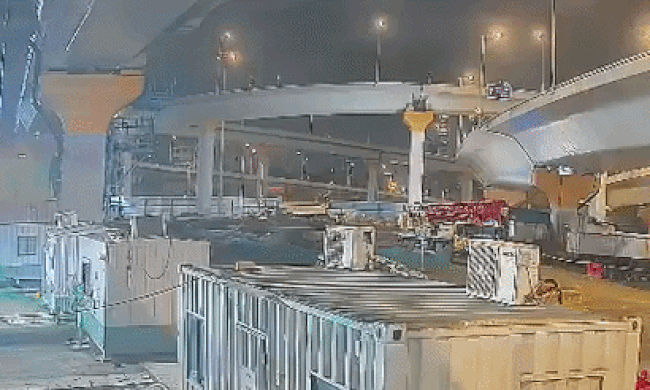
The bustling coastal landscapes of Mumbai were struck by tragedy in the early hours of September 20, when a high-end luxury vehicle met with a catastrophic accident that has sent shockwaves across the region. A sleek black BMW, traveling at an excessive and dangerous speed along the newly constructed Coastal Road, violently breached safety barriers, launched over the edge of an elevated section, and plummeted dozens of feet downward. The vehicle crashed directly into an active construction zone for parking facilities below, resulting in an immediate and devastating loss of life.
Out of the four young occupants traveling inside the luxury sedan, three were pronounced dead before they could even reach the hospital. The lone survivor, a 23-year-old, remains hospitalized in critical condition, fighting for their life as medical professionals work tirelessly to address severe polytrauma. Investigations subsequently revealed that all four individuals inside the car were college students pursuing their higher education at various institutions across Mumbai. The incident has once again ignited intense public discourse surrounding reckless driving, urban safety infrastructure, and the alarming frequency of high-speed accidents on metropolitan expressways.
A Chronological Timeline of the Fatal Incident
According to local authorities, traffic police, and initial emergency response logs, the sequence of events unfolded rapidly in the pre-dawn hours, leaving very little time for intervention.
At approximately 5:19 AM on September 20, the first distress call was placed to local emergency services. Commuters passing through the Coastal Road corridor noticed the catastrophic aftermath of the crash and immediately alerted the police and ambulance dispatchers.
Minutes prior to the emergency call, the black BMW was captured on various municipal and private surveillance systems navigating the multi-lane coastal expressway. Eyewitness accounts and preliminary forensic assessments indicate that the driver lost control of the high-performance engine due to excessive velocity. Modern luxury sedans of this caliber are engineered to handle high speeds, but the combination of urban road curvatures, wet or slick morning asphalt, and radical acceleration proved fatal.
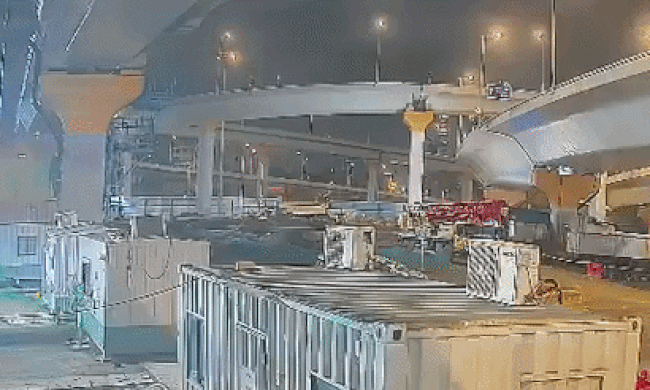
The vehicle veered sharply toward the edge of the elevated road, smashing directly through heavy-duty guardrails and safety fencing. Rather than skimming the barrier, the car vaulted completely off the elevated structure, experiencing a sheer drop of several meters. It landed nose-first into a subterranean construction site designated for future parking infrastructure, tearing through hanging signage and industrial rigging on its way down.
Emergency medical technicians and police units arrived at the scene within minutes of the initial distress call. All four victims were extricated from the mangled wreckage with extreme urgency and rushed to nearby medical facilities. However, attending physicians confirmed that three of the occupants had already succumbed to their catastrophic injuries at the scene or during transit.
Victim Profiles and Medical Status
The identities and personal backgrounds of the victims have added a poignant human dimension to the tragedy, underscoring the irreversible impact on grieving families and academic communities in Mumbai.
The three deceased individuals have been identified as young adults on the threshold of their professional lives: a 21-year-old, a 19-year-old, and a 17-year-old. The fourth occupant, who is currently clinging to life in the intensive care unit, is 23 years old. Medical reports from the treating hospital indicate that the survivor suffered extensive internal trauma, multiple fractures, and severe head injuries, requiring round-the-clock intensive medical intervention.
All four individuals were active students enrolled in colleges across Mumbai. Investigators are currently piecing together their movements in the hours leading up to the crash to determine where they had been and what prompted the high-speed journey in the early morning hours. Toxicological screenings are standard protocol in such investigations to ascertain whether alcohol or other impairing substances played a role in the driver’s loss of control, though final lab results are still pending.
Forensic Analysis and Extent of Vehicular Damage
The physical evidence left behind at the accident site paints a vivid picture of the sheer kinetic force involved in the crash. Forensic teams and accident reconstruction experts who examined the scene reported extensive structural damage to both the highway infrastructure and the automobile itself.
The impact zone on the elevated roadway featured deep, gouged skid marks stretching along the concrete lane, terminating abruptly where the steel guardrails were sheared entirely off their foundational bolts. Below the overpass, a heavy metal informational sign was ripped clean from its suspension brackets by the falling vehicle.
The BMW itself was reduced to a unrecognizable heap of twisted metal and shattered glass. Inspection of the wreckage revealed that the roof of the vehicle was severely crushed inward, suggesting multiple rollovers or a direct, crushing impact upon landing. The front windshield was completely shattered into a spiderweb of fragments, while the entire front fascia was crumpled beyond recognition. The heavy steel front bumper and engine components were forced outward, exposing the internal mechanical framework of the luxury automobile and illustrating the immense energy dissipated during the fall.
Infrastructure and Urban Road Safety Concerns
The Mumbai Coastal Road project has been lauded as a vital engineering marvel designed to alleviate massive traffic congestion along the city’s western coastline, slashing commute times for thousands of motorists daily. However, high-speed corridors of this nature frequently double as temptation grounds for motorists inclined to test the limits of high-performance vehicles, particularly during off-peak hours when traffic density is low.
Urban planners and road safety advocates have raised pressing questions regarding the structural efficacy of existing barriers on elevated expressways. While standard guardrails are designed to withstand typical vehicular impacts at moderate speeds, accidents involving severe over-speeding by heavy luxury vehicles often exceed the design thresholds of conventional barriers. This incident has prompted renewed calls for the installation of reinforced, high-containment crash barriers along elevated curves, as well as the implementation of advanced speed-monitoring technology.
Furthermore, the presence of active construction zones directly beneath elevated roadways has come under scrutiny. Although infrastructure development is a continuous necessity in rapidly expanding metropolitan areas, safety experts emphasize the need for enhanced protective netting, buffer zones, or restricted access areas beneath high-risk overpasses to mitigate the secondary hazards of falling debris or stray vehicles.
Law Enforcement Response and Ongoing Investigations
Mumbai Police have registered an accidental death report and launched a comprehensive, multi-angle investigation into the crash. Investigators are currently gathering closed-circuit television (CCTV) footage from various points along the Coastal Road to establish an accurate timeline of the vehicle’s speed and trajectory prior to the loss of control.
Authorities are also examining vehicle registration documents to determine the legal owner of the BMW and whether the driver was authorized to operate the high-powered automobile. Forensic vehicle inspectors are analyzing the electronic control unit (ECU) of the car, which functions much like an airplane’s black box. The ECU data is expected to yield precise readings regarding the vehicle’s speed, braking application, throttle input, and steering angle in the critical seconds leading up to the impact.
Police officials have reiterated their commitment to public safety, noting that upcoming awareness campaigns will target youth and young adult drivers regarding the lethal consequences of reckless driving and excessive speed on urban expressways. As Mumbai mourns the loss of these young lives, the tragedy serves as a grim and sobering reminder that the thrill of speed on metropolitan roadways can extract an irreversible toll in a matter of seconds.