Electric Motorcycle Market in Vietnam Surges with Automotive-Inspired Reverse Mode Technology

The electric two-wheeler market in Vietnam is undergoing a transformative period, driven by rapid advancements in battery chemistry, motor efficiency, and smart vehicle architecture. As manufacturers race to capture a burgeoning urban demographic seeking sustainable transportation alternatives, competition has transcended basic range and power metrics. A notable trend defining this evolution is the integration of automotive-inspired features into everyday scooters, most prominently the inclusion of electronic Reverse Mode or Reverse Assist. Once reserved exclusively for four-wheeled automobiles and heavy-duty industrial transport, this specialized functionality is quickly becoming a standard selling point across various vehicle segments in Vietnam, addressing critical ergonomic challenges associated with modern electric mobility.
The Evolution of Urban Electric Mobility and Ergonomic Innovations
Over the past decade, Vietnam’s transition from internal combustion engine scooters to electric motorcycles has accelerated significantly. Government initiatives promoting green energy, coupled with rising fuel costs and urban congestion, have created fertile ground for EV adoption. However, this transition has introduced unique operational challenges for riders. Modern electric scooters frequently feature large-capacity battery packs—such as Lithium Iron Phosphate (LFP) configurations—and heavy-duty chassis designs to support extended ranges and high payload capacities. Consequently, the overall curb weight of these urban commuters has risen noticeably compared to traditional lightweight gasoline scooters.
For many daily commuters, navigating tight parking spaces, reversing out of crowded residential alleys, or maneuvering heavy vehicles on inclined surfaces presents a physical burden. Recognizing these ergonomic pain points, manufacturers have begun incorporating reverse assist systems into their newest models. This technological shift reflects a broader industry trend toward enhancing user convenience and lowering the physical barrier to entry for heavier, high-performance electric motorcycles.
Understanding Reverse Mode Technology: Mechanics and Safety Protocols
Reverse Mode on an electric motorcycle operates by reversing the rotational polarity of the electric motor through digital controller commands. When activated, the system allows the vehicle to move backward at a strictly controlled, low speed when the rider applies the throttle. This function is designed to assist riders in mitigating physical strain when extracting a heavy vehicle from a parking stall or a confined space, but it explicitly does not replace the rider’s responsibility to maintain situational awareness.
Safety protocols for operating reverse assist require a deliberate sequence of inputs to prevent accidental activation. Typically, riders must bring the vehicle to a complete stop, engage specific combinations of handlebar controls—such as holding a dedicated ‘R’ button, a parking ‘P’ mode toggle, or a sequence of brake levers and secondary switches—and wait for a designated indicator symbol to appear on the digital instrument cluster. Once the dashboard confirms reverse engagement, gentle throttle application initiates backward movement. Releasing the throttle or the activation switch immediately halts the vehicle. Industry safety experts emphasize that while the feature significantly reduces physical exertion, operators must perform rigorous visual checks of the blind spots behind them before and during the maneuver to avoid collisions with pedestrians or obstacles.
Comprehensive Review of Models Featuring Reverse Mode in Vietnam
VinFast: Expanding Urban Accessibility with Evo Grand and Feliz Series
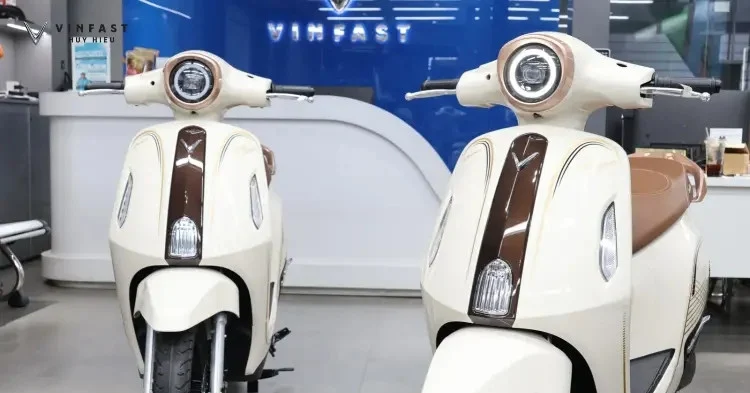
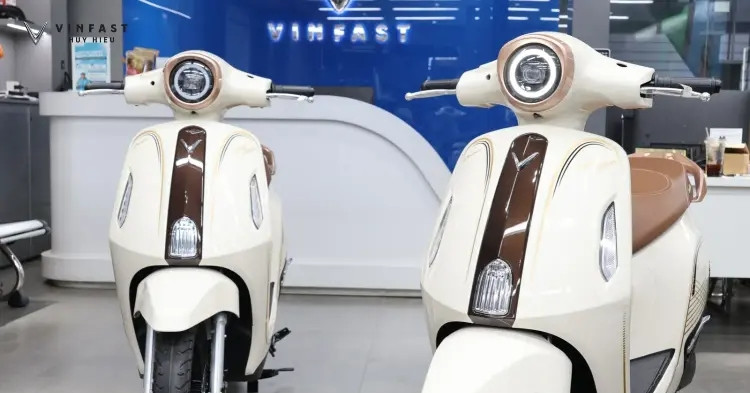
As a pioneer in Vietnam’s domestic electric vehicle ecosystem, VinFast has systematically integrated reverse functionality into its latest lineup, including the Evo Grand Premia, Evo Grand Limited, and the updated Feliz 2027. These urban-focused electric scooters are engineered specifically for daily commuting needs within densely populated metropolitan areas.
The Evo Grand series utilizes an Inhub electric motor capable of delivering a maximum power output of 2,250W, enabling a top speed of 70 km/h. Powered by a 2.4 kWh LFP battery, the base configuration offers an advertised operating range of approximately 134 kilometers. For users requiring extended travel distances, the secondary battery slot expands the total advertised range to 262 kilometers, while maintaining a practical 35-liter under-seat storage capacity when operating with a single battery.
To activate reverse mode on these VinFast models, riders press and hold the ‘R’ button or a designated ‘B/P’ switch on the handlebar control cluster until the digital display illuminates the ‘R’ signifier. Riders then twist the throttle to move backward. The primary advantages of VinFast’s lineup include a diverse selection of styling options, competitive pricing tiers, wide battery capacities, and an extensive nationwide service and warranty network. However, buyers must carefully calculate their real-world range requirements based on payload weights and operating conditions.
Honda: Bringing Global Engineering Standards with CUV e: and UC3
Japanese manufacturing giant Honda has entered the Vietnamese electric two-wheeler arena with globally developed platforms that prioritize advanced safety systems and ergonomic refinement, prominently featuring Reverse Assist across its flagship models.

The Honda CUV e: is propelled by an electric motor generating up to 6kW of maximum power, achieving a top speed of approximately 80 km/h. It relies on dual removable Honda Mobile Power Pack e: batteries, delivering a per-charge operating range of roughly 73 kilometers. Notable technological inclusions feature a 7-inch TFT instrument display, Honda RoadSync Duo smartphone connectivity, smart-key ignition, Combi Brake System (CBS), and three distinct riding modes. Priced at 65 million VND with the complete battery and charger package, or 45 million VND for the vehicle-only variant without batteries, the CUV e: caters to users seeking premium build quality.
Meanwhile, the Honda UC3 utilizes a comparable 6kW electric motor configuration but pushes top speed to 82 km/h. Equipped with an LFP battery system, the UC3 extends its operating range to approximately 120 kilometers per charge. It incorporates a 5-inch TFT display, Honda RoadSync connectivity, CBS, regenerative braking, and a spacious 26-liter under-seat compartment, with a retail price starting around 80 million VND depending on the trim level.
Operating the reverse function on Honda’s electric models requires a dual-input safety sequence: the rider must press and hold the ‘Start’ button on the right handlebar while simultaneously holding down the lower-arrow switch on the left handlebar. The vehicle moves backward only while both buttons are held and halts immediately upon release. While the UC3 boasts extended range capabilities and rapid-charging compatibility, its elevated price point requires consumers to evaluate access to compatible charging infrastructure.
Selex Motors: Tailored Solutions for Commercial Delivery and Logistics
Designed specifically to serve the commercial delivery, logistics, and service transport sectors, Selex Camel 1 and Camel 2 feature robust chassis architectures designed to support multiple swappable batteries and heavy cargo loads, making reverse assist an indispensable tool for couriers navigating tight urban spaces with heavy loads.
The Selex Camel 1 features an electric motor with a maximum output of 3,000W, a top speed of 70 km/h, and a claimed operating range of up to 150 kilometers when configured with three active battery packs. Its maximum payload capacity reaches an impressive 225 kg. The Camel 2 steps up performance with a 4,000W motor, a top speed of 80 km/h, a 150 km range, and a payload capacity of 150 kg. Listed retail prices are 28.3 million VND for the Camel 1 and 29.3 million VND for the Camel 2, excluding batteries, insurance, and registration fees.
Activation of the reverse gear on Selex models involves pressing the horn button on the left handlebar followed by holding the ‘MODE’ switch on the right side until the instrument panel displays negative mileage values, signaling that throttle twist will move the vehicle in reverse. While commercial operators benefit greatly from payload capacity and rapid battery-swapping networks, the substantial physical weight of the vehicle when fully loaded with three battery packs can make low-speed manual maneuvering challenging without the electronic reverse assist.
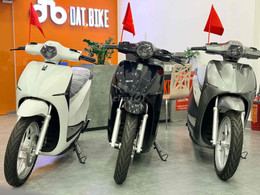
Dat Bike: High-Performance Electric Motorcycles with Quantum Series and Era
Vietnamese EV startup Dat Bike has captured market attention with high-performance powertrains integrated across its Quantum S Series (S1, S2, S3) and the retro-styled Era line.
The Quantum S1 features a formidable 7,000W electric motor, a top speed of 100 km/h, a high-capacity 6.4 kWh battery, and an impressive advertised range of 285 kilometers. The Quantum S2 maintains the 7,000W power output with a 90 km/h top speed and identical 285 km range, while the S3 utilizes a 6,000W motor with a 200 km range. Retail prices for these three variants are set at 49.9 million VND, 42.9 million VND, and 34.9 million VND, respectively.
Additionally, the Dat Bike Era offers an E2 variant priced at 29.9 million VND and an E1 version at 32.9 million VND, featuring a 5,000W motor, a 4.3 kWh battery, an 82 km/h top speed, a 200 km range, and a massive 50-liter storage compartment.
To engage reverse mode on Dat Bike Quantum models, the rider must ensure the vehicle is in Parking (‘P’) mode, squeeze either brake lever, and quickly double-tap the multi-function dual-action button. Once the system shifts into reverse, the throttle controls rearward movement. Disengaging the mode requires fully releasing the throttle and pressing the multi-function button again. Dat Bike models offer exceptional power and extended range, but their substantial curb weight—ranging from 130 kg to 144 kg—makes the electronic reverse assist not merely a convenience, but a necessary mechanical aid for tight spatial maneuvers.
Market Implications and Future Outlook
The widespread adoption of reverse mode technology across diverse segments of Vietnam’s electric motorcycle market highlights a maturation of the industry. As manufacturers cater to an increasingly discerning consumer base, the focus has shifted from basic electric conversion to holistic user experience, safety engineering, and ergonomic optimization.
Analysts project that as traffic density in major urban hubs like Hanoi and Ho Chi Minh City continues to rise, consumer demand for intelligent riding assistance features will only intensify. Furthermore, the integration of automotive-grade features into two-wheelers bridges the psychological gap between traditional cars and electric motorcycles, potentially accelerating consumer conversion rates. Future developments in the sector are expected to focus on refining software-based safety limits for reverse speeds, expanding standardized battery-swapping ecosystems, and lowering overall acquisition costs to ensure sustainable long-term growth for Vietnam’s green transportation sector.