Tragic Mumbai High-Speed Crash Claims Three Young Lives After Midnight BMW Collision Near Lotus Jetty

A catastrophic high-speed automobile accident in the early hours of Sunday, September 20, near the Lotus Jetty opposite the Lala Lajpatrai College in Mumbai, has left three college students dead and sent shockwaves through academic and local communities. The fatal crash, involving a high-performance luxury sedan, highlights the ongoing, lethal dangers of reckless driving and excessive speeds on urban arterial roads during late-night hours. Local law enforcement authorities, along with regional traffic safety divisions, have launched an intensive, multi-faceted investigation to reconstruct the exact final moments leading up to the disaster and to determine accountability.
Chronology of the Incident
According to preliminary investigative reports compiled by the Mumbai Police traffic branch, the incident occurred in the pre-dawn hours of Sunday. The vehicle involved—a late-model BMW sedan—was traveling from the scenic and heavily trafficked Marine Drive corridor toward the suburb of Haji Ali. Eyewitness accounts and initial traffic camera footage suggest that the driver lost total control of the automobile due to extreme, unsafe speeds well above the legal urban limit.
Prior to the fatal impact, the group of four young adults had spent their evening visiting the popular Marine Drive promenade. The collision occurred as the group was making their return journey toward their residential quarters. The severity of the crash was such that the luxury vehicle suffered catastrophic structural failure, rendering it nearly unrecognizable. First responders and emergency medical services rushed to the scene following frantic calls from bystanders, extracting the occupants and transporting them immediately to a nearby metropolitan hospital for emergency life-saving interventions.
Identification of the Victims and Survivors
Upon arrival at the emergency medical facility, attending physicians pronounced three of the vehicle’s occupants dead on arrival. The victims were formally identified by police authorities as Sanay Gujar, aged 21; Aditya Jakasniya, aged 19; and a fourth victim aged 17. Investigators confirmed that Sanay Gujar was behind the wheel at the time of the crash, operating the high-powered sedan, while the other three victims were seated in the passenger compartments.
Miraculously, one occupant—identified as 20-year-old Aditya Oswal—survived the high-impact collision, sustaining serious injuries that required intensive medical care. Oswal remains under close medical supervision as authorities await his physical recovery to gather vital testimony regarding the vehicle’s speed, the events preceding the crash, and any internal distractions that may have contributed to the driver’s loss of control.
Background of the Students and Local Impact
All four young men involved in the devastating accident were students enrolled at NMIMS College located in the Juhu area of Mumbai. The group had recently relocated from Ahmedabad in the neighboring state of Gujarat to pursue their higher education. While residing in Mumbai, they lived together in a paying guest (PG) accommodation facility, far away from their immediate family support networks.
The news of the tragedy sent immediate shockwaves through the student body at NMIMS College and the wider academic community in Mumbai. Relatives residing within the Mumbai metropolitan area rushed to the hospital upon receiving the grim news. Meanwhile, the parents of the victims living in Gujarat embarked on emergency journeys across state lines, arriving at the medical facility to identify their deceased children and coordinate the repatriation of their remains.
Scene of the Accident and Vehicle Condition
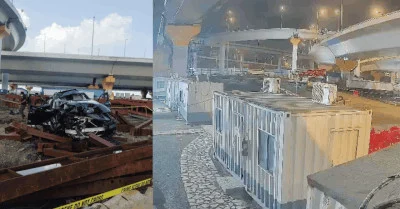
Forensic teams examining the wreckage at the crash site described a scene of absolute devastation. The BMW sedan absorbed the brunt of the kinetic energy, resulting in structural collapse, shattered glass, and twisted metal scattered across the asphalt of Lala Lajpatrai Marg. Debris blocked lanes for hours as municipal cleanup crews worked alongside accident reconstruction specialists to clear the roadway.
Photographs and video footage captured by first responders illustrated the terrifying magnitude of the collision, noting that the vehicle’s chassis was severely warped and its safety airbag deployment systems were entirely overwhelmed by the forces involved. The car was subsequently towed from the location to a secure police facility for comprehensive mechanical and forensic inspection.
Ongoing Police Investigation and Legal Framework
The Mumbai Police have registered an accidental death report (ADR) and launched a comprehensive criminal inquiry into the incident. Investigators are scrutinizing closed-circuit television (CCTV) footage captured along the entire route from Marine Drive to the crash site to establish a precise timeline, verify the vehicle’s speed through automated speed-detection portals, and rule out or confirm the presence of other contributing factors such as driving under the influence or mechanical failure.
Forensic experts are conducting digital downloads from the BMW’s onboard event data recorder (EDR)—often referred to as the vehicle’s "black box"—which will yield definitive data regarding throttle position, braking applications, steering inputs, and vehicle velocity in the final five seconds before impact.
Broader Implications for Urban Road Safety
This tragic event has reignited intense public debate across India concerning reckless driving, the proliferation of high-performance luxury vehicles in densely populated urban centers, and the prevalence of late-night speeding among young drivers. Traffic safety advocates point out that arterial stretches like Marine Drive, while designed for smooth traffic flow during peak hours, frequently transform into dangerous speedways during late-night and early-morning hours when traffic volume diminishes.
Urban planners and law enforcement agencies are under mounting pressure from civil society groups to implement stricter enforcement mechanisms, including automated speed enforcement cameras, acoustic monitoring devices to detect illegally modified exhausts and high-revving engines, and increased random checkpoint inspections during weekend overnight hours.
As the investigation progresses, the tragedy stands as a sobering reminder of the fragile nature of life and the catastrophic consequences that follow when speed limits and road safety protocols are disregarded on metropolitan thoroughfares.