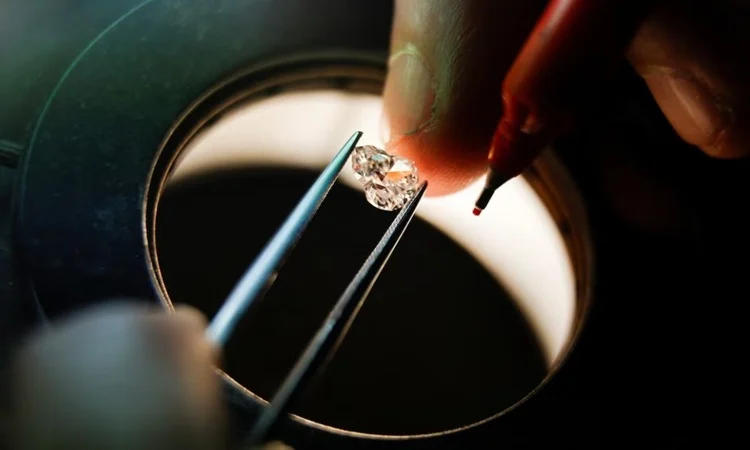
The global semiconductor landscape is witnessing an unconventional pivot as Chinese synthetic diamond manufacturers, long the bedrock of the jewelry trade, aggressively transition into the high-stakes sector of artificial intelligence infrastructure. Facing a saturated jewelry market and eroding profit margins, these firms are repurposing their high-pressure, high-temperature (HPHT) production capabilities to address one of the most pressing bottlenecks in modern computing: thermal management for AI-driven processors.
A Strategic Pivot Amid Market Saturation
For years, the Chinese synthetic diamond industry—centered primarily in Henan province—has dominated the global supply chain, accounting for nearly 50% of the world’s output. However, the commoditization of lab-grown diamonds has led to a sharp decline in retail prices, forcing producers like Jiaruifu and Henan Liliang Diamond to seek more lucrative industrial applications.
Data from industry analysts indicates that while jewelry-grade diamonds currently command profit margins of approximately 30–40%, industrial-grade synthetic diamonds, specifically those engineered for semiconductor thermal management, offer margins exceeding 50%. This economic imperative has triggered a shift in capital allocation, with manufacturers diverting millions of dollars from jewelry production lines toward research and development in thermal interface materials (TIMs) and diamond-based wafers.
The Physics of the AI Heat Crisis
The urgency of this transition is driven by the physical limitations of current cooling technologies. As AI processors become more powerful, they generate unprecedented levels of heat. According to a 2025 report from the International Energy Agency (IEA), global data center power consumption is projected to nearly double by 2030, reaching approximately 945 terawatt-hours—a figure equivalent to the total annual electricity consumption of Japan.
Traditional cooling systems are approaching their physical threshold. Standard semiconductor components typically handle thermal loads of roughly 400 watts per square centimeter. In contrast, synthetic diamond possesses extraordinary thermal conductivity, capable of dissipating heat exceeding 2,000 watts per square centimeter—five times the efficiency of conventional materials. By integrating diamond substrates directly onto the silicon of AI chips, engineers can effectively dissipate heat from the "hot spots" that would otherwise throttle performance or lead to hardware failure. This allows for the creation of denser, more compact, and faster microprocessors.
Chronology of the Industrial Shift
The evolution of this industry from decorative to functional began in earnest around 2019, when rapid technological advancements allowed for the mass production of larger, higher-quality crystals.
- 2019: Small-scale production of synthetic diamonds for industrial applications begins to gain traction in Henan.
- 2023–2024: A significant decline in the retail price of jewelry-grade lab-grown diamonds creates a financial crunch for major producers.
- June 2025: High-profile investments, including those from industry leaders like Lip-Bu Tan (a former Intel board member), signal growing institutional confidence in diamond-based semiconductor materials.
- Late 2025: Major tech conglomerates, including Huawei, TSMC, and Lenovo, begin testing diamond-based heat dissipation solutions, with Lenovo launching laptop models featuring diamond-copper hybrid cooling materials.
Technological Breakthroughs and Scaling
Historically, synthetic diamonds were limited by size, typically measuring only a few millimeters. However, recent breakthroughs by Chinese research institutions, such as the Ningbo Institute of Materials Technology and Engineering, have enabled the production of much larger crystals. Today, manufacturers like Huanghe Whirlwind are producing diamond heat spreaders with diameters exceeding 20 centimeters, nearly the size of a standard dinner plate.

These large-scale wafers are critical for the next generation of AI hardware. By placing these diamond layers directly atop the semiconductor die, manufacturers can stabilize operating temperatures during the intensive training and inference phases of AI models. This capability is not merely an incremental improvement; it is a fundamental shift in how high-performance computing is architected.
Geopolitical and Supply Chain Implications
The move by Chinese manufacturers to supply the global AI infrastructure chain carries significant geopolitical weight. As the United States and China engage in an intensifying race for technological supremacy, the control of critical materials has become a central point of friction. If synthetic diamond becomes an essential component for the cooling systems of the most advanced AI processors, China’s near-monopoly on production capacity could become a strategic leverage point.
Manan Goenka, a project manager at the consultancy firm Ken Research, notes that this transition has direct implications for the global technology supply chain. "The demand for high-performance thermal management is now the primary growth engine for the synthetic diamond industry," Goenka stated. "This is no longer a niche market; it is becoming a critical layer in the stack of global AI infrastructure."
Economic Outlook and Industry Reconfiguration
For individual manufacturers, the transition is a matter of survival. Mr. Phung, a representative of the Jiaruifu plant, has explicitly stated plans to reduce the company’s reliance on the jewelry sector from its current majority share to approximately 30% by 2030. Conversely, he expects industrial-grade diamond production to constitute more than 50% of the firm’s total output within the same timeframe.
The financial shift is evidenced by the scale of investment. Henan Liliang Diamond, for example, has moved over 149 million USD from jewelry-related capital budgets into industrial-grade diamond projects. These companies are betting that the future of their business lies in the cooling systems of the world’s most powerful data centers rather than in the display cases of jewelry retailers.
Future Challenges: Adoption and Integration
Despite the clear physical advantages of diamond-based thermal management, widespread industry adoption remains contingent on cost-efficiency and integration maturity. While diamond cooling offers superior performance, the manufacturing process—requiring immense pressure and precise temperature control—remains energy-intensive and complex.
Furthermore, the integration of diamond into existing CMOS (Complementary Metal-Oxide-Semiconductor) fabrication processes presents significant engineering challenges. Unlike traditional thermal pastes or copper heat pipes, integrating diamond requires high-precision bonding and material deposition techniques that are still being perfected by companies like Diamond Foundry and various Chinese research hubs.
As AI continues to drive the demand for ever-smaller and more powerful chips, the heat dissipation crisis will only intensify. If Chinese manufacturers can successfully scale the production of cost-effective, large-format diamond substrates, they will position themselves at the heart of the AI revolution, effectively turning a decorative commodity into the silent engine behind the world’s most advanced artificial intelligence systems. The shift from "precious stone" to "strategic material" is currently underway, and it is set to redefine the supply chains of the 21st century.
Related posts: