Ministry of Agriculture and Environment Clarifies Land Classification Rules Following Citizen Inquiries Over Red Book Discrepancies


The complexities of land administration and property rights continue to present significant legal hurdles for landowners across the country, particularly when historical documentation conflicts with modern regulatory frameworks. A recent inquiry submitted by a property owner regarding a land use rights certificate—commonly known as a "Red Book"—issued by a provincial People’s Committee in 2002 has brought these challenges to the forefront of public discourse. The citizen’s case highlights a recurring friction point in real estate transactions, inheritance procedures, and administrative updates: the discrepancies between historical land classifications and contemporary legal definitions under updated land laws.
According to the details of the case, the property owner holds a legitimate Red Book granted by the provincial administration more than two decades ago, specifically in the year 2002. The official document explicitly records a total parcel consisting of 200 square meters of residential land alongside 407.6 square meters of garden land. However, complications arose when a recent re-measurement of the property was conducted. During this modern cadastral survey, the 200 square meters of residential land was reaffirmed, but the remaining 407.6 square meters of garden land was officially reclassified and documented as land designated for the cultivation of perennial crops.
The crux of the citizen’s grievance lies in the physical and spatial reality of the parcel. The garden land in question is situated directly adjacent to the primary residential structure and the core residential land area. Troubled by the reclassification during routine surveying and potential future administrative actions such as transfers or inheritance, the property owner raised a fundamental question: Is the re-evaluation and re-categorization of land types under these circumstances legally compliant with current statutory regulations, or does it represent an administrative overreach?

Background Context on Vietnam’s Evolving Land Law Framework
To understand the gravity of the citizen’s concern, one must examine the broader evolution of land management policy in the country. Over the past few decades, land administration has undergone substantial legislative transformations. The legal landscape governing real estate, property classification, and land use rights has transitioned through several iterations of the Land Law, most notably the Land Law of 2003, subsequent amendments, and the comprehensive Land Law of 2024, which went into effect alongside a series of guiding decrees issued by the government.
Historically, local authorities in various provinces adopted differing methodologies for categorizing mixed-use parcels—those containing both residential footprints and surrounding gardening or agricultural areas—during the massive land titling campaigns of the late 1990s and early 2000s. Back then, administrative recording standards were less unified, and digital geographic information systems (GIS) were virtually non-existent at the local level. As a result, many households were granted Red Books that grouped residential land and adjacent garden land under generalized local classifications.
In recent years, as local land offices digitize records, conduct comprehensive re-surveys, and enforce strict compliance with the Land Law of 2024 and its accompanying statutory guidelines, discrepancies have increasingly come to light. Property owners attempting to subdivide, sell, mortgage, or transfer titles are frequently met with demands from local authorities to adjust land categories, split certificates, or convert portions of perceived residential or integrated garden land into strictly defined agricultural or perennial crop land based on current master plans and technical land-coding criteria.
Official Response from the Ministry of Agriculture and Environment
In response to the growing wave of public inquiries concerning land re-categorization during transfers, inheritance procedures, and titling updates, the Ministry of Agriculture and Environment has issued detailed administrative guidance. Addressing the specific case of the 2002 Red Book with its 200 square meters of residential land and 407.6 square meters of garden land, the Ministry emphasized that any definitive legal evaluation requires a comprehensive review of foundational records.
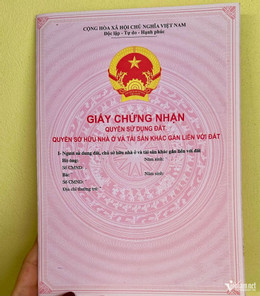
The Ministry stated that evaluating the validity and accuracy of a land classification adjustment depends heavily on the specific archival dossiers, cadastral documents, and historical maps currently preserved at the local municipal and provincial levels. Furthermore, authorities must assess the legal status of the land, the historical context of its management, and the actual utilization history of the specific parcel over time.
Because the Ministry did not possess the full set of localized case files at the time of the inquiry, it noted that it lacked the direct evidentiary basis to conclusively declare whether the local re-evaluation of the land type in this specific instance was entirely correct or legally flawed. Nevertheless, the Ministry proactively outlined the governing legal framework that dictates how land categories must be determined and under what precise conditions replacement or modified Red Books may be issued.
Legal Provisions and Regulatory Guidelines
Navigating the labyrinth of modern land regulations requires adherence to several key legislative acts and governmental decrees. The Ministry pointed specifically to Article 9 of the 2024 Land Law, which establishes the foundational statutory criteria for the classification of land nationwide. Complementing this, Article 4 of Decree No. 102/2024/ND-CP provides granular, detailed definitions for various specialized sub-categories of land within the broader agricultural land group.
Of particular importance to landowners facing discrepancies is Clause 2, Article 7 of Decree No. 102/2024/ND-CP. This specific provision outlines the regulatory procedures for determining land types in scenarios where properties lack the standard documentary evidence specified under Clause 1, Article 10 of the Land Law, or conversely, where the land category recorded on previously issued legal documents differs from the classification framework mandated by the current Land Law or diverges from the actual physical current use of the land.

When addressing the adjustment or correction of land classification data on previously issued certificates, the Ministry referenced point d, Clause 1, Section VII, Content C, Part V of Schedule I, promulgated in conjunction with Decree No. 151/2025/ND-CP issued by the Government. Under this regulatory mechanism, one of the legally sanctioned grounds for the issuance of a replacement or updated Red Book occurs when the recorded land use purpose at the time of initial issuance differs from the classification standards set forth in the current Land Law and its accompanying implementation directives.
Additionally, regarding discrepancies between historical paper records and modern physical realities on the ground, the recording of current land types must strictly follow Clause 3, Article 33 of the relevant statutory guidelines, alongside Clause 3, Article 8 of Circular No. 10/2024/TT-BTNMT, which standardizes technical cadastral mapping and registration practices.
Broader Implications for Property Owners and Citizens
The ambiguity surrounding mixed-use land parcels—such as urban or rural residential plots flanked by extensive garden areas—extends far beyond isolated administrative corrections. Similar disputes have clogged local administrative channels across multiple provinces. For instance, in related administrative queries addressed by regulatory bodies, families possessing large plots of residential land granted in the late 1990s have encountered unexpected administrative bottlenecks when attempting to process inheritance transfers following the passing of a parent. In several documented instances, heirs attempting to complete name-transfer procedures were notified that statutory limits on residential land quotas had changed, reducing their recognized residential footprint and forcing portions of long-held residential land to be reclassified as garden land.
Similarly, other property owners facing damaged, lost, or destroyed original Red Books—left with only photocopy records—frequently discover that administrative attempts to restore missing titles expose them to mandatory re-surveys and subsequent land-type down-gradings. These systemic hurdles highlight a major friction point between historical property rights acquired under older legal regimes and the tightening, highly standardized requirements of contemporary administrative mapping.

Legal experts and real estate analysts point out that while the ongoing push toward digital cadastral standardization and transparent land management is necessary for national economic development and urban planning, it places an unfair burden of proof on individual citizens. Many landowners who lawfully acquired properties decades ago under the oversight of local authorities now find themselves penalized by retroactive interpretations or strict modern coding conventions that fail to account for the integrated nature of traditional rural and semi-urban homesteads.
Recommendations and Future Outlook
For property owners currently navigating similar administrative dilemmas, legal and real estate advisors recommend taking a methodical, documented approach to safeguard their property rights. Citizens facing unexpected re-categorizations of their land parcels should take the following steps:
- Request Formal Written Explanations: Demand that the local Land Registration Office or municipal Department of Natural Resources and Environment provide the precise legal basis, historical planning maps, and statutory articles used to justify any re-measurement or reclassification of land types.
- Compile Archival Evidence: Gather all historical tax receipts, neighborhood testimonies, old architectural blueprints, and archival correspondence dating back to the initial issuance of the Red Book in 2002 or earlier to establish an uninterrupted history of physical use.
- Engage Legal Counsel: For high-value properties or significant reductions in residential land quotas, consult with specialized legal professionals experienced in administrative litigation and land law to file formal grievances or administrative appeals within statutory timeframes.
As state agencies continue to refine the implementation of the 2024 Land Law and its supporting decrees, clarity regarding the transition of legacy land titles remains paramount. Whether administrative bodies will adopt more flexible transitional provisions to protect long-standing residential and garden integrations remains to be seen, but for now, thorough documentation and strict adherence to administrative appeal procedures are the primary defenses available to affected property owners.