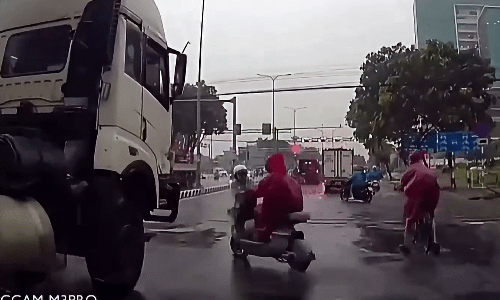
The intersection along Nguyen Tat Thanh Boulevard in Da Nang had already transformed into a treacherous stretch of asphalt by the late afternoon of October 28, 2026. A relentless downpour reduced visibility to a fraction of its normal range, casting a gray, distorted veil over the bustling urban corridor where vehicular traffic and railway lines intersect. Drivers strained to keep their eyes on the slick road, their concentration tested by blurred windshields, pooling water, and the constant, erratic spray thrown up by heavy commercial vehicles. It was amidst this chaotic atmospheric backdrop that a near-tragedy unfolded—one that was averted only through the extraordinary vigilance and lightning-fast reflexes of a local railway crossing guard.
The Critical Incident: Seconds from Disaster
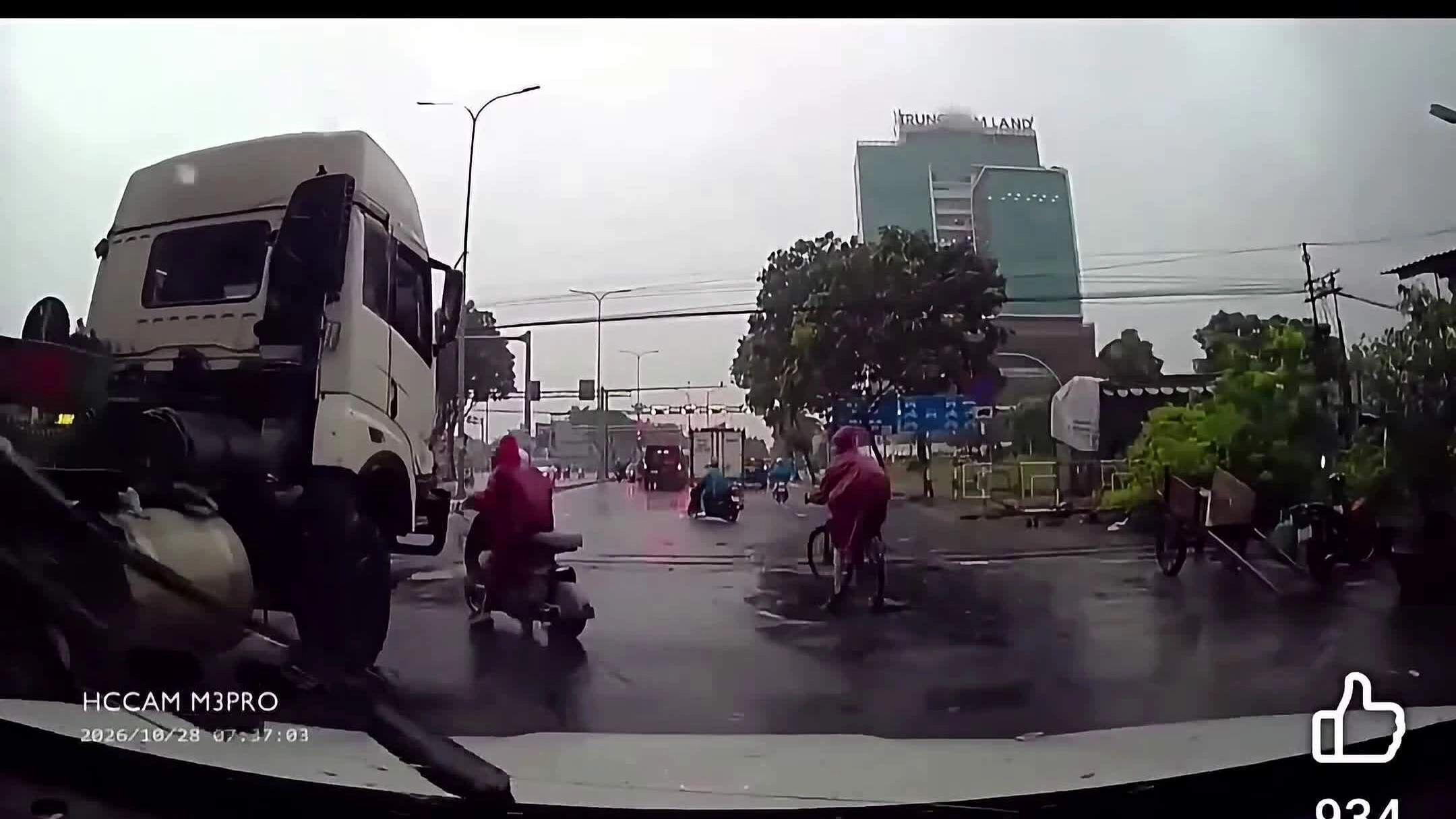
At approximately the moment when a massive multi-axle tractor-trailer was lumbering across the active rail tracks, visibility was at its absolute worst. A young student, clad in a bulky raincoat that significantly restricted both peripheral vision and physical mobility, was navigating the intersection on an electric bicycle. Overburdened by the weather and likely distracted by the sensory overload of the storm, the student inadvertently veered directly into the path of the oncoming heavy transport vehicle.
The driver of the semi-truck, seated high in the cabin and contending with compromised sightlines through rain-streaked glass, was entirely unaware of the small cyclist entering the vehicle’s immediate blind spot directly in front of the massive front bumper.
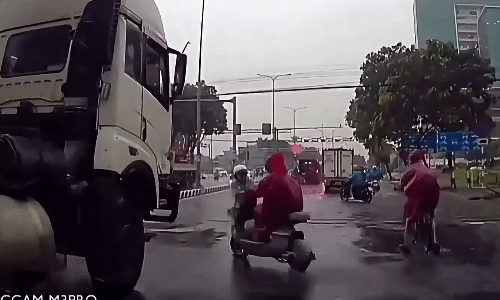
Stationed nearby to manage the manual crossing gates and oversee the safety of the junction, the on-duty railway guard observed the unfolding peril in real time. Recognizing that a verbal warning would be entirely drowned out by the roar of the rain and the engine, the guard made a split-second decision. Moving with urgent, athletic decisiveness, the worker bolted toward the front of the moving truck. In a heart-stopping fraction of a second just as the front wheels threatened to crush the bicycle, the guard reached out, gripped the student with a powerful yank, and pulled them backward out of the lethal danger zone.
The entire sequence, captured on surveillance and dashcam footage, transpired in less than three seconds. The tractor-trailer rolled past the precise spot where the student had been standing mere moments before, continuing down the boulevard unaware of how close it had come to a catastrophic fatality.
Chronology of Events on Nguyen Tat Thanh Boulevard
To understand how the incident escalated so rapidly, traffic safety analysts and local authorities pieced together the timeline leading up to the near-miss on October 28:
- 16:00 (Local Time): Heavy seasonal rains commence across Da Nang, rapidly saturating major thoroughfares, including the high-capacity commercial corridor of Nguyen Tat Thanh Boulevard.
- 16:45: Visibility drops significantly as storm clouds darken the late afternoon sky. Traffic volume swells with evening commuters, delivery vehicles, and students returning home from school.
- 17:10: A heavy tractor-trailer approaches the railway intersection, adhering to permitted speed limits but facing severe visibility limitations due to heavy downpours and fogged mirrors.
- 17:12: The student on an electric bicycle approaches the crossing from a blind angle, wearing a restrictive full-body raincoat that muffles exterior sound and limits head movement.
- 17:13: The student drifts directly into the front blind spot of the moving semi-truck. The on-duty railway crossing guard spots the hazard, sprints toward the vehicle, and physically yanks the student out of harm’s way just before the truck’s front bumper clears the tracks.
- 17:15: Normal traffic resumes after a brief pause as the shocked student is brought to safety inside the crossing guard’s shelter.
Broader Implications: The Hidden Dangers of Raincoats and Electric Bikes
While the prompt action of the railway employee prevented a tragedy, transportation safety experts emphasize that the incident highlights a deeply entrenched, systemic vulnerability on urban roads: the combination of vulnerable student commuters, electric two-wheelers, and severe weather conditions.
In recent years, electric bicycles and lightweight electric scooters have surged in popularity among middle and high school students across urban centers in Vietnam. These vehicles are quiet, affordable, and do not require a formal driver’s license for lower-powered models. However, this accessibility often correlates with a deficit in formal traffic safety education. Young riders frequently lack comprehensive training regarding defensive driving, blind-spot awareness, and the strict rules governing interactions with heavy transport vehicles such as container trucks, buses, and semi-trailers.
Furthermore, weather-related impediments significantly exacerbate these risks. Traditional full-body ponchos and oversized raincoats—widely utilized by commuters during tropical downpours—are notorious for creating physical hazards. They frequently billow in the wind, obstruct lateral vision when turning the head, cover bicycle handlebars, and muffle ambient sounds like train horns or engine roars.
Traffic authorities in major municipalities have repeatedly issued advisories urging commuters, particularly students, to opt for two-piece rainsuits rather than sprawling ponchos. Two-piece gear fits snugly to the body, eliminating excess fabric that can catch on mirrors, steering mechanisms, or passing vehicles. Additionally, educational campaigns continue to stress that cyclists and electric bike riders must strictly adhere to designated lane markings, maintain a safe lateral buffer from heavy commercial trucks, and exercise extreme caution when traversing complex multi-modal intersections where rail lines and heavy vehicular traffic intersect.
A Pattern of Vulnerability at Urban Intersections
The Da Nang incident is not an isolated event. It echoes a growing number of recorded traffic conflicts involving young riders and heavy vehicles in urban environments. For instance, a widely publicized incident in March 2025 at Dich Vong Hau Street in Hanoi’s Cau Giay district captured a starkly similar hazard, where a student riding an electric bicycle attempted to cut directly across the front of a moving automobile, resulting in a collision.

Safety advocates point out that urban infrastructure in rapidly developing cities often forces diverse forms of mobility—ranging from massive freight carriers to silent electric bicycles—into close proximity without sufficient physical separation. While grade-separated interchanges and dedicated bicycle lanes are expanding, many legacy corridors like Nguyen Tat Thanh Boulevard remain shared spaces where human error, compounded by adverse weather, can prove fatal in an instant.
Official Response and Public Commendation
Following the release of the dashcam and surveillance footage, local municipal authorities and railway management offices in Da Nang launched an internal review to officially commend the quick-thinking crossing guard. Transport officials have emphasized that the vigilance demonstrated by frontline railway personnel goes far beyond operating crossing gates; their constant situational awareness often serves as the final line of defense in chaotic urban environments.
Local education departments have also seized upon the incident to reinforce safety protocols in schools. Announcements are being broadcast across district institutions, utilizing the Da Nang footage as a case study in classroom safety seminars. Educators are instructing students on the critical importance of defensive positioning during inclement weather, the hazards associated with restricted visibility, and the absolute necessity of maintaining a wide safety margin from commercial trucks, buses, and active railway crossings.
As urbanization accelerates and weather patterns become increasingly unpredictable, experts argue that infrastructural enhancements—such as improved lighting at railway junctions, mandatory reflective gear for students during the rainy season, and stricter speed controls for heavy freight vehicles in residential corridors—will be essential to preventing future near-misses from turning into irreversible tragedies.
Related posts: