Tran Quyet Chien Survives Group of Death Drama as Round 4 Concludes at Tour 2 HBSF Cup MIN Table 2026


The second tour of the prestigious Ho Chi Minh City Billiards & Snooker Federation (HBSF) Cup MIN Table 2026 has delivered intense drama, unexpected upsets, and breathtaking comebacks as the competition reached its pivotal Round 4 stage on September 10, 2026. Held in the vibrant hub of southern Vietnam, the tournament continues to showcase the absolute pinnacle of domestic cue sports, attracting the country’s most elite athletes alongside rising regional talents.
As the group stage matches concluded, all eyes were fixed on the star-studded encounters in Group C, featuring global heavyweights and national icons including Tran Quyet Chien, Tran Thanh Loc, Chiem Hong Thai, and Chuong Thanh Nhan. What transpired on the baize was a masterclass in tactical resilience, nerves of steel, and the unpredictable nature of carom 3-cushion billiards.
Group C Drama: Chiem Hong Thai Dominates While Tran Quyet Chien Scrapes Through
Group C was widely dubbed by analysts and fans alike as the ultimate "Group of Death," a label that proved entirely accurate as the matches unfolded. Chiem Hong Thai continued his scintillating run of form throughout the 2026 season, displaying immaculate positional play and ruthless scoring efficiency. Demonstrating his tactical superiority, Hong Thai secured two impressive victories against Thanh Loc and Chuong Thanh Nhan, alongside a hard-fought, emotionally charged draw against world-class maestro Tran Quyet Chien. With these stellar performances, Hong Thai comfortably clinched the top spot in Group C with 5 match points, further solidifying his status as a formidable force on the circuit.

Meanwhile, multi-time World Cup champion Tran Quyet Chien endured a surprisingly harrowing path to qualification. Known for his ice-cold composure under pressure, Quyet Chien found himself flirting with elimination in the tournament’s preliminary rounds. Despite suffering a dramatic defeat in his final group match against Tran Thanh Loc—where Thanh Loc electrified the arena by executing a stunning 17-point run—Quyet Chien managed to scrape through on points, finishing second in the group with 3 match points.
The razor-thin margins of Group C left Thanh Loc and Thanh Nhon heartbroken, as both finished with 2 points despite displaying world-class capabilities. Thanh Loc’s elimination was particularly bittersweet; his staggering 17-point run against Quyet Chien will undoubtedly be remembered as one of the standout highlights of the tournament, though it ultimately proved insufficient to overturn earlier losses.
Bao Phuong Vinh Shines in Group A Alongside Regional Standouts
While Group C provided nail-biting theater, Group A witnessed absolute dominance from another world champion, Bao Phuong Vinh. Exhibiting complete control over the table, Phuong Vinh swept through his group with a flawless record, defeating Le Van Thai, Dinh Duy Tuan, and Nguyen Hoan Tat in succession to secure the top position with commanding authority.
Across the remaining groups, established contenders and seasoned veterans lived up to expectations. Familiar names such as Nguyen Chi Long, Pham Quoc Thich, Nguyen Tran Thanh Tu, Nguyen Nhat Hoa, Nguyen Huu Thanh, and Nguyen Nho Le all maintained their composure and high performance levels, successfully navigating the treacherous group stage to secure coveted berths in the Round of 16. The depth of talent on display underscores the rapid growth and competitive intensity of the HBSF tour structure, which has increasingly become a proving ground for international success.

Women’s Carom and Pool Divisions Deliver Upsets and Brilliance
The excitement on September 10 extended far beyond the men’s carom 3-cushion discipline, with the women’s carom and pool events offering an equally compelling spectacle. In the women’s carom 3-cushion division, defending champion Nguyen Duc Yen Sinh demonstrated her championship pedigree with a commanding 30-13 victory over Ho Thu Yen Nhi, asserting her dominance as a prime candidate for the title.
In another stunning turn of events that sent ripples through the billiard community, veteran cueist Nguyen Tu Trinh continued her Cinderella run. Trinh pulled off a massive upset by defeating SEA Games gold medalist Le Thao Ngoc Huyen 30-15, continuing a remarkable journey that has propelled her deep into the latter stages of the HBSF Tour.
In other women’s carom encounters, Nguyen Thi Bich Tram secured a hard-fought 30-22 win over Nguyen Thi Thu Hien, while Luong Thi Tham matched the scoreline with a 30-22 triumph against Bui Xuan Vang.
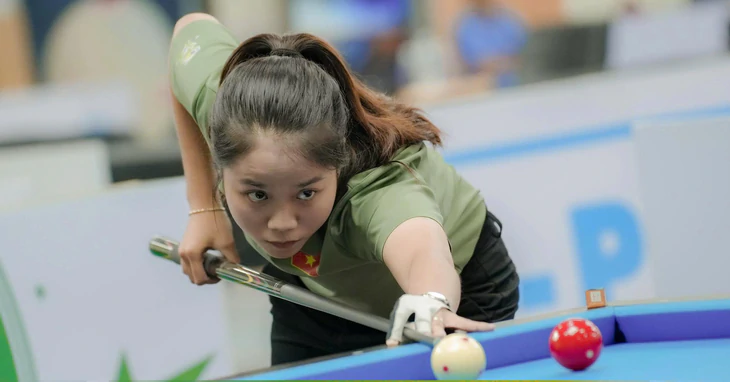
The women’s pool division followed a more predictable yet fiercely competitive script. Four of the country’s most celebrated pool players—Bui Xuan Vang, Nguyen Bich Tram, Duong Yen Vi, and Tran Tu Tran—demonstrated superior skill and tactical nous to secure their spots in the semi-finals. Particular attention was drawn to Duong Yen Vi, who delivered a tactical masterclass in the Round of 16 held on the afternoon of September 10, overcoming formidable cueist Huynh Thi Ngoc Huyen in a high-stakes duel.
Men’s Pool Division Sets the Stage for Knockout Warfare
The men’s pool division also reached a boiling point as the Round of 16 solidified. The upcoming knockout rounds feature an elite lineup of domestic stars, including Nguyen Hoang Minh Tai, Lim Leng, Tat Duy Kien, Nguyen Truong Quoc, Vu Tuan Anh, Cao Van Hao, Quach Vu Nam, Ho Su Phat, Chau Chiu Minh, and Luong Chi Duong. These players represent the absolute vanguard of Vietnamese pool, promising explosive matches and tactical battles when play resumes.
Schedule and Implications for the Final Stages
As the tournament enters its climax, the schedule for September 11 promises non-stop action across all disciplines. The carom 3-cushion and men’s pool categories will feature two intense rounds of knockout matches, moving swiftly from the 1/8 finals to the quarterfinals. Meanwhile, the women’s pool and women’s carom divisions are scheduled to contest their semi-finals starting at 9:30 AM, culminating in the championship showdowns at 12:30 PM, where this tour’s ultimate victors will be crowned.
The implications of the HBSF Cup MIN Table 2026 extend well beyond the immediate prize purse and regional prestige. For athletes like Tran Quyet Chien and Bao Phuong Vinh, these domestic competitions serve as crucial training grounds and competitive barometers ahead of demanding international schedules, including the upcoming Billiards World Cup circuits. Conversely, for rising talents and regional competitors, performances on the HBSF stage offer a direct pathway to national recognition and potential selection for major international multi-sport delegations.
As the cue sports landscape in Vietnam continues its meteoric rise on the global stage, events like the HBSF Tour provide the structural foundation, competitive pressure, and fan engagement necessary to sustain excellence. With the knockout rounds set to unfold, fans and pundits alike await to see whether seasoned champions will reassert their dominance or if dark horses will seize the ultimate glory in Ho Chi Minh City.