An In-Depth Examination of Hinge Durability and Dust Resistance: Comparing the Apple iPhone Duo and Samsung Galaxy Z Fold8

The rapid evolution of foldable smartphones has consistently pushed engineering boundaries, yet manufacturers continue to grapple with a fundamental vulnerability: particulate intrusion. As devices like the Apple iPhone Duo and the Samsung Galaxy Z Fold series compete for dominance in the ultra-premium mobile market, the mechanical integrity of their hinges remains a critical battleground. Recent macro-level inspections of the iPhone Duo and the Samsung Galaxy Z Fold8 provide a revealing look at how competing design philosophies address the persistent threat of dust, grit, and structural wear over time.

Understanding the Vulnerability of Foldable Hinges
Foldable smartphones rely on intricate mechanical hinges to facilitate smooth folding and unfolding motions while housing flexible OLED display panels. However, these mechanical joints inherently create microscopic gaps when the device is manipulated. Dust, sand, and fine debris represent the primary adversaries of foldable hardware. When particulate matter infiltrates the hinge mechanism, it can cause various mechanical failures, ranging from an audible crunching sound during operation to internal friction that prevents the device from closing completely or damages the flexible screen layer from behind.
Industry standards for ingress protection—commonly referred to IP ratings—provide baseline metrics for consumer awareness. The Apple iPhone Duo generally features an IP68 classification, while the Samsung Galaxy Z Fold8 and its higher-tier variants hold an IP48 certification. While these ratings indicate varying degrees of resistance against solids and liquids, manufacturers frequently emphasize that such protections are not permanent. Normal daily wear and tear, coupled with the mechanical stress of unfolding, can degrade these protective seals over time. Furthermore, standard laboratory tests for IP ratings are typically conducted under static conditions, meaning the devices are tested while stationary rather than while undergoing continuous folding cycles in real-world environments.

Design Approaches: Apple iPhone Duo vs. Samsung Galaxy Z Fold8
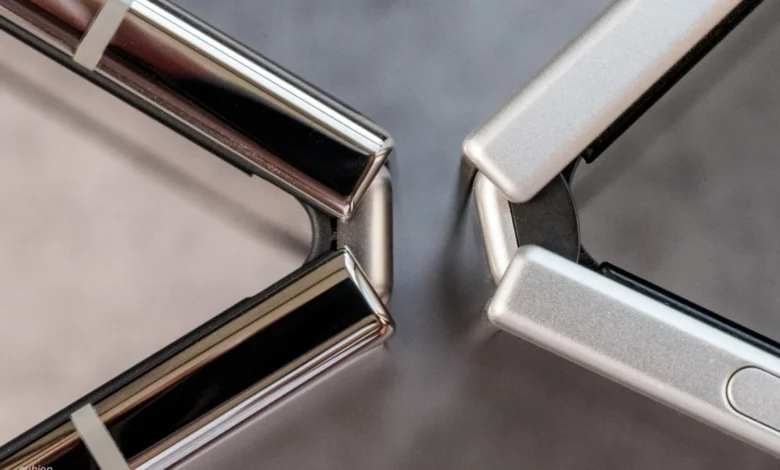
A close-up visual analysis of the Apple iPhone Duo reveals distinct structural characteristics around its folding axis. When the device is bent, a narrow micro-gap emerges immediately behind the curved section of the display. Macro photography highlights that while these spaces appear negligible to the naked eye, they are wide enough to allow microscopic grains of dust and sand to slip inside during normal operation. This susceptibility becomes particularly pronounced when users open and close the device repeatedly in outdoor environments where particulate matter is prevalent in the air.
Conversely, Samsung has implemented structural modifications in the Galaxy Z Fold8 to mitigate this exact vulnerability. A detailed comparison with the Z Fold8 reveals that Samsung has integrated a specialized physical barrier—effectively a small protective flap or shield—designed to cover the vulnerable hinge gap when the device is articulated. This barrier serves as a blocking mechanism that significantly reduces the likelihood of dust channelling directly into the core mechanical assembly.

Nevertheless, these contrasting engineering solutions come with their own set of trade-offs. While Samsung’s protective flap successfully deflects particulate matter away from critical internal components, it introduces visible creases or structural ridges on the exterior casing when the device is viewed from specific angles. These design elements demonstrate the delicate balance manufacturers must strike between mechanical protection, structural aesthetics, and long-term durability.
Real-World Implications and Stress Testing
Independent teardowns and durability assessments conducted by organizations such as iFixit and prominent technology reviewers have consistently underscored hinge vulnerability as a primary Achilles’ heel for foldable technology. In practical scenarios, users do not operate their smartphones in sterile laboratory environments. Pocket lint, beach sand, and urban particulate matter frequently come into contact with mobile devices.

When abrasive particles breach the housing of a foldable phone, the consequences can compromise the user experience. Reviewers performing stress tests, such as repeated exposure to particulate matter followed by actuation cycles, have demonstrated that unprotected hinges are prone to collecting debris that inhibits magnetic alignment and smooth closing actions. While the Apple iPhone Duo boasts a sleek profile that minimizes visible external obstructions in certain configurations, its reliance on tighter tolerances without dedicated physical blocking flaps leaves it exposed to potential particulate accumulation over extended periods of use.
On the other hand, the physical countermeasures utilized in the Samsung Galaxy Z Fold8 lineage illustrate a proactive approach to hardware resilience. By introducing protective shielding directly into the hinge architecture, Samsung acknowledges the inevitability of dust exposure and attempts to intercept debris before it can compromise internal components. However, users must accept minor aesthetic compromises, such as the appearance of the protective flap mechanism along the spine when the device is fully extended.

Industry Context and the Evolution of Foldable Engineering
The debate over dust resistance reflects the broader maturity curve of the foldable smartphone market. When the first generation of commercial foldables debuted several years ago, devices lacked any meaningful ingress protection ratings, making them highly susceptible to mechanical failure from dust particles. Over successive generations, engineering teams have steadily improved material science, adhesive placement, and mechanical sealing.
The current generation—typified by the comparison between the iPhone Duo and the Galaxy Z Fold8—highlights a divergence in engineering philosophy. Apple continues to refine its precision-machined tolerances, focusing on tight mechanical closures that maintain a seamless aesthetic profile. Meanwhile, Samsung leans toward pragmatic mechanical defenses, utilizing physical barriers that prioritize functional longevity over absolute minimalism.

As consumer expectations rise, the demand for truly dust-proof foldable devices remains unfulfilled. Current IP ratings indicate that while moisture resistance has reached high levels, complete dust-proofing remains constrained by the moving parts inherent to folding displays. Future iterations of both Apple and Samsung foldable lines will undoubtedly need to innovate further, potentially exploring magnetic fluid seals, self-cleaning hinge geometries, or advanced elastomeric membranes to permanently resolve the challenge of particulate intrusion.
Conclusion
The examination of the hinge structures on the Apple iPhone Duo and the Samsung Galaxy Z Fold8 underscores the complex engineering compromises required to build durable foldable displays. While the iPhone Duo showcases tight manufacturing tolerances that give it a clean visual profile, it remains vulnerable to fine debris slipping through micro-gaps during everyday use. In contrast, the Samsung Galaxy Z Fold8 employs protective physical barriers designed to block dust entry, albeit with visible structural trade-offs along the spine. As the foldable market continues to mature, resolving the tension between sleek aesthetics and robust mechanical protection will remain a central focus for smartphone engineers worldwide.