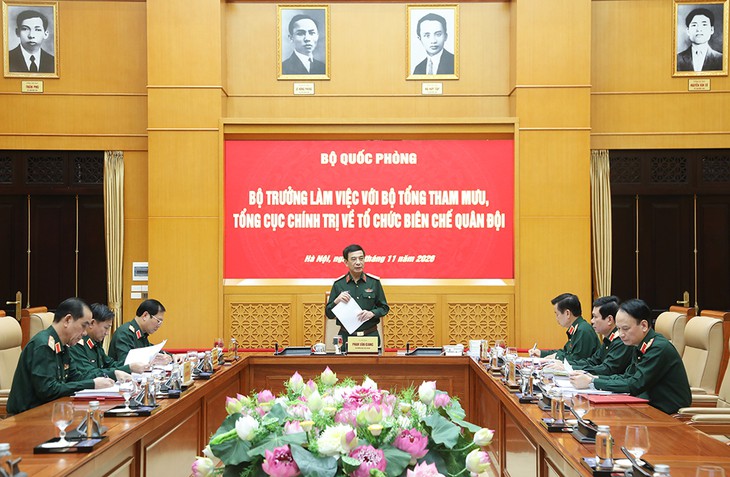
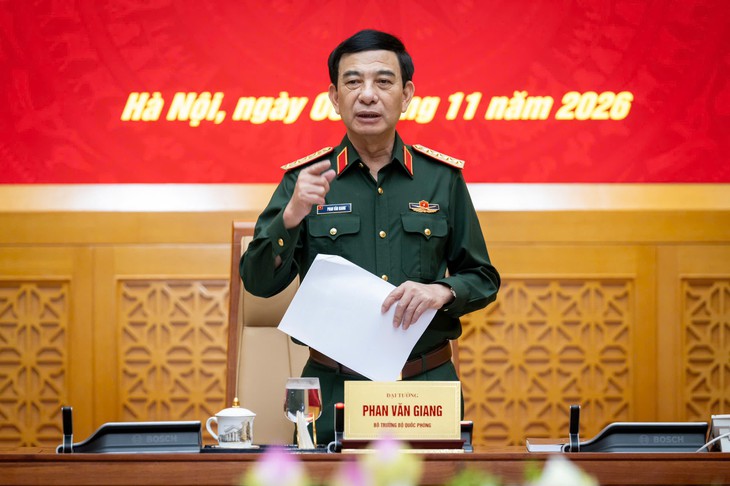
HANOI — In an ongoing nationwide effort to build a leaner, stronger, and more modern military force, Senior General Phan Van Giang, Minister of National Defense, recently presided over a high-level working session with the General Staff, the General Department of Political Affairs, and key leadership agencies. The gathering was convened to evaluate military and national defense performance for the third quarter of 2026, project strategic directions for the final quarter, and review sweeping structural adjustments across all branches of the Vietnam People’s Army.
The directive follows Conclusion No. 386, issued on October 7, during the third plenary session of the Central Military Commission. Grounded in the broader vision of national defense modernization, the Ministry of National Defense is moving forward with calculated precision to optimize military personnel, administrative frameworks, and operational units from the central headquarters down to tactical field formations.
Strategic Context and Background of Military Modernization
The current restructuring initiatives within the Vietnam People’s Army do not occur in a vacuum; rather, they represent the continuation of a long-term, systematic roadmap aimed at transforming Vietnam’s defense capabilities to meet contemporary geopolitical and security realities. The foundational guidelines for this transformation are anchored in two pivotal policy documents: Resolution No. 05 of the Politburo and Resolution No. 230 of the Central Military Commission, both charting the strategic course for the organization of the Vietnam People’s Army through the 2021–2030 period and beyond.
Over the past several years, the Central Military Commission has spearheaded multiple phases of organizational streamlining. These efforts are designed to reduce bureaucratic bloat, eliminate overlapping functions between civil-military administrative bodies, and redirect resources toward core combat-readiness units, high-technology warfare divisions, and modern defense infrastructure. As regional security dynamics shift and military technology advances at an unprecedented pace, the Vietnamese military leadership recognizes that conventional force structures must evolve to address multifaceted security challenges, ranging from traditional territorial defense to non-traditional threats such as cyber warfare, maritime security, and disaster response.
Comprehensive Scope of the Structural Review
During the working session, Senior General Phan Van Giang instructed the Department of Management, operating under the direct purview of the General Staff, to collaborate closely with relevant military agencies and specialized units. The mandate requires a rigorous, multi-layered review of the current organizational tables and personnel caps across the entire armed forces.
The scope of this comprehensive assessment is exceptionally broad, focusing heavily on four critical institutional pillars:
- Ministry of National Defense Headquarters: Streamlining central administrative departments, supervisory boards, and policy-making organs to ensure rapid command response times and reduced administrative overhead.
- Service Branches and Combat Arms: Re-evaluating the force distribution and logistical support networks of the Navy, Air Defense-Air Force, Army, and specialized corps to ensure they directly correlate with modern operational doctrines.
- Military Education and Training Institutions: Reviewing the academic system, military academies, and training command centers to elevate instructional quality, integrate modern combat simulators, and align educational curricula with modern warfare requirements.
- Defense Industrial Enterprises: Assessing the operational efficiency, economic viability, and technological output of state-owned defense enterprises to optimize resource allocation between commercial manufacturing and defense production.
The overarching objective of these adjustments is to achieve a synchronized, harmonious balance between troop strength, operational functions, and logistical sustainment capabilities. Military planners have been directed to ensure that any proposed reduction in personnel numbers or reorganization of units does not compromise combat readiness, training standards, scientific research, or daily operational discipline.
Chronology and Implementation Roadmap
The timeline governing the current phase of military restructuring highlights the methodical pace adopted by Vietnam’s defense establishment:
- Early 2021 – 2025: Initial phases of the Resolution No. 05 implementation, focusing on dissolving redundant intermediary units, merging smaller administrative bureaus, and laying the groundwork for digital transformation within military command structures.
- October 7, 2026: The Central Military Commission convenes its third plenary session, culminating in the issuance of Conclusion No. 386, which sets forth accelerated milestones for force downsizing and structural optimization.
- November 2026: Senior General Phan Van Giang holds dedicated working sessions with the General Staff and the General Department of Political Affairs to review initial proposals, address structural bottlenecks, and mandate precise adjustments to pending operational blueprints.
- Q4 2026 and Beyond: Implementation of localized structural pilots, comprehensive socio-political impact assessments, and the gradual rollout of adjusted force structures across targeted military regions and specialized branches.
Official Directives and Methodological Guidelines
Addressing the assembled military leadership, Senior General Phan Van Giang emphasized that adjusting the organization and force structure of the military is a task of paramount strategic importance. He noted that such changes exert a direct, immediate impact on the overall combat readiness, combined-arms synergy, and operational capacity of the entire armed forces.
"The process of research, formulation, and proposal must be executed with extreme caution, scientific rigor, and comprehensive foresight," Senior General Giang stated. "Every proposal must closely reflect the statutory functions, assigned duties, and distinct operational environments of each agency and unit. We must strictly preserve the principles of historical continuity, institutional stability, systemic synchronization, and internal cohesion across our entire organizational architecture."
The Defense Minister outlined several non-negotiable criteria for the drafting teams:
- Zero Administrative Overlaps: Planners must rigorously eliminate any potential structural overlaps in duties or responsibilities between newly merged or reorganized units to prevent bureaucratic friction.
- Prevention of Operational Vacuums: The restructuring process must guarantee that command, control, administration, logistical support, and routine military activities remain uninterrupted, ensuring no gaps emerge in national defense execution.
- Quality Over Quantity: The transition must be intrinsically tied to the ongoing objective of building a "revolutionized, regular, elite, and modern" military. This involves elevating the professional caliber, technical proficiency, and tactical adaptability of officers and specialized technical personnel.
- Maximized Resource Utilization: Existing real estate, physical infrastructure, and technological assets must be fully optimized to support newly configured units without necessitating excessive capital expenditure.
Political and Ideological Safeguards
Recognizing that large-scale structural adjustments inevitably impact the professional lives, postings, and morale of military personnel, Senior General Phan Van Giang placed special emphasis on political and ideological work. He mandated that party committees and political organs at all levels proactively synchronize their communication strategies with structural implementation.
Military commanders have been instructed to execute rigorous personnel policies, ensuring that comprehensive welfare, compensation, and social security arrangements are fully enacted for officers, professional soldiers, and defense workers affected by downsizing or redeployment. Maintaining institutional solidarity, ideological stability, and high morale across the ranks is viewed as a prerequisite for the successful completion of the restructuring roadmap.
The General Staff has been tasked with leading the final consolidation of feedback gathered during the session. In coordination with the General Department of Political Affairs, the General Staff will refine the master blueprint, ensuring that every proposed modification rests on solid theoretical foundations and practical operational realities before formal submission to the Minister of National Defense for final approval and subsequent execution.