Hanoi properties skyrocket as Vanh Dai 2.5 infrastructure development turns back-alley homes into high-value street-front assets

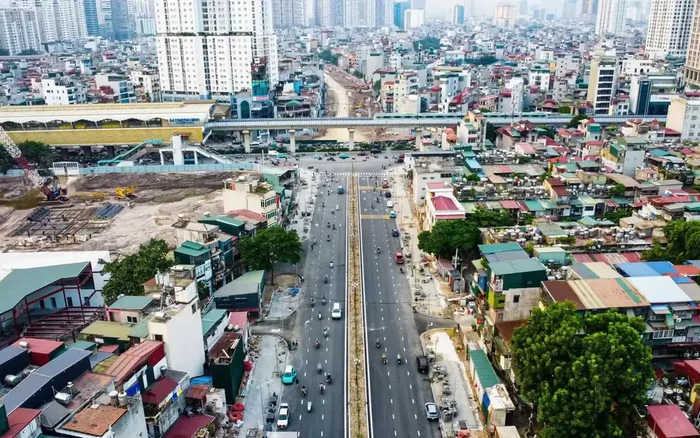
The completion of the Vanh Dai 2.5 (Ring Road 2.5) segment, specifically the stretch connecting Nguyen Trai Street through Khuong Dinh to Ha Dong, has fundamentally altered the real estate landscape of Hanoi’s residential districts. Following extensive land clearance and urban redevelopment efforts, numerous properties that were previously tucked away in narrow, inaccessible alleys have been transformed into highly sought-after street-front assets. This sudden shift in geographical status has triggered a dramatic surge in asking prices, with some property owners demanding as much as 500 to 600 million VND per square meter, despite the irregular, often non-rectangular shapes of these newly exposed land plots.
The Evolution of Urban Connectivity and Real Estate Value
For decades, the area surrounding the Khuong Dinh and Nguyen Trai corridor was characterized by a labyrinthine network of small, congested alleys. Residents in this sector often faced significant challenges regarding accessibility, emergency services, and commercial potential. The implementation of the Vanh Dai 2.5 project—a critical artery in Hanoi’s master plan for urban traffic management—has acted as a catalyst for rapid gentrification.
As the road widened, the "back-alley" status of these homes was stripped away, replacing isolation with direct exposure to a major thoroughfare. In the real estate market, such a transition is historically correlated with significant price appreciation. However, the current market climate in Hanoi has seen this appreciation reach unprecedented levels. Real estate agents active in the region report that the transformation has created a "gold rush" mentality among sellers, who are leveraging the new frontage to justify premiums that far exceed standard market valuation models for residential land in the capital.
Chronology of Infrastructure Development
The development of the Vanh Dai 2.5 route has been a multi-year endeavor marked by complex land acquisition and compensation disputes, which are typical for major infrastructure projects in high-density urban environments.
- Initial Planning Phase: The project was identified as a priority for alleviating the chronic congestion on major radials like Nguyen Trai and Le Van Luong.
- Land Clearance Stage: This period involved the displacement of hundreds of households, with significant portions of plots being acquired by the state. This left many remaining structures in "mutilated" or irregular states, often with narrow or awkward footprints.
- Construction and Opening: The completion of the road surface and infrastructure integration marked the point at which property owners began realizing the windfall potential of their newly accessible locations.
- Post-Completion Speculation: Since the opening of the road, the market has entered a phase of aggressive pricing, where the scarcity of available street-front land drives up the speculative value of any parcel touching the new thoroughfare.
Economic Analysis of the Price Surge
Current market data indicates that properties in the vicinity of the newly developed road are being listed at prices ranging between 500 and 600 million VND per square meter. A notable example involves a 32-square-meter parcel currently listed for approximately 19 billion VND, equating to nearly 594 million VND per square meter. Similarly, a 42-square-meter property has been placed on the market for 25 billion VND, reaching nearly 595 million VND per square meter.
These figures represent a significant deviation from the average market value for comparable land in surrounding districts. Several factors complicate these valuations:
- Irregular Geometry: Many of the plots currently being sold were victims of "slanted" or "partial" land clearance. Consequently, the resulting land shapes are often trapezoidal, triangular, or otherwise non-functional for standard construction, requiring specialized architectural intervention.
- Buyer Liability: In many of these listings, the seller has offloaded all transaction-related costs onto the buyer, further increasing the effective acquisition price.
- Speculative Premium: There is a notable gap between "asking prices" and "transaction prices." While sellers are testing the market at these record highs, there is little public data to confirm that these properties are being absorbed at such rates, raising questions about the market’s true absorption capacity.
Perspectives from Industry Experts
Dr. Tran Xuan Luong, a researcher at the Vietnam Institute for Economic and Real Estate Research (VIREED), emphasizes that while infrastructure development naturally drives value, the current pricing in the Khuong Dinh-Nguyen Trai area is bordering on irrational.
"The increase in value is a standard economic phenomenon when connectivity is improved," Dr. Luong explains. "However, the value of a property is determined by a confluence of factors: utility, legal status, actual usable area, and shape. When a property is ‘mutilated’ by a clearance process, its functional value is severely limited. A buyer who pays 600 million VND per square meter for a plot that cannot be easily built upon or utilized for high-density commercial activity is ignoring fundamental real estate risks."
Experts warn that investors must distinguish between the "prestige" of having a street-front address and the actual economic utility of the land. Properties that have been reduced to "sliver" or "cat-tongue" shapes due to road widening often face significant legal hurdles regarding building permits and property rights, which can render them virtually impossible to develop into profitable commercial or residential units.
The Risks of "Super-Thin, Super-Odd" Properties
The emergence of "super-thin, super-odd" (siêu mỏng, siêu méo) houses is a recurring issue in Hanoi’s urban planning history. These structures, often remaining after road expansion, pose aesthetic and safety concerns. For prospective buyers, the risk is not merely financial but also administrative.
Legal experts caution that before purchasing such property, investors must conduct a rigorous audit of the cadastral records. Key documents to verify include:
- The Certificate of Land Use Rights: Ensuring the land area matches the current physical state.
- The Planning Map: Verifying the boundaries to ensure the plot is not subject to further set-back requirements.
- Construction Permits: Confirming that the current footprint meets municipal standards for minimum width and area for new construction.
Without these checks, a buyer could inherit a plot of land that is legally prohibited from being renovated or expanded, effectively trapping their capital in an asset that cannot be liquidated or improved.
Broader Implications for Hanoi’s Real Estate Market
The situation on the Vanh Dai 2.5 segment serves as a microcosm of the challenges facing Hanoi’s rapidly expanding real estate market. As the city continues to prioritize major arterial roads to support its growing population, the ripple effects on local real estate prices will continue to be a primary driver of urban dynamics.
However, the current trend of hyper-inflation in property values along new corridors may signal a cooling phase. As interest rates fluctuate and the government continues to refine land management policies, the "speculative bubble" surrounding these irregularly shaped plots may eventually burst.
For the average citizen, the high prices underscore a broader affordability crisis. When small, non-viable, or irregularly shaped plots are marketed at prices exceeding half a billion VND per square meter, it pushes the barrier to entry for legitimate business owners and residents out of reach, potentially leading to a stagnation of local commercial development.
In summary, while the Vanh Dai 2.5 project has undeniably succeeded in its goal of improving transit, the secondary market reaction has created a high-risk environment. Investors and homebuyers are urged to exercise extreme caution, prioritizing verified legal documentation and long-term functional utility over the allure of a newly established street-front location. The market correction for these properties is likely to be significant as reality meets the current, overly optimistic price expectations.