DJI Neo 3 Leaks Reveal Major Upgrades Including a 1/1.1-Inch Square Sensor and Built-In Radio Transmitters Ahead of Official Launch

The consumer drone market is bracing for a significant shift as industry leader DJI inadvertently leaked detailed specifications, hardware images, and activation guides for the upcoming DJI Neo 3. The accidental disclosure occurred within the newly released DJI Fly application update, version 1.21.18, which prominently featured the unannounced drone model within its connection menus and setup tutorials. This unexpected software-level confirmation strongly suggests that the device is in the final stages of pre-production, with an official global launch expected in the near future.
As content creators, tech enthusiasts, and aviation hobbyists eagerly anticipate the formal debut, the leaked documentation outlines a series of aggressive hardware overhauls. These modifications address key limitations of previous iterations—specifically the original Neo and Neo 2 models—and position the third-generation ultra-compact drone as a formidable tool for modern short-form video production across platforms such as TikTok, Instagram Reels, and YouTube Shorts.
Comprehensive Hardware Overhauls and Camera Enhancements
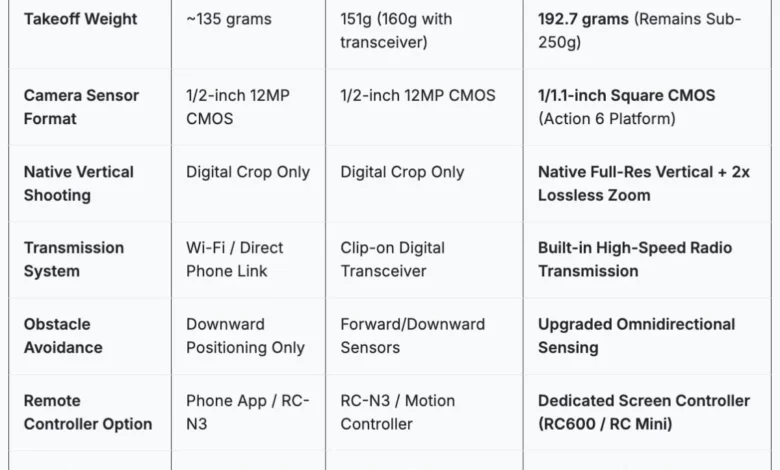
The most transformative upgrade in the DJI Neo 3 centers on its imaging system. Departing from the 1/2-inch 12-megapixel sensors utilized in its predecessors, the Neo 3 incorporates a 1/1.1-inch square sensor. This advanced sensor shares structural DNA with the one found in the Osmo Action 6, marking a monumental leap in light-gathering capability and dynamic range for a drone of this scale.
Because of the square sensor design, the DJI Neo 3 can natively capture vertical 9:16 video at full resolution without requiring a physical camera rotation mechanism. This capability eliminates the traditional compromise between horizontal cropping and vertical framing, preserving maximum detail for mobile-first content creators. Furthermore, the camera system supports lossless 2x digital zoom, offering enhanced framing flexibility while airborne.
Despite these heavy-duty optical additions, DJI has maintained a lightweight profile. The Neo 3 tips the scales at 192.7 grams—an increase from the 151-gram weight of the Neo 2, primarily driven by the larger sensor module and internal layout changes. Crucially, the aircraft remains safely below the critical 250-gram regulatory threshold enforced by aviation authorities in many global jurisdictions, including the United States, the European Union, and various Asian markets. This compliance allows operators to fly the drone recreationally without undergoing burdensome registration processes or acquiring specialized licensing, preserving the core accessibility advantage that defined the original Neo series.
Streamlined Architecture and Advanced Flight Safety
Beyond optical improvements, DJI has re-engineered the internal and external architecture of the Neo 3. The company has completely eliminated the external transceiver units seen on previous models, opting instead to integrate radio frequency components directly into the primary circuit board. This internal consolidation not係 streamlines the exterior shell but also improves aerodynamic efficiency and structural durability.
Safety and autonomy have also received substantial investment. The DJI Neo 3 features a fully upgraded, omnidirectional obstacle avoidance sensor suite. By integrating advanced spatial awareness hardware, the drone can navigate complex environments with significantly reduced risk of collision. This sensor array works in tandem with enhanced software features, notably upgraded iterations of DJI’s proprietary tracking algorithms: ActiveTrack and SelfieShot 2.0. These systems enable smoother, more reliable subject tracking, allowing solo creators to capture cinematic, complex flight paths without requiring a dedicated ground pilot.

Introduction of the RC600 (RC Mini) Dedicated Controller
In tandem with the drone itself, the leaked DJI Fly application files revealed an accompanying controller designated as the RC600, internally referred to as the RC Mini. Unlike smartphone-dependent controllers or stripped-down gamepads often bundled with entry-level ultra-compact drones, the RC Mini features an integrated display screen, physical control sticks, and a dedicated gimbal adjustment wheel.
This standalone controller design addresses a frequent user complaint regarding the friction of mounting and syncing smartphones in fast-paced shooting scenarios. By allowing operators to power on the controller and drone for immediate flight without external device pairing, DJI aims to drastically reduce deployment time in the field.
Industry Context and the Evolution of the Ultra-Compact Drone Segment
The leak of the DJI Neo 3 arrives at a pivotal time for the consumer drone industry. Over the past three years, the market has bifurcated into high-end professional cinematography platforms—such as the DJI Mavic series—and ultra-portable, autonomous flying cameras designed for casual users and vloggers. The original DJI Neo, introduced to lower the barrier of entry for aerial photography, proved that consumers desired a pocket-sized, self-launching drone that could double as a personal videographer.
However, earlier models faced valid criticisms regarding low-light performance, fixed-aspect-ratio constraints, and limited wind resistance. By introducing a 1/1.1-inch sensor, comprehensive obstacle sensing, and a dedicated hardware controller, DJI is systematically closing the performance gap between ultra-compact drones and traditional professional hardware. Industry analysts note that this strategy allows DJI to capture an increasingly lucrative demographic of digital content creators who prioritize rapid workflow integration over advanced manual camera settings.
Regulatory Implications and Future Outlook
While DJI has not yet disclosed official pricing, distribution regions, or a concrete release date, the inclusion of the Neo 3 in a public application update signifies that mass manufacturing and firmware stabilization are largely complete. Historically, DJI follows a predictable product lifecycle wherein software leaks precede official marketing campaigns by two to four weeks.
From a regulatory standpoint, the 192.7-gram weight of the Neo 3 ensures compliance with the European Union Aviation Safety Agency (EASA) C0 open category requirements, as well as the Federal Aviation Administration (FAA) guidelines in the United States that exempt sub-250g recreational drones from mandatory registration. This regulatory buffer remains a cornerstone of the Neo series’ commercial viability, enabling widespread adoption among travelers and casual hobbyists who wish to avoid bureaucratic hurdles.
As the tech community awaits formal confirmation from DJI headquarters, the overarching implications of the Neo 3 point toward an increasingly competitive landscape for mobile content creation tools. Whether the device will launch ahead of the upcoming holiday shopping season remains the primary point of speculation, but the hardware blueprint is now firmly established.
Related posts: