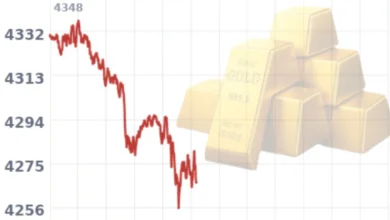
Gold price suffers nearly 37 percent correction from peak as global economic shifts reshape market dynamics


The global gold market is currently navigating one of its most turbulent phases in recent history, as spot gold prices have retreated by nearly 37 percent from their all-time high of approximately 5,600 USD per ounce reached in January 2026. This dramatic correction, which has seen the precious metal slip toward the 3,500 USD per ounce threshold, reflects a fundamental realignment of global monetary policies, shifting geopolitical temperatures, and a significant rotation of investor capital away from non-yielding assets.
The Chronology of a Market Reversal
To understand the current volatility, one must examine the meteoric rise that preceded this decline. Between October 2023 and January 2026, gold experienced an unprecedented rally, surging more than 206 percent from a base of 1,830 USD per ounce. This period was characterized by extreme geopolitical instability, aggressive central bank buying, and a general flight to safety among institutional investors.
However, the tide began to turn in the first quarter of 2026. As inflationary pressures showed signs of stabilization, the Federal Reserve shifted its monetary trajectory. After a series of rate cuts intended to stimulate the economy between late 2024 and 2025, the central bank pivoted in September 2026, initiating a tightening cycle that brought benchmark interest rates to the 3.75–4 percent range. This move signaled to the market that the era of "easy money" was coming to a definitive close, stripping gold of its primary appeal as a hedge against negative real interest rates.
By the trading session of November 20, 2026, the downward pressure reached a crescendo. Spot gold plummeted by 87 USD, or 2.4 percent, in a single day, testing the 3,538 USD level—a price point not seen since September 2025. This rapid descent has forced a massive liquidation of speculative positions, as traders scramble to adjust to a new macroeconomic environment dominated by a resurgent US Dollar and high-yielding fixed-income securities.
Comparative Historical Analysis
The current 37 percent correction is noteworthy not only for its depth but for the speed at which it has unfolded over a ten-month window. Historical precedent suggests that such corrections are often painful but serve to purge speculative froth from the market.
In 1980, gold experienced a staggering 42.9 percent decline in just ten weeks following a 260 percent surge over nine months. Similarly, the 2008 financial crisis triggered a 32.9 percent drop over a seven-month period. The current situation shares parallels with these cycles, where the combination of high interest rates and the normalization of risk appetite acts as a powerful catalyst for institutional selling. Analysts note that the current decline is part of a necessary, albeit brutal, phase of price discovery that follows an unsustainable parabolic move.
The Role of Monetary Policy and the Greenback
The primary driver of gold’s weakness remains the Federal Reserve’s hawkish stance. Market participants are currently pricing in a 90 percent probability of a 25-basis-point rate hike in December 2026. Minutes from the October policy meeting revealed that central bank officials remain deeply concerned about "sticky" inflation, suggesting that interest rates may remain elevated for longer than previously anticipated.
When interest rates rise, the opportunity cost of holding non-interest-bearing assets like gold increases significantly. As yields on 30-year US Treasury bonds climbed past 5.7 percent, gold lost its competitive edge. Furthermore, the US Dollar has strengthened considerably, exerting inverse pressure on dollar-denominated commodities. For international investors, the strength of the greenback makes gold significantly more expensive, further depressing global demand.

Geopolitical De-escalation and Market Sentiment
A crucial, often overlooked factor in the recent price decline is the cooling of geopolitical tensions that previously served as a floor for gold prices. Diplomatic efforts, particularly the summit between the United States, China, and Russia on the sidelines of the APEC meeting on November 19, 2026, have yielded tangible results.
Commitments regarding the stabilization of oil supply chains, mutual respect for sovereignty, and explicit pledges to prevent nuclear escalation have significantly reduced the "fear premium" embedded in gold prices. Investors who had piled into gold as a war-hedge are now reallocating capital toward equities and other productive assets as the specter of a major global conflict recedes. While the situation in the Middle East and the ongoing conflict in Ukraine remain unresolved, the market is currently favoring a narrative of diplomatic containment over existential threat.
Impact on Domestic Markets: The Case of Vietnam
The ripple effects of this international correction are clearly visible in domestic markets. In Vietnam, SJC gold bars, which hit an all-time peak of 191 million VND per tael in early March, have fallen to 133.5 million VND per tael as of November 21. This represents a decline of over 57.5 million VND per tael.
A unique challenge for Vietnamese investors is the persistent gap between domestic prices and global spot prices. Even as international gold stabilizes, the local market often trades at a significant premium—sometimes as high as 22–23 million VND per tael. As global volatility persists, this gap is expected to narrow, which may cause domestic prices to remain under pressure even if international prices find a temporary floor.
The Road Ahead: Risk Factors and Long-term Outlook
Despite the deep correction, analysts caution that the risk of further downside remains. The most significant threat is the potential for a "liquidity crunch" triggered by the US equity market. The Nasdaq Composite’s recent 5.28 percent drop, coupled with heavy losses in AI-related stocks like Nvidia and AMD, has raised alarms about systemic risk. If the "AI bubble" continues to deflate, institutional investors may be forced to sell their remaining gold holdings to cover margin calls or meet liquidity requirements.
However, the long-term case for gold remains supported by structural factors. The US national debt, currently exceeding 41 trillion USD, remains a looming concern for long-term fiscal stability. CIBC Capital Markets has warned that the government may need to raise its debt ceiling by nearly 5 trillion USD by February 2027 to remain solvent ahead of the 2028 election cycle.
This massive debt burden creates long-term concerns regarding the devaluation of the US Dollar and the long-term sustainability of the current fiscal trajectory. As central banks worldwide continue to diversify their reserves away from the dollar, the underlying demand for gold as a store of value is unlikely to vanish.
Conclusion
The gold market is currently in a state of transition. The 37 percent decline serves as a reality check for a market that had become overly reliant on geopolitical fear and low-interest-rate environments. While the 3,500 USD per ounce level is an important psychological and technical support, it does not yet signal the definitive end of the correction cycle.
Investors should remain cautious, as the interplay between aggressive central bank policies and potential equity market volatility will likely dictate the next phase of price action. For now, the market is shifting its focus away from panic-driven buying and toward a more sober assessment of fundamental economic realities. The resilience of gold in the face of such a correction will ultimately depend on whether the "fear trade" can be replaced by a more sustainable "store of value" narrative as debt levels and fiscal challenges continue to mount on the global stage.