
The global landscape of criminal justice and administrative discipline is undergoing a significant paradigm shift, with many nations increasingly favoring community service over traditional punitive measures such as incarceration or heavy fines. This trend, often categorized as "restorative justice" or "alternative sentencing," is designed to foster social reintegration, alleviate prison overcrowding, and ensure that minor offenders contribute back to the community they have harmed. As Vietnam prepares to implement its own administrative penalty reforms by 2028, a closer look at how major global economies—including the United States, South Korea, Singapore, France, and the United Kingdom—manage these programs reveals a complex, multi-faceted approach to modern justice.
The Philosophy Behind Community Service as a Penalty
At its core, the movement toward community service is rooted in the belief that for non-violent, minor infractions, the state should prioritize rehabilitation and societal utility over mere retribution. Traditional fines often disproportionately impact low-income individuals, essentially turning financial hardship into a cycle of debt or incarceration. Conversely, community service transforms a punitive action into a productive one, allowing the offender to pay their "debt to society" through labor that benefits the public good, such as park maintenance, administrative support for social services, or environmental cleanup.
A Comparative Analysis: The United States Model
In the United States, there is no single federal mandate for community service; rather, it is decentralized across states and jurisdictions. This creates a patchwork of policies that reflect the diverse legal philosophies within the country.
In Nevada, for example, courts have the authority to order traffic offenders to perform community service in lieu of paying a portion or all of their administrative fines. This is particularly common in cases where the offender can demonstrate financial hardship. The oversight for these programs is typically handled by local government agencies, state departments, or certified non-profit organizations that provide supervision and report completion to the court.

California offers a more structured approach, particularly in counties like Marin and Sacramento. In these jurisdictions, courts often establish a "conversion rate"—for example, one hour of community service may be valued at $24 in waived fines. Offenders must work at pre-approved facilities and provide documented proof of completion. Failure to adhere to the schedule can result in the reinstatement of the original financial penalty, demonstrating that these programs are not a "free pass" but a conditional substitution. At the federal level, the U.S. Sentencing Commission provides guidelines for community service, generally suggesting a cap of 400 hours to ensure that the work remains manageable while allowing for effective monitoring by probation officers.
South Korea’s Socio-Economic Integration
South Korea has implemented a sophisticated system that allows those convicted of minor criminal offenses—who lack the financial capacity to pay fines—to perform community service as a substitute. This program is regulated by the Ministry of Justice.
According to official guidelines, individuals facing fines of up to 5 million won who are unable to pay may apply to a public prosecutor within 30 days of the sentencing. If approved, the offender is placed in roles that match their skills and the community’s needs. These roles range from assisting at senior care facilities and child welfare centers to environmental restoration and repair work for low-income households. The program is highly regarded for its dual benefit: it provides essential labor for social services while allowing the offender to maintain their dignity and employment status, which is crucial for preventing recidivism.
The Singaporean Approach: Corrective Work Orders
Singapore, known for its strict adherence to public order, utilizes a unique mechanism known as the Corrective Work Order (CWO). Introduced in 1992, the CWO is specifically targeted at public hygiene offenders, such as those caught littering.
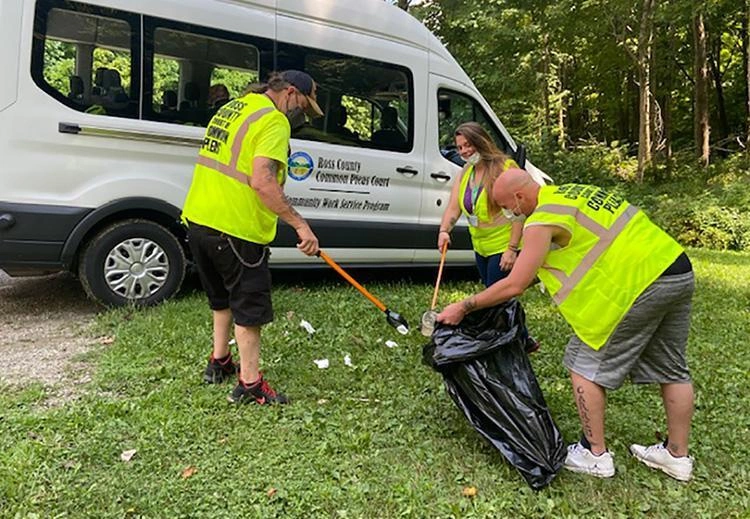
Unlike the voluntary substitution models seen elsewhere, the CWO is designed to be visible and deterrent. Offenders are often required to wear high-visibility vests while cleaning public areas under the supervision of the National Environment Agency. The goal is to maximize the psychological impact on both the offender and the public, reinforcing the severity of the offense. For instance, an individual who litters from a high-rise building may be subject to both a heavy fine and a mandatory CWO, forcing them to confront the physical consequences of their actions in the very environment they neglected.
European Models: Switzerland, France, and the UK
European nations have long integrated community service into their criminal codes to combat the high costs and negative externalities of short-term incarceration.
In Switzerland, the penal code allows community service to replace short-term prison sentences of up to six months. The key criteria for eligibility is the absence of a high risk of re-offending or flight. The work is unpaid and must serve a public interest or support those in need. The maximum duration for this substitution is two years, though it is usually shorter. If an offender fails to complete the service, the court can revert to the original prison sentence or fine, providing a strong incentive for compliance.
France employs a similar measure known as Travail d’Intérêt Général (TIG). This program is available for various offenses, with time commitments ranging from 20 to 400 hours. The French system emphasizes matching the work to the offender’s skills and health conditions, with a strong focus on rehabilitation. Common tasks include maintaining public parks, assisting disabled individuals, and participating in anti-recidivism educational programs.
In the United Kingdom, the "Community Payback" program allows courts to impose between 40 and 300 hours of unpaid work. This program is highly community-driven; local residents are often invited to suggest projects, such as clearing overgrown paths or repairing community buildings, which creates a sense of local ownership and restorative justice.
Implications and Future Outlook
The global trend toward community service as a punitive tool carries several important implications for public policy:

- Economic Efficiency: By reducing the number of people in short-term jail stays, states save significant tax dollars while gaining public labor.
- Social Reintegration: Keeping offenders in the community allows them to maintain their jobs, family ties, and housing, which are the most significant factors in preventing long-term criminal behavior.
- Public Perception: When community service is visible (as in Singapore or the UK), it serves as a powerful deterrent. When it is rehabilitative (as in South Korea or France), it improves the social fabric by addressing the root causes of minor offenses.
However, challenges remain. Effective implementation requires rigorous monitoring to ensure that the work is actually performed and that the offender is not subjected to exploitative conditions. Furthermore, there is the risk of "net-widening," where individuals who might have received a simple warning are now subjected to state-monitored labor, potentially increasing the burden on the justice system.
As Vietnam prepares to integrate these practices into its own legal framework starting in 2028, the success of the program will likely depend on the clarity of the guidelines provided by the government. The ability to monitor compliance, the availability of diverse service roles, and the careful selection of candidates will be the pillars upon which the efficacy of this new administrative penalty rests.
Ultimately, the global experience suggests that community service is most effective when it is viewed not as a soft option, but as a constructive, demanding, and highly supervised alternative that benefits both the individual and the community. By shifting the focus from punishment to restoration, these nations are setting a blueprint for a more humane and efficient justice system in the 21st century.