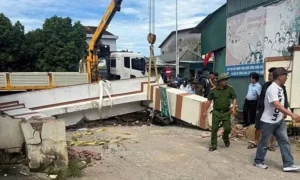
Southern Coastal Corridor Degrades Into Death Trap as Potholes and Severe Deterioration Endanger Commuters in Cà Mau


The Southern Coastal Corridor, a vital economic and logistical artery connecting Cà Mau Province with neighboring regions in the Mekong Delta, has deteriorated into an alarming state of disrepair. Once heralded as a major infrastructure milestone to boost trade, agriculture, and daily mobility across the region, sections of this highway have transformed into hazardous obstacle courses. Deep potholes, extensive surface crumbling, and massive subsidence now threaten the safety of thousands of motorists, cyclists, and pedestrians who rely on the corridor for their daily livelihoods.
Within a span of just one week, multiple severe accidents involving local residents have brought national attention to the escalating crisis. The catastrophic state of the roadway has left communities living in constant fear, forcing authorities to face mounting pressure to implement urgent restorative measures before more lives are endangered.

A Week of Terror: Local Residents Fall Victim to Severe Road Damage
The human toll of the degraded infrastructure has become increasingly evident through a series of violent traffic incidents reported throughout mid-September. The deterioration of the asphalt surface has proven particularly perilous for operators of two-wheeled vehicles, who find themselves vulnerable to unseen craters hidden amidst shadows or filled with rainwater during downpours.
The first major incident occurred on September 15 at approximately 5:00 PM. Ms. Nguyễn Kiều Trang, a 47-year-old teacher at Biển Bạch Đông Elementary School, was commuting home along the Southern Coastal Corridor—commonly known as the Xuyên Á Road—traveling from Biển Bạch Commune toward Thới Bình Commune. As she navigated the stretch passing through Phước Hòa Hamlet, her motorcycle unexpectedly plunged into a deep, jagged pothole.

The violent impact caused both the vehicle and the rider to lose control instantaneously. Ms. Trang was thrown violently onto the asphalt, sliding across the rough surface and sustaining severe injuries. She received immediate initial first aid at the scene before being rushed to the Cần Thơ Central General Hospital for emergency treatment. Diagnostic evaluations revealed catastrophic trauma: Ms. Trang suffered fractures in both arms and one leg, necessitating three separate major surgical procedures performed over two consecutive days.
Barely twelve hours later, on the morning of September 16 at around 7:00 AM, another severe accident struck the corridor near the Bà Chúa Bridge, located in Cái Sắn Hamlet near the administrative border of Thới Bình and Biển Bạch communes. Mr. Nguyễn Văn Tuấn, a 54-year-old resident of Nguyễn Phích Commune, was operating his motorcycle when his front wheel dropped into a severe depression in the road surface. The sudden jolt threw him off balance, leading to a violent crash that left him unconscious at the scene. Local bystanders quickly intervened, transporting him to the Thới Bình General Hospital for urgent medical care.
Less than a week later, on September 22 at approximately 2:00 PM, a third horrific accident was recorded near Canal 2 in Quyển Thiện Hamlet, Biển Bạch Commune. Mr. Tăng Văn Tỷ, 38 years old, fell victim to the deteriorating infrastructure when his motorcycle struck another unmanaged rut. The impact inflicted severe injuries, including deep lacerations on his legs, a torn lip, severe head trauma, and bruised lung tissue, requiring emergency hospitalization and intensive medical intervention.

An Indispensable Regional Artery Plunged Into Disrepair
The Southern Coastal Corridor serves as a critical infrastructural spine within the Mekong Delta, linking Cà Mau directly to the Cần Thơ–Cà Mau Expressway via the IC12 interchange. Spanning dozens of kilometers through Cà Mau and extending upward into An Giang Province—passing through communes such as Hồ Thị Kỷ, Thới Bình, Biển Bạch, An Minh, Đồng Hòa, and Đông Thái—the route facilitates millions of passenger trips and massive volumes of agricultural freight every year.
However, recent field inspections and journalistic investigations by regional media outlets have revealed that the roughly 70-kilometer stretch between the Cần Thơ–Cà Mau expressway interchange and National Highway 63 is in an advanced state of collapse. While the roadway was originally constructed with a standard width of approximately seven meters, significant portions have experienced severe structural failure.

Instead of minor surface wear, large segments of the asphalt have completely delaminated, buckled, and fractured. Depressions ranging from 10 to 20 centimeters in depth are now commonplace, with diameters stretching from several tens of centimeters to more than half a meter. In numerous locations, structural degradation consumes nearly half of the available driving lane. Most alarmingly, many of these profound craters are positioned directly in the middle of bridges, on descent ramps, or immediately preceding blind curves, making visual detection and timely evasion nearly impossible for drivers.
Commuters and Schoolchildren Navigate Daily Peril
For the residents who rely on the Xuyên Á Road to commute to work, transport goods, or send their children to school, every journey has become an exercise in extreme anxiety.
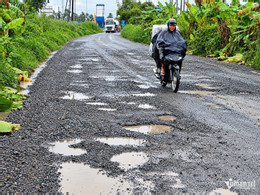
Ms. Trương Thúy Hồng Thấm, a resident of Thới Bình Commune who works professionally in Biển Bạch Commune, expressed the daily psychological toll of traveling the route. "Being on the road means you must constantly stare downward to dodge potholes," Ms. Thấm shared. "There are sections where you are driving normally, and suddenly a deep void appears directly in front of you. Wanting to avoid it is exceptionally difficult because larger vehicles, such as trucks and commercial transport, flank you on either side."
Mr. Lâm Văn Khởi, another regular commuter from Thới Bình Commune, noted that travel times have increased dramatically due to the necessary caution required to navigate the route. A journey that once took roughly forty minutes now routinely stretches to nearly an hour and a half. "These potholes sit right in the middle of the road. If you drive too fast or if you lack confidence in handling a motorcycle, you are almost guaranteed to crash," Mr. Khởi warned.
Beyond the immediate physical dangers faced by motorcyclists, the widespread infrastructural decay has disrupted the broader transport network. Commercial vehicles, agricultural freight trucks, and public transport buses are forced to constantly alter their trajectories, swerve into opposing lanes, and drastically reduce their operating speeds. This chronic slowdown impairs supply chains, delays the transport of perishable farm produce, and increases vehicular wear and tear for commercial operators.

The situation is particularly perilous for students. Near educational facilities such as the Tân Bằng Secondary and High School, the road surface has degraded to a degree that poses a direct threat to children walking or cycling to classes, elevating public anxiety regarding pedestrian safety.
Local Authorities Respond Amid Mounting Pressure
Faced with mounting public outcry and a rapidly escalating risk to public safety, local administrative bodies have begun pushing for official intervention. Leadership from the People’s Committee of Thới Bình Commune acknowledged that the stretch of the Southern Coastal Corridor within their jurisdiction has suffered from severe peeling, surface rutting, and structural failure, profoundly impacting the daily lives of local citizens.
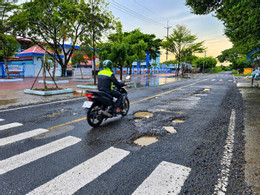
Similarly, officials in Biển Bạch Commune confirmed that recent adverse weather patterns, including heavy seasonal rains, have accelerated the degradation of the roadway. The local government has recorded a spike in single-vehicle accidents caused by drivers losing control over damaged patches.
In response to the crisis, the People’s Committee of Biển Bạch Commune has officially issued formal dispatches to higher-level transportation authorities and relevant management agencies. The local administration has strongly urged immediate field inspections and the deployment of comprehensive remedial action plans to patch critical craters, resurface damaged segments, and restore baseline safety standards along the route.
Broader Implications for Mekong Delta Infrastructure
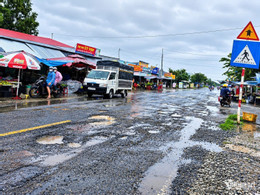
The deterioration of the Southern Coastal Corridor highlights persistent challenges regarding infrastructure maintenance and the rapid wear induced by heavy commercial traffic associated with major construction projects, such as regional expressway developments. Heavy transport vehicles carrying construction materials have frequently overloaded secondary feeder roads, accelerating structural fatigue far beyond standard design projections.
Transport analysts note that without immediate, large-scale rehabilitation rather than temporary patching, the corridor will continue to deteriorate, threatening both regional economic integration and human safety. As local communities await concrete action from provincial departments and transport ministries, the Xuyên Á Road remains a stark reminder of the delicate balance between rapid regional development and the long-term maintenance required to sustain it.