Phó bí thư Thành ủy TP.HCM Nguyễn Phước Lộc: Nâng cao năng lực trạm y tế để chăm sóc người dân gần nhà


Ho Chi Minh City is accelerating its strategic healthcare initiatives, focusing heavily on bridging the gap between major medical institutions and grassroots health facilities. On the afternoon of September 28, a high-level working session convened between Ho Chi Minh City’s leadership and the municipal Department of Health to review the ongoing integration program connecting hospitals with local medical stations for the 2026–2030 period. Presiding over the meeting was Mr. Nguyễn Phước Lộc, Member of the Party Central Committee, Deputy Secretary of the City Party Committee, and Chairman of the Vietnam Fatherland Front Committee of Ho Chi Minh City.
The core objective of the meeting was to evaluate the preliminary success and chart the future roadmap of the city’s sweeping primary healthcare reform. This reform aims to elevate grassroots healthcare capacity, ensuring that every resident can access quality, continuous, and comprehensive medical services within their immediate neighborhood, thereby reducing the burden on overcrowded upper-tier hospitals.
Bridging the Geographical Divide and Administrative Bottlenecks
During the working session, Mr. Nguyễn Phước Lộc commended the Department of Health for its proactive approach in operationalizing key directives from the Municipal Party Committee’s Standing Board. Specifically, the department has worked swiftly to implement Resolution 72 and various resolutions passed by the Ho Chi Minh City People’s Council concerning breakthrough solutions for public health protection, care, and improvement.
City leadership emphasized that geographical distance and administrative hurdles should never act as barriers preventing citizens from accessing essential medical care. While advanced tertiary hospitals in Ho Chi Minh City possess world-class capabilities, the average citizen often faces logistical challenges, long commutes, and complicated procedures for routine check-ups or chronic disease management.
To resolve this structural inefficiency, the city’s new healthcare paradigm pivots toward proactive community-based care. The overarching vision is to ensure that medical services delivered at the grassroots level are fast, localized, superior in quality, and continuous. However, city leaders issued a stern reminder that decentralization must not compromise the integrity of patient data or clinical accuracy. The model requires seamless, uninterrupted data flow between general hospitals, specialized medical centers, and local healthcare stations, underpinned by comprehensive health tracking mechanisms for the entire population.
The Two-Way Connection Model: Hand-Holding, Not Replacement
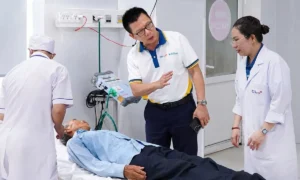
A critical operational principle highlighted by the Deputy Secretary of the City Party Committee is the distinction between collaboration and substitution. When major hospitals establish partnerships with local health stations, they must avoid merely replacing the local staff’s daily responsibilities. Instead, the model relies on a "hand-holding" approach—transferring professional expertise, standardizing procedures, and mentoring local staff while preserving the independent function and identity of the grassroots station.
"Support activities must aim to expand capacity, manage a higher volume of patients, and—crucially—maintain that elevated operational capacity long after the formal support program concludes," Mr. Lộc stated. He stressed that when a specialized hospital eventually withdraws its direct support team from a local station, the resident staff must possess the reinforced professional capabilities to independently sustain and build upon the transferred skills.

To ensure accountability, the Department of Health has been instructed to establish clear processes, performance criteria, specific duties, and measurable outcomes for each support program. Traditional evaluation metrics—such as counting the number of visiting physicians or training seminars held—are no longer considered sufficient. Instead, success must be measured by tangible improvements in the professional competence of local station staff, the expanded capacity to manage chronic illnesses, local patient retention rates, and the satisfaction levels of both healthcare workers and the public.
Comprehensive Network Architecture and Multi-Tiered Support
According to reports presented by the Ho Chi Minh City Department of Health, the integration initiative marks a paradigm shift from a traditional one-way support framework to a dynamic, two-way connection model. Under this updated architecture, when a patient’s medical needs exceed the diagnostic or therapeutic capabilities of a local station, they are seamlessly transferred to a higher-level hospital. Once stabilized, the patient is safely referred back to their local community health station for ongoing monitoring and long-term health management.
The quantitative scope of this deployment is substantial. Currently, all 168 communes, wards, and special zones across Ho Chi Minh City have been paired with a designated "companion" hospital. A total of 41 general hospitals and regional health centers are participating in the initiative, with each unit taking responsibility for between one and eight local medical stations based on localized healthcare demand and infrastructural capacity.
Furthermore, 14 specialized hospital groups have been mobilized to provide targeted, high-level professional training and technical support to frontline facilities. Rather than waiting for local stations to request assistance, these specialized hospitals take the initiative to formulate essential clinical packages. These packages equip local physicians and nurses with the diagnostic tools and mental frameworks necessary to identify early warning signs, handle emergencies within their legal scope of practice, and execute timely, safe referrals.
Workforce Rotation and the Five-Doctor Benchmark
A persistent challenge for grassroots healthcare in Vietnam has been the shortage of resident physicians willing to commit to long-term work at commune-level medical stations. To combat this, the city’s program enforces a mandatory workforce rotation policy, sending qualified medical personnel from major hospitals to local stations on a rotating basis.
The immediate programmatic milestone is to ensure that every community health station across Ho Chi Minh City achieves a minimum staffing threshold of at least five doctors. However, city leadership reiterates that rotation is not merely a numbers game designed to pad staffing rosters on paper. The true metric of success lies in hands-on clinical training, the active transfer of specialized techniques, the drafting of standard operating procedures, and the day-to-day elevation of practical competence among permanent station staff.
Broader Implications and Future Outlook
The strategic push to empower grassroots healthcare in Ho Chi Minh City reflects a broader national imperative within Vietnam’s healthcare reform agenda. As urban populations expand and chronic non-communicable diseases—such as hypertension, diabetes, and cardiovascular conditions—rise alongside an aging demographic, relying solely on centralized tertiary hospitals is economically and logistically unsustainable.
By channeling resources, medical talent, and technological infrastructure down to the commune and ward levels, Ho Chi Minh City is establishing a resilient, preventive-first health architecture. The ultimate success of the 2026–2030 program will be judged not by the volume of infrastructure built, but by how seamlessly a resident can walk into a neighborhood health station and receive continuous, high-quality care close to home.