Ho Chi Minh City’s livestock sector is undergoing a profound structural transformation, driven by the urgent need to cut production costs, enhance biosecurity, and meet modern environmental standards. On September 29, industry experts, agricultural policymakers, and corporate leaders from both Vietnam and Denmark converged for a high-level seminar titled Smart Production, Sustainable Future: Danish Technology for Vietnam’s Agriculture and Food Industry. The discussions centered on pressing challenges within Vietnam’s livestock value chain, notably the stiff competition posed by cheap imported meat and the heavy financial burden of feed expenses.
The economic pressure on domestic livestock producers has intensified significantly throughout 2026. Official market assessments reveal that imported fresh, chilled, and frozen pork has flooded the Vietnamese market at an average price of approximately 43,000 Vietnamese Dong (VND) per kilogram during the first seven months of the year. In stark contrast, domestic live hog prices have fluctuated between 55,000 and 59,000 VND per kilogram over the same period. This stark price differential has placed local farmers under intense margin compression, compelling industry stakeholders to seek immediate technological interventions to optimize production efficiency and reduce overhead expenses.
The Scale of Livestock Production in Ho Chi Minh City
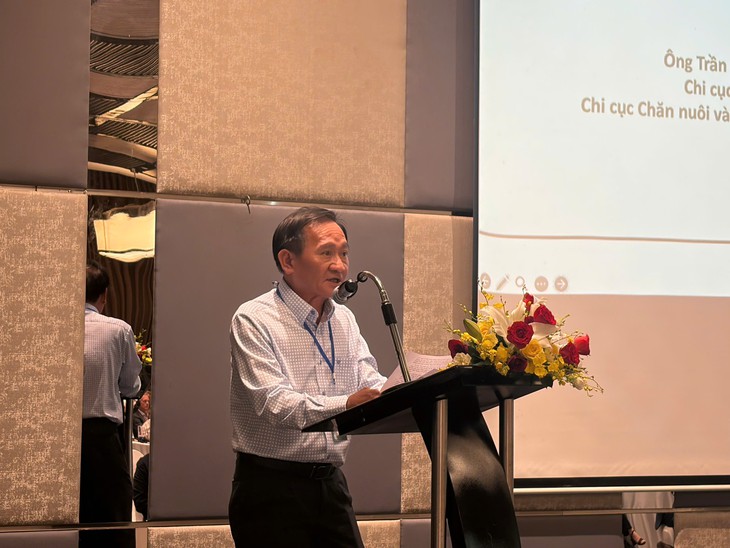
Addressing the seminar, Mr. Tran Phu Cuong, Head of the Ho Chi Minh City Sub-Department of Livestock Production and Veterinary Medicine, provided a comprehensive overview of the city’s agricultural landscape. With a sprawling population of approximately 14 million residents, Ho Chi Minh City’s localized fresh meat production currently satisfies only about 50 percent of total consumer demand. The remaining half of the metropolis’s meat supply must be regularly procured from neighboring provinces and external regions.
Current municipal inventories reflect a vast animal husbandry network, comprising over 21 million poultry birds, roughly 1.3 million pigs, and nearly 100,000 cattle and buffaloes, which includes a dairy herd of approximately 36,000 cows. To ensure public health and food safety, municipal authorities rigorously monitor 80 licensed slaughterhouses across the city. On a daily basis, these facilities process and supply the market with more than 9,000 pigs, approximately 140,000 poultry birds, and between 120 and 125 cattle.
According to Mr. Cuong, maintaining a stable food supply in a densely populated urban center requires seamless coordination across every segment of the supply chain, encompassing breeding, slaughtering, processing, and distribution. In response to competitive market pressures and environmental regulations, the city’s livestock sector is systematically pivoting away from fragmented backyard farming toward large-scale, high-technology farm models. Advanced technology-driven husbandry currently accounts for roughly 70 percent of the city’s total poultry production and 78 percent of its total pig production. However, the remaining share continues to rely on traditional, smallholder practices. To elevate biosecurity standards and curb environmental degradation, municipal authorities have implemented policies designed to gradually phase out small-scale farming while proactively supporting the establishment and expansion of high-tech agricultural enterprises. The central focus remains on shifting the structural paradigm toward farm-based, high-tech, biosecure models integrated directly into circular agricultural frameworks.

Tackling the High Cost of Animal Feed
A primary obstacle facing Vietnamese livestock producers is the exorbitant cost of animal feed, which accounts for 60 to 70 percent of the total production cost for both swine and poultry. Distinguished Professor Dr. La Van Kinh, Vice Chairman of the Vietnam Animal Feed Association, emphasized that because Vietnam remains heavily dependent on imported feed ingredients, the industry must pivot toward maximizing feed efficiency rather than merely reacting to volatile global raw material prices.
One of the most promising technological solutions introduced at the seminar is precision feeding. This innovative approach involves the real-time adjustment of feed quantities and nutritional profiles to match the exact physiological requirements of livestock at various stages of growth. Dr. Kinh noted that alongside securing high-quality breeding stock and optimizing feed formulas, investing in advanced climate-control technology for barns represents a vital pathway to improving productivity and reducing per-unit production costs.
Danish Agricultural Expertise and Precision Solutions
Building upon Vietnam’s modernization goals, Mr. Mathias Sandholt Knauf, representing the Danish Agriculture and Food Council, highlighted the vast untapped potential for applying Danish agricultural technology to boost Vietnamese production efficiency. Mr. Knauf observed that Vietnam’s rapid economic development has generated a corresponding surge in consumer demand for food safety, animal welfare, environmental protection, and green technological solutions—sectors in which Danish enterprises hold globally recognized expertise.
Echoing this sentiment, Mr. Lasse Pedersen Hjortshøj, Head of Trade and Investment at the Embassy of Denmark, pointed out that superior indoor climate control within housing facilities is essential for mitigating animal stress and reducing disease mortality, which in turn optimizes overall operational productivity. Modern ventilation systems and precise temperature regulators create optimal living conditions for livestock. Furthermore, Danish firms are introducing advanced biological solutions, feed additives, and data-driven precision farming equipment. These specialized devices continuously monitor livestock health and dispense precise quantities of feed in real-time, effectively eliminating waste and lowering environmental footprints.
The Evolution of Bilateral Agricultural Cooperation
The partnership between Vietnam and Denmark in food safety and agricultural technology is deeply rooted. Following the seminar, the visiting Danish business delegation embarked on field inspections across several key agricultural hubs, touring modern swine farms, dairy operations, and veterinary processing facilities to better understand localized production challenges and identify concrete avenues for commercial collaboration.
Vietnam and Denmark formally established a strategic sector cooperation agreement in food safety starting in 2017. Under this bilateral framework, the Danish Veterinary and Food Administration has consistently provided high-level technical assistance and capacity-building support to relevant Vietnamese regulatory bodies. This ongoing cooperation aims to harmonize regulatory standards, bolster biosecurity protocols, and facilitate the transfer of sustainable agricultural technologies.
Broader Implications for Vietnam’s Agricultural Economy
The collaborative dialogue between Vietnamese policymakers and Danish agricultural experts underscores a critical turning point for Vietnam’s livestock sector. As consumer expectations shift toward premium, traceable, and responsibly sourced food products, traditional farming models are increasingly economically and environmentally unviable. By embracing precision agriculture, improving feed utilization efficiency, and adopting circular economy frameworks, Vietnamese producers can effectively neutralize the cost advantages currently enjoyed by foreign meat importers.
Ultimately, the transition toward high-tech, biosecure, and environmentally sustainable livestock production will safeguard national food security, protect public health, and elevate the global competitiveness of Vietnam’s agricultural economy. Through continued strategic partnerships with technological leaders like Denmark, Vietnam is well-positioned to construct a resilient, modern, and sustainable agricultural future.
Related posts: