Navigating the Digital Frontier: Vietnam’s Data-Driven Business Evolution and the SME Imperative


The landscape of corporate governance and operational management in Vietnam is undergoing a fundamental transformation, propelled by a national shift toward a data-driven economy. During a specialized seminar focusing on enterprise management and operations held on May 29, industry leaders, technology experts, and government officials convened to dissect the core challenges and strategic imperatives facing Vietnamese businesses. The discourse highlighted a critical reality: while national strategies are laying the groundwork for a robust digital infrastructure, small and medium-sized enterprises (SMEs)—which form the backbone of the country’s economy—continue to face significant hurdles in operationalizing data effectively.
The National Blueprint: Data as the New Economic Resource
The discussions on May 29 were deeply anchored in the broader context of Vietnam’s national digital agenda, which took center stage just a day prior at the Vietnam – Asia DX Summit 2024. Opening the summit on May 28, Minister of Information and Communications Nguyen Manh Hung articulated a paradigm shift in how modern development is conceptualized. According to the Minister, digital transformation fundamentally creates a new class of resource: data. For the first time in human history, development is no longer synonymous with the depletion of finite natural resources; rather, contemporary growth actively generates new, inexhaustible informational assets.
Recognizing the strategic necessity of this resource, the Vietnamese government has set its sights on positioning the nation alongside global leaders in data-driven development. Under the advisement of the Ministry of Information and Communications (MIC), Prime Minister Pham Minh Chinh approved the National Data Strategy to 2030 earlier in February 2024. This milestone strategy serves as the foundational architecture for the country’s national digital transformation, prioritizing the creation of a comprehensive data infrastructure encompassing open data, big data, structured data, and unstructured data.

At the May 29 seminar, Tran Minh Tan, Deputy Director of the MIC’s National Institute of Information and Communications Strategy (NIICS), elaborated on the core principles of this national roadmap. He emphasized that the state’s overarching philosophy is to act as a guiding force, establishing an environment where the entire population and business community can participate in data development and equitably share in its benefits.
"Data infrastructure comprising open data, big data, and structured and unstructured data will lay the foundation for digital transformation and the development of artificial intelligence applications," Tan stated. He outlined three primary strategic objectives of the national data strategy: developing public data to serve societal advancement, cultivating commercial data to foster a competitive data market, and ensuring data security while managing cross-border data flows to keep information securely anchored within Vietnam.
To execute this strategy, the MIC has issued comprehensive implementation guidelines and an action plan for ministries, sectors, and localities. A critical immediate task for local authorities and government bodies is the public release of their respective open and big data catalogs and strategic frameworks. By integrating data development objectives into annual digital transformation plans, public institutions aim to provide a transparent framework that encourages organizations, agencies, and enterprises to actively participate in data sharing and utilization.
The SME Dilemma: Navigating the Maturity Curve
While the national government builds the macroeconomic scaffolding for a digital economy, the micro-level reality for Vietnamese enterprises tells a more complex story. During the specialized seminar, corporate leaders addressed the practical challenges of transitioning from traditional management models to data-driven decision-making.

Nguyen Ngoc Ly, Director of the Business Center at MISA—a prominent digital technology corporation supporting numerous organizations through their digital transitions—delivered a frank assessment of the corporate landscape. Ly underscored that organizations capable of effectively harnessing and exploiting data can dramatically optimize their operations, enhance competitiveness, and multiply productivity, particularly when integrated with artificial intelligence (AI) processing tools.
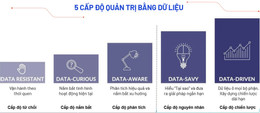
However, a stark disparity exists between the strategic ideals of data management and the operational realities on the ground. According to MISA’s internal evaluations across the five developmental tiers of data management, the vast majority of Vietnamese enterprises—particularly SMEs—remain "stuck" at level two: the foundational data-capturing phase. Many businesses have yet to unlock the deeper predictive and prescriptive potential of their accumulated data.
"Enterprises need to calculate and plan to manage and operate based on data right now, with a crucial requirement being the availability of technological solutions that support data integration," Ly advised. She noted that many businesses suffer from a fragmented approach to digitalization, where different departments adopt disparate software solutions without integration. This departmental segmentation leads to data silos, redundant manual data entry, and fragmented reporting. Furthermore, when companies outgrow entry-level software, migrating historical data to comprehensive enterprise resource planning (ERP) systems often proves technically arduous and financially prohibitive for smaller firms.
Three Core Challenges in Data-Driven Operations
MISA’s analysis identified three primary bottlenecks that hinder SMEs from successfully operating in a data-driven environment: application risks, data interoperability issues, and high implementation costs.

- Application and Operational Risks: Many businesses implement piecemeal software solutions that fail to scale with organizational growth. Without a unified architecture, operational continuity is frequently disrupted during software transitions or expansions.
- Data Fragmentation and Interoperability Barriers: The tendency of individual departments to procure isolated tools creates data silos. Information must often be manually re-entered across systems, increasing the margin for human error and preventing leadership from accessing a unified, real-time organizational overview.
- Prohibitive Financial and Resource Barriers: Comprehensive ERP solutions capable of unifying enterprise data have traditionally been associated with high implementation costs and complex configurations, placing them out of reach for many smaller businesses operating on tight budgets.
Addressing these structural barriers requires a deliberate strategy of comprehensive digital investment, targeted workforce upskilling, and a fundamental shift in executive mindset. Industry experts emphasize that SMEs cannot afford to delay their data strategies until they reach a large scale; establishing structured data practices from inception significantly lowers long-term operational costs compared to retrofitting legacy systems at a later stage of growth.
Technological Ecosystems and the Path Forward
To bridge the gap between national data ambitions and corporate operational realities, technology providers are increasingly focusing on integrated ecosystem models. Solutions such as MISA’s unified management platforms are designed to consolidate core business operations—ranging from finance and accounting to human resources and customer relationship management—onto a single system. By aggregating data across these domains, such platforms generate multi-dimensional, visual reports that provide enterprise leaders with a holistic organizational picture to guide strategic decision-making and optimize operational workflows.
Moreover, the integration of advanced conversational AI agents—such as specialized business assistants embedded within enterprise software ecosystems—represents a growing trend aimed at lowering the technical barrier to data analysis. By enabling natural language queries for business metrics, AI-driven tools allow managers and executives to extract insights without requiring deep technical expertise in data science.
Broader Economic Implications
The convergence of Vietnam’s National Data Strategy to 2030 and the organic digital evolution of the corporate sector holds profound implications for the national economy. As government agencies systematically open public data catalogs and establish secure, cross-border data governance frameworks, the private sector is expected to find fertile ground for innovation.
For Vietnam to achieve its overarching ambition of joining the global frontrunners in digital and green transformations, the digital maturation of its SME sector is paramount. Bridging the gap between macro-level policy and micro-level execution requires continued collaboration between regulatory bodies, technology developers, and business associations. By fostering an environment where data is treated not merely as a byproduct of business activity, but as a core operational asset from day one, Vietnamese enterprises can secure sustainable productivity gains and enhance their resilience in an increasingly competitive global marketplace.