Navigating the Digital Frontier: Vietnam’s National Data Strategy and the Imperative of Data-Driven Governance for Small and Medium Enterprises


As Vietnam accelerates its comprehensive digital transformation, the country stands at a pivotal juncture where data is no longer merely a byproduct of business operations, but the primary economic resource driving future growth. During the Vietnam – Asia DX Summit 2024, held in late May, high-ranking government officials, technology leaders, and enterprise representatives converged to discuss the overarching theme of modern management: transitioning toward data-driven governance. Within this broader national framework, the spotlight has increasingly turned toward Small and Medium Enterprises (SMEs), which form the backbone of Vietnam’s economy yet face distinct structural hurdles in harnessing the true potential of digital data.
The discussions at the summit underscored a profound paradigm shift. For the first time in modern economic history, humanity is actively creating new resources rather than merely depleting existing ones. This foundational philosophy underpins the National Data Strategy to 2030, an ambitious roadmap designed to reshape Vietnam’s digital infrastructure, foster a robust digital economy, and elevate local enterprises onto the global stage.
The Genesis of the National Data Strategy: A Macro-Level Vision
The foundation for Vietnam’s data-centric trajectory was formally laid in early February 2024, when the Prime Minister approved the National Data Strategy to 2030, following extensive preparations and advisories led by the Ministry of Information and Communications (MIC). Speaking at the specialized session titled Governance and Effective Enterprise Operations, Organized Based on Data on May 29, Tran Minh Tan, Deputy Director of the MIC’s Strategy Institute, detailed the core tenets of this monumental policy.

According to Tan, the strategy places data at the absolute center of socio-economic development, guiding the creation of new infrastructure platforms that support everything from conventional digital applications to advanced artificial intelligence systems. The overarching principle is clear: the State plays a guiding, directional role to encourage nationwide participation, ensuring that the benefits of the data economy are shared equitably across society.
The National Data Strategy establishes three primary macro-level objectives. First, it aims to develop public data to organize, exploit, and share information effectively for societal advancement. Second, it focuses on developing private and commercial data, establishing a vibrant data market that fuels national economic expansion. Third, it mandates rigorous data security frameworks while governing the cross-border flow of data, ensuring that critical assets remain securely anchored within Vietnam.
To translate this vision into reality, the MIC has developed a comprehensive action plan and issued clear implementation guidelines for various ministries, sectors, and local authorities. A critical priority for these government bodies is the prompt publication of open and big data inventories, alongside strategic data frameworks tailored to their respective jurisdictions. This proactive approach ensures that public, private, and organizational entities can seamlessly participate in data sharing, exploitation, and collaborative innovation.
The Corporate Reality: SMEs at a Crossroads
While national policies establish the macroeconomic architecture for a data-driven society, individual enterprises must adapt their operational models to survive and thrive in a hyper-competitive landscape. At the same summit, Nguyen Ngoc Ly, Director of the MISA Business Center, offered a sharp, ground-level assessment of how Vietnamese enterprises—particularly SMEs—are currently managing their digital information.

Ly emphasized that organizations capable of capturing, analyzing, and exploiting data effectively can dramatically streamline their operations, enhance their competitive positioning, and multiply their productivity. This advantage is exponentially amplified when artificial intelligence is integrated into data processing workflows. However, a significant gap remains between strategic vision and daily execution.
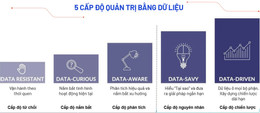
According to MISA’s operational metrics, enterprise data maturity can be categorized across five distinct levels, ranging from basic data collection to advanced, predictive, and autonomous analytics. Unfortunately, the vast majority of Vietnamese SMEs remain "trapped" at the second level—primarily focused on basic data capture—failing to unlock the deeper diagnostic, predictive, and prescriptive potential of their information assets. Overcoming this barrier requires a comprehensive investment in digital transformation, targeted workforce training, and a fundamental evolution in management mindset.
The Triple Challenge: Friction, Fragmentation, and Financial Barriers
During her presentation, Ly outlined three core challenges that persistently hinder SMEs from successfully transitioning to data-driven operations: application fragmentation, integration friction, and high operational costs.
In many growing businesses, different departments independently adopt disparate software solutions without centralized oversight. This departmental silos approach creates severe integration bottlenecks, forcing staff to manually re-enter data across platforms and resulting in fragmented, unreliable datasets. Furthermore, point solutions chosen to address immediate challenges during early growth stages often lack scalability, making future data integration exceedingly difficult.

Compounding these structural issues is the high cost barrier associated with comprehensive Enterprise Resource Planning (ERP) systems. Traditional ERP solutions are frequently priced out of reach for smaller enterprises, or they come bloated with complex features that smaller teams cannot effectively utilize. Consequently, many SMEs operate in a state of operational risk, characterized by disconnected information streams and limited visibility into real-time business performance.
To address these hurdles, technology providers have increasingly focused on integrated ecosystem models. Solutions such as the MISA AMIS platform have been deployed across more than 250,000 enterprises and 25,000 business households in Vietnam, spanning diverse industries and operational scales. By unifying core management disciplines—such as accounting, human resources, customer relationship management, and sales—onto a single shared system, such platforms provide leadership teams with multidimensional, real-time dashboards. These unified views enable strategic decision-making and operational optimization without the friction of fragmented data silos. Furthermore, the integration of specialized artificial intelligence assistants, like MISA AVA, allows organizations to automate routine tasks and extract actionable business insights with unprecedented efficiency.
Early Adoption vs. Delayed Implementation: The Cost of Waiting
A recurring theme among industry experts at the Vietnam – Asia DX Summit 2024 was the economic advantage of early architectural planning. Ly strongly advised emerging businesses to design and organize their data architectures from inception, noting that establishing data governance frameworks during a company’s foundational phase is exponentially cheaper than attempting a retroactive overhaul once the organization has scaled.
When a company delays digital integration until it reaches a large corporate scale, the restructuring of legacy databases, retraining of personnel, and remediation of fragmented historical data involve massive capital outlays and operational disruptions. Conversely, businesses that bake data governance into their operational DNA from day one can scale smoothly, adapting rapidly to market shifts and regulatory changes.
Broader Implications for Vietnam’s Digital Economy
The convergence of government-led data strategies and private-sector digital tools signals a mature phase in Vietnam’s digital evolution. The National Data Strategy to 2030 is not merely an administrative exercise; it is an industrial policy designed to create high-value employment, foster indigenous technology sectors, and secure the nation’s economic sovereignty in an increasingly interconnected global market.
However, the ultimate success of this macroeconomic vision depends on the grassroots adaptability of the SME community, which generates a substantial share of national employment and GDP. If Vietnamese SMEs can successfully transition past basic data collection into advanced analytics and AI-driven management, the collective productivity gains will significantly reinforce Vietnam’s ambitions to join the front ranks of digitally advanced nations.
As government ministries continue to refine open data catalogs and establish cross-border data protection guardrails, and as technology firms expand access to modular, cost-effective digital ecosystems, the pathway forward is becoming increasingly well-defined. For Vietnamese enterprises, the message from the 2024 summit is unequivocal: data-driven governance is no longer an optional luxury for multinational corporations, but an operational necessity for businesses of all sizes striving to secure their place in the future economy.