France is currently grappling with one of its most significant waves of civil unrest in recent memory as over 800,000 citizens took to the streets on October 24 to protest against the soaring cost of living and mounting economic instability. The demonstrations, which spanned from the capital, Paris, to regional hubs like Lyon, Nantes, and Marseille, underscore a deepening divide between the administration of President Emmanuel Macron and a significant portion of the French public frustrated by inflation, particularly in energy and fuel costs.
While the government reported a turnout of approximately 410,000, labor unions and organizers—including the AFP—placed the figure at roughly 800,000, marking a substantial increase from the previous week’s mobilization. The protests, driven by a coalition of labor groups and political factions, have evolved from isolated grievances into a broader movement challenging the current economic trajectory of the nation.
A Chronology of Escalation
The current unrest did not emerge in a vacuum. The roots of the discontent can be traced back to the onset of the Middle East conflict in February, which triggered a global surge in fuel prices. As France, like much of Europe, faced the dual pressures of supply chain disruptions and volatile energy markets, the household budget for the average French family began to tighten significantly.
By mid-October, localized protests began to coalesce into a national movement. On October 17, the country witnessed severe rioting in several cities, which resulted in widespread property damage, looting of approximately 3,000 businesses, and financial losses estimated in the hundreds of millions of euros. That initial violent outburst set the stage for the massive mobilization seen on October 24.
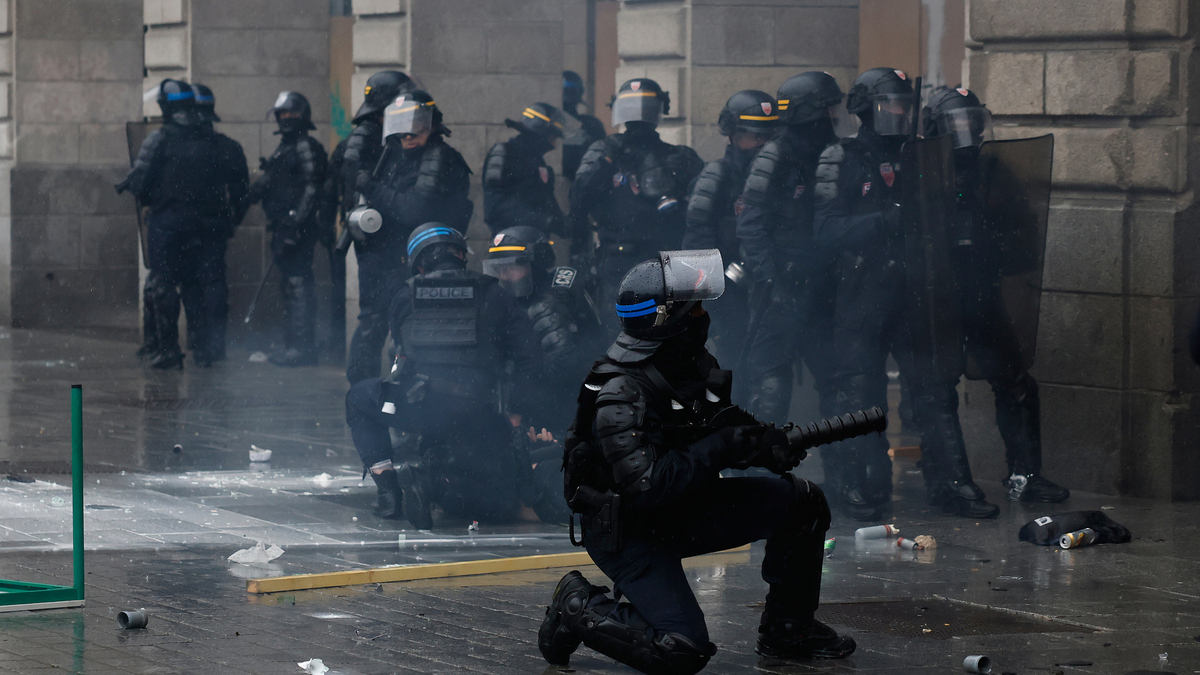
Throughout the week leading up to the 24th, the government attempted to mitigate the risk of further violence. By the time the protests commenced on the morning of October 24, a heavy security presence was already established. Over 70,000 police officers and gendarmes were deployed nationwide—an increase of more than 10,000 compared to the October 17 mobilization—signaling the state’s determination to prevent a repeat of the previous week’s chaos.
The Dynamics of the October 24 Protests
The atmosphere in Paris remained tense throughout the day. Authorities preemptively redirected protest routes, pushing demonstrators away from the city’s historic center and toward the southeastern districts. This strategy aimed to protect high-value commercial zones that had been targeted during earlier protests. Despite these precautions, the tension remained palpable.
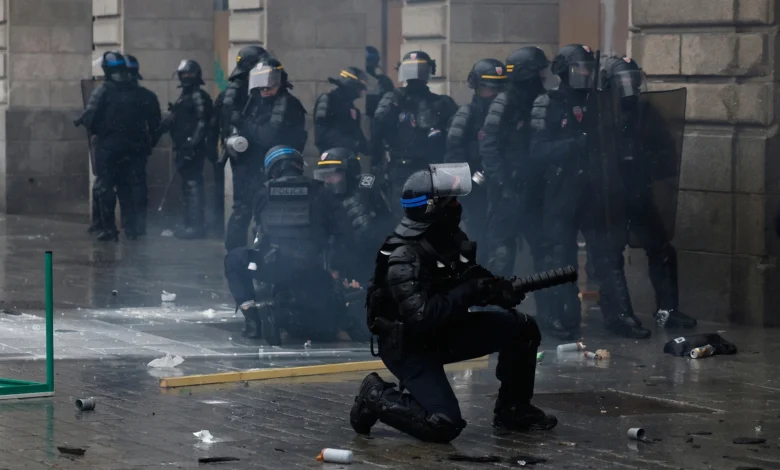
In Paris, the police reported approximately 110,000 participants, while organizers insisted the number was closer to 250,000. While the day was marked by less widespread destruction than the events of the previous week, isolated clashes were still recorded. Authorities confirmed that 65 individuals were arrested in Paris, with a total of 135 arrests recorded nationwide by late afternoon.
The police seized a troubling array of items from protesters, including fireworks, rubber slingshots, metal ball bearings, improvised weapons, katana swords, and non-lethal projectile launchers. The presence of such items suggests that, while the majority of the marchers were peaceful, there were organized elements within the crowd intent on provoking law enforcement or engaging in destruction.
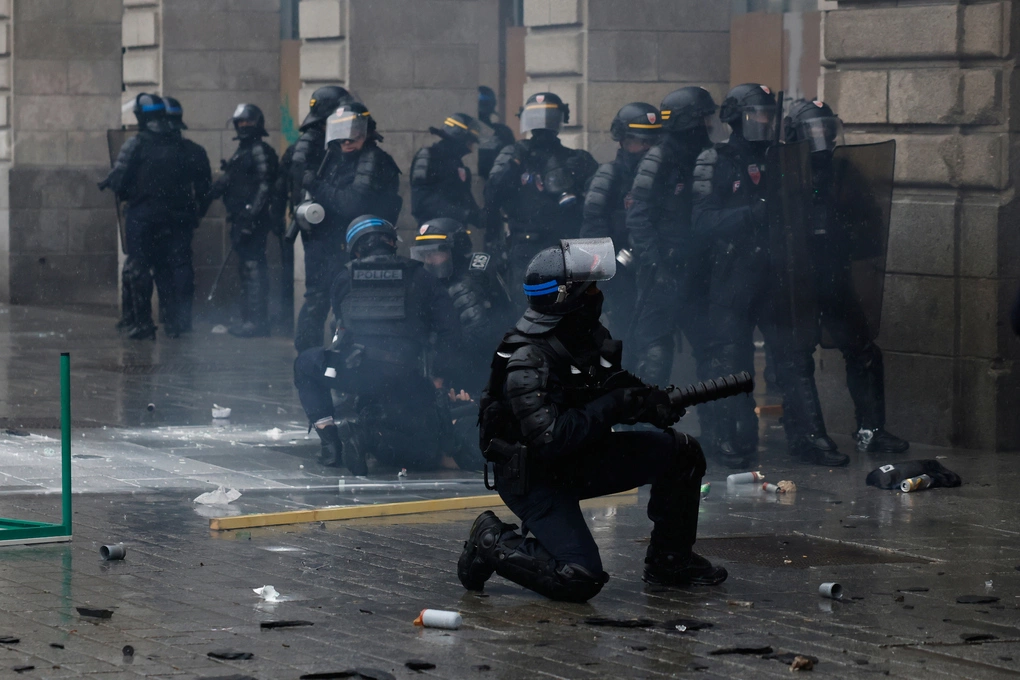
In Nantes, the situation escalated when thousands of protesters breached police barriers to enter the city center. Law enforcement responded with tear gas and water cannons to disperse the crowd, who retaliated by throwing debris and firing fireworks at the police lines. Similar tactical responses were required in Lyon and Marseille, where groups of masked youth engaged in skirmishes with security forces.
Official Response and Security Measures
The French Ministry of the Interior, led by Minister Laurent Nunez, has adopted a zero-tolerance policy toward violence. Following the day’s events, the government reiterated that any acts of vandalism or civil disruption would be prosecuted to the full extent of the law.
To maintain order, the government implemented strict security protocols. In central Paris, several metro stations were closed, and major retailers boarded up their storefronts to prevent looting. Prestigious cultural institutions, including the Louvre, the Orsay Museum, the Picasso Museum, and the Grand Palais, were forced to close their doors to the public. Furthermore, in several sensitive areas, authorities imposed curfews effective through October 26 to stabilize the environment.
These measures, however, have faced criticism from labor unions and civil rights groups. They argue that the government’s restrictions on protest routes and the heavy police presence constitute an infringement on the right to free expression and peaceful assembly. "The government is trying to silence the voices of the people by framing every grievance as a security threat," said one union representative.
Economic Context and Political Implications
The primary driver of this unrest is the relentless inflation that has eroded the purchasing power of the French working and middle classes. The cost of living crisis, exacerbated by energy price hikes, has left many households struggling to meet basic needs.
Politically, the situation is precarious for President Emmanuel Macron. Jean-Luc Mélenchon, a prominent left-wing leader, has been a vocal participant in the marches. He has declared that these demonstrations will become a weekly occurrence until the government addresses the underlying socio-economic grievances. The political opposition is increasingly capitalizing on the perception that the government is disconnected from the realities faced by ordinary citizens.

The implications for the French economy are significant. Beyond the immediate costs of property damage and the expense of deploying massive security forces, the unrest creates an environment of uncertainty that can deter investment and hamper tourism—a vital sector of the French economy. The closures of world-renowned museums and the general perception of instability risk causing long-term damage to the country’s international reputation.
Looking Ahead: The Path Forward
The French government now faces a delicate balancing act. On one hand, it must maintain law and order to ensure public safety and protect private property. On the other, it must find a way to engage with the legitimate economic concerns of its citizens before the situation spirals into a systemic political crisis.
Analysts suggest that without significant policy shifts—such as targeted subsidies, tax relief, or a comprehensive review of energy pricing—the protests are unlikely to subside. The movement has shown a high degree of resilience, with numbers increasing rather than decreasing despite the risk of arrest and the government’s aggressive security stance.
As France looks toward the coming weeks, the nation stands at a crossroads. The ability of the Macron administration to bridge the gap between its fiscal policies and the immediate needs of the populace will determine whether this period of unrest remains a temporary phenomenon or signals a fundamental shift in the French political and social landscape. The eyes of Europe are now on Paris, watching to see how a major Western democracy navigates the volatile intersection of economic hardship and public dissent.