MB Pioneers End-to-End Digital Signatures in Lending: From Hundreds of Physical Pages to a Single Tap

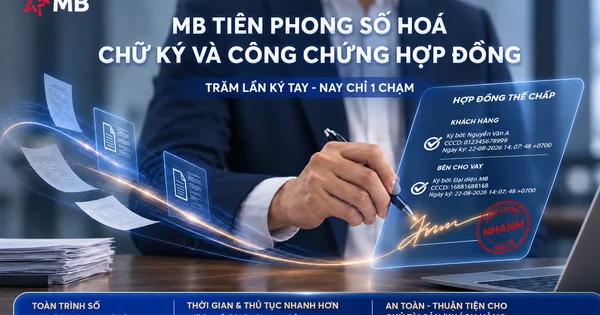
Military Commercial Joint Stock Bank (MB) has officially introduced a comprehensive digital signature framework spanning its entire credit lifecycle. This major technological overhaul is designed to eliminate tedious manual paperwork, streamline complex administrative procedures, and fundamentally reshape how both individual retail borrowers and corporate entities interact with the bank. By introducing seamless digital verification and pioneering the integration of electronic notarization with collateral registration on a unified digital platform, MB has dramatically minimized physical touchpoints, optimized turnaround times, and reduced operational overhead.
The initiative marks a significant milestone in Vietnam’s banking sector, bridging internal institutional processes with external legal and administrative frameworks to create a friction-free credit journey.
Reinventing the Loan Lifecycle: Eliminating Redundant Paperwork
Historically, securing a secured loan—particularly one backed by real estate or valuable assets—required borrowers to wade through mountains of paperwork. A single credit dossier typically demanded loan application forms, detailed credit agreements, mortgage contracts, and numerous accompanying annexes. Under legacy procedures, a standard borrowing process could easily accumulate nearly 100 distinct instances of physical signatures and initials distributed across dozens of pages. This cumbersome requirement created immense administrative friction, necessitating continuous physical printing, manual delivery, and complex document coordination between multiple internal departments and external stakeholders.
MB’s newly deployed digital solution fundamentally redefines this experience. Borrowers can now review, authenticate, and digitally sign all qualifying credit documents within a secure electronic environment, effectively replacing repetitive manual signing tasks. Once authenticated, the digital files are processed and routed entirely through internal digital workflows, drastically reducing the reliance on physical paper. According to bank metrics, the entire process of finalizing digital signatures for customers alongside a public notary can now be completed in under three minutes.
This modernization significantly accelerates processing speeds, compresses document review timelines, and shortens the physical transit of files between bank departments. Consequently, customers experience a much faster path to capital access, removing traditional bottlenecks that have long hampered commercial and retail lending operations.
Pioneering Electronic Notarization and Remote Collateral Registration

Beyond digitizing internal credit documentation, MB has successfully expanded its technological infrastructure to encompass external legal procedures, specifically electronic notarization and the registration of security measures. These steps have traditionally demanded extensive face-to-face interactions and the physical transport of legal documents.
The breakthrough gained rapid momentum following regulatory updates in municipal governance. On April 16, 2026, just two weeks after Hanoi issued formal guidelines authorizing the reception of electronic notarization documents within administrative procedures, MB successfully processed its first electronic notarization for a mortgage agreement tied to a bank loan.
Building on this initial milestone, MB swiftly expanded electronic notarization coupled with digital security registration across Hanoi and Ho Chi Minh City. Current operational data from MB indicates that 100% of its partner notary offices across these two major metropolitan areas have adopted electronic mortgage agreements via direct or online formats.
The introduction of online notarization has effectively dissolved geographical boundaries, allowing participants in mortgage transactions to execute procedures even when located in different cities. For instance, consider a married couple co-owning real estate in Hanoi, while the husband is temporarily stationed for work in Ho Chi Minh City. Rather than requiring the husband to book a flight back to Hanoi simply to sign a mortgage contract, both parties can now visit their respective local notary offices, connect online, and execute the transaction simultaneously. Notary publics at both ends verify, authenticate, and witness the signing in strict compliance with legal frameworks.
This interconnected digital journey eliminates physical friction points, significantly reducing transit times, travel expenses, and logistical hurdles for borrowers.
Driving Digital Transformation Across the Banking Ecosystem
The shift toward total digitization reflects a broader industry trend where forward-thinking financial institutions look beyond basic mobile banking applications to reshape complex ecosystems. Routine banking tasks—such as checking account balances, transferring funds, or paying utility bills—have long been migrated to digital channels. However, complex transactions involving multi-party coordination, such as lending, collateral pledging, and legal notarization, have traditionally remained anchored to physical paperwork.
MB’s implementation of an end-to-end digital lending journey addresses this gap by aligning internal bank workflows with external legal partners, notary offices, and state administrative agencies. This interconnected approach generates tangible operational synergies for all participating stakeholders:

- Borrowers benefit from drastically reduced time commitments, lower administrative expenses, and minimal physical paperwork.
- Notating and legal professionals gain standardized digital data pipelines that streamline identity verification, document validation, and electronic processing.
- State administrative agencies experience increased efficiency in receiving, sharing, and processing public data.
- MB optimizes operational efficiency, boosts workforce productivity, and elevates customer service quality by standardizing risk control and credit assessment procedures.
By moving away from isolated internal digital upgrades toward an integrated ecosystem approach, MB demonstrates how modern financial institutions can scale digital transformation to encompass broader societal and regulatory frameworks.
Strategic Alignment with National Digital Transformation Goals
MB currently serves nearly 40 million customers, with over 99% of all banking transactions conducted smoothly through digital channels. Powered by its core digital flagships—the App MBBank for retail users and BIZ MBBank for corporate clients—the bank continues to push the boundaries of digital capability, gradually moving from simple daily transactions to complex, multi-party financial operations.
This strategic expansion aligns directly with the directives outlined in Resolution 57-NQ/TW issued by the Politburo, which emphasizes the national imperative to accelerate science, technology, innovation, and comprehensive digital transformation across the economy.
Leadership at MB has repeatedly emphasized that true digital transformation extends far beyond simply offering mobile banking interfaces. It requires the deep integration of banking procedures with external operational ecosystems to deliver tangible benefits to end-users. By streamlining credit workflows and minimizing administrative barriers, MB aims to reduce operating costs while establishing a new benchmark for customer experience in Vietnam’s banking sector.
As the financial landscape continues to evolve, MB plans to deepen its strategic partnerships with regulatory bodies, technology providers, and legal institutions. The ultimate objective is to make credit acquisition as seamless, transparent, and secure as possible, reinforcing the bank’s position as a technological pioneer within Vietnam’s dynamic financial ecosystem.