Vietnam Airlines Q3 2026 Financial Report: Net Profit Plummets Nearly 77% Despite Revenue Growth Amid Middle East Geopolitical Pressures

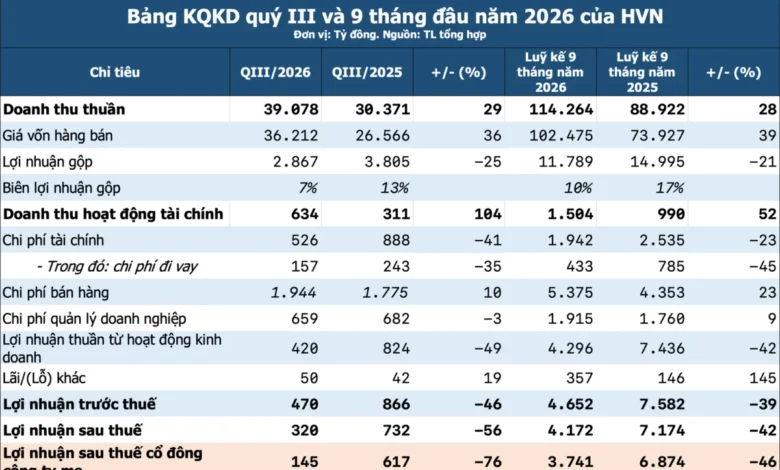
The national flag carrier of Vietnam, Vietnam Airlines Corporation (UPCoM: HVN), has released its consolidated financial statement for the third quarter of 2026, revealing a complex picture of robust top-line growth overshadowed by surging operational costs and geopolitical headwinds. While consolidated net revenue recorded a significant upward trajectory, soaring input costs—particularly jet fuel driven by escalating conflicts in the Middle East—severely compressed profit margins, causing net profit attributable to the parent company to tumble by nearly 77% compared to the same period last year.
Revenue Expansion Offset by Escalating Cost Pressures
During the third quarter of 2026, Vietnam Airlines achieved a consolidated net revenue of approximately VND 39,078 billion, representing a robust increase of nearly 29% year-on-year. This growth reflects the continued recovery and expansion of passenger and cargo transport demand across both domestic and international networks.
However, this top-line expansion was heavily counterbalanced by a steep escalation in the cost of goods sold, which spiked by nearly 36% to reach approximately VND 36,212 billion. Consequently, the airline’s gross profit experienced a contraction of nearly 25%, dropping to about VND 2,867 billion. This dynamic compressed the gross profit margin significantly, falling from 12.5% in the third quarter of 2025 down to just 7.3% in the corresponding period of 2026.
Below-the-line items presented a mixed performance. Financial income nearly doubled to reach approximately VND 634 billion, while financial expenses decreased by nearly 41% to roughly VND 526 billion. Selling expenses increased by nearly 10% to approximately VND 1,944 billion, whereas general and administrative expenses registered a modest decline of nearly 3%, settling at nearly VND 659 billion.

Overall, the consolidated net profit after tax for Vietnam Airlines dropped to approximately VND 320 billion, marking a sharp decline of nearly 56% compared to the same period in 2025. More specifically, the net profit after tax attributable to the parent company stood at roughly VND 145 billion, representing a steep drop of nearly 77%.
Chronology and Operational Performance of the Parent Company
According to the official explanations provided by Vietnam Airlines’ management, the primary driver behind the contraction in consolidated quarterly earnings was the downturn in the parent company’s standalone business results.
During the third quarter of 2026, the parent company posted a net loss after tax of VND 284 billion, a stark reversal from the net profit of VND 412 billion recorded in the third quarter of 2025. Total revenue and other income for the parent company expanded by approximately VND 3,785 billion, or roughly 15%, compared to the previous year. A deeper dive into these figures reveals that revenue from international transport services increased by nearly 27%, whereas domestic transport service revenue contracted by approximately 8%.
In sharp contrast, the parent company’s total expenses surged by approximately VND 4,482 billion, or around 18%, largely propelled by soaring cost of goods sold. Specifically, fuel expenses alone jumped by 61%, contributing an additional burden of nearly VND 4,360 billion compared to the same period last year.
Vietnam Airlines noted that its business operations throughout the second and third quarters of 2026 were severely impacted by severe volatility in global aviation fuel prices. This turbulence was principally triggered by persistent geopolitical tensions and armed conflicts in the Middle East, which sent shockwaves through international energy markets and elevated operating overheads for carriers worldwide. Because the pace of expense growth drastically outstripped revenue gains, the parent company transitioned from a profitable standing into a net-loss position, directly pulling down the group-wide consolidated profitability.

Nine-Month Financial Trajectory and Full-Year Target Implications
Despite the challenges faced in the third quarter, the cumulative performance for the first nine months of 2026 demonstrates underlying resilience. For the January–September period, Vietnam Airlines achieved a consolidated net revenue of nearly VND 114,265 billion, marking an increase of nearly 29% compared to the same timeframe in 2025.
Cumulative net profit after tax for the nine-month period reached nearly VND 4,172 billion, representing a decrease of nearly 42%, while net profit stood at approximately VND 3,741 billion, down by nearly 46%.
Looking ahead at corporate governance and strategic planning, Vietnam Airlines set ambitious targets for the full year of 2026, aiming for a consolidated net revenue of VND 138,899 billion and a modest net profit after tax of VND 22 billion. Remarkably, supported by strong performances in earlier quarters, Vietnam Airlines has already vastly exceeded its full-year profit plan based on the nine-month figures, securing a financial cushion despite ongoing macroeconomic volatility.
Balance Sheet Restructuring and Liquidity Position
As of September 30, 2026, Vietnam Airlines’ total assets expanded to approximately VND 83,460 billion, reflecting a 5% increase compared to the end of the second quarter and an expansion of nearly 14% since the beginning of the year.
An analysis of the asset structure indicates a strong liquidity buffer. Cash and short-term deposits surged to approximately VND 22,136 billion, representing a 15% increase compared to the end of the previous quarter and a 22% growth since the start of the year. Short-term receivables remained stable at approximately VND 11,446 billion, while fixed assets stood at roughly VND 22,679 billion.

On the liability and capital side, total outstanding loans and financial lease obligations at the close of the third quarter stood at nearly VND 11,346 billion, marking a reduction of approximately 12% compared to both the end of the second quarter and the beginning of the year. This total debt comprises approximately VND 9,120 billion in short-term debt and nearly VND 2,226 billion in long-term debt.
Owner’s equity at the end of the period was recorded at approximately VND 10,249 billion. While this represents a slight dip compared to the end of the second quarter, it reflects a strong expansion of nearly 52% compared to the beginning of the year. The equity figure includes nearly VND 31,115 billion in contributed capital, offset by accumulated losses totaling approximately VND 23,264 billion.
Market Valuation and Investor Sentiment
In the broader financial markets, shares of Vietnam Airlines (ticker: HVN) have experienced fluctuations reflective of broader macroeconomic pressures and shifting airline industry dynamics. In recent trading sessions leading up to the end of the period, HVN stock adjusted downward by nearly 2%, closing at VND 20,750 per share. This places the enterprise’s market capitalization at approximately VND 64,564 billion.
Financial analysts observe that while high fuel prices and geopolitical friction continue to present near-term margin risks for commercial aviation, Vietnam Airlines’ ability to maintain robust top-line revenue growth and build up its cash reserves underscores its operational recovery trajectory following years of post-pandemic restructuring. Moving into the final quarter of 2026, the carrier’s primary focus will likely remain on dynamic fuel hedging strategies, route optimization, and cost containment to safeguard profitability against external shocks.
Related posts: