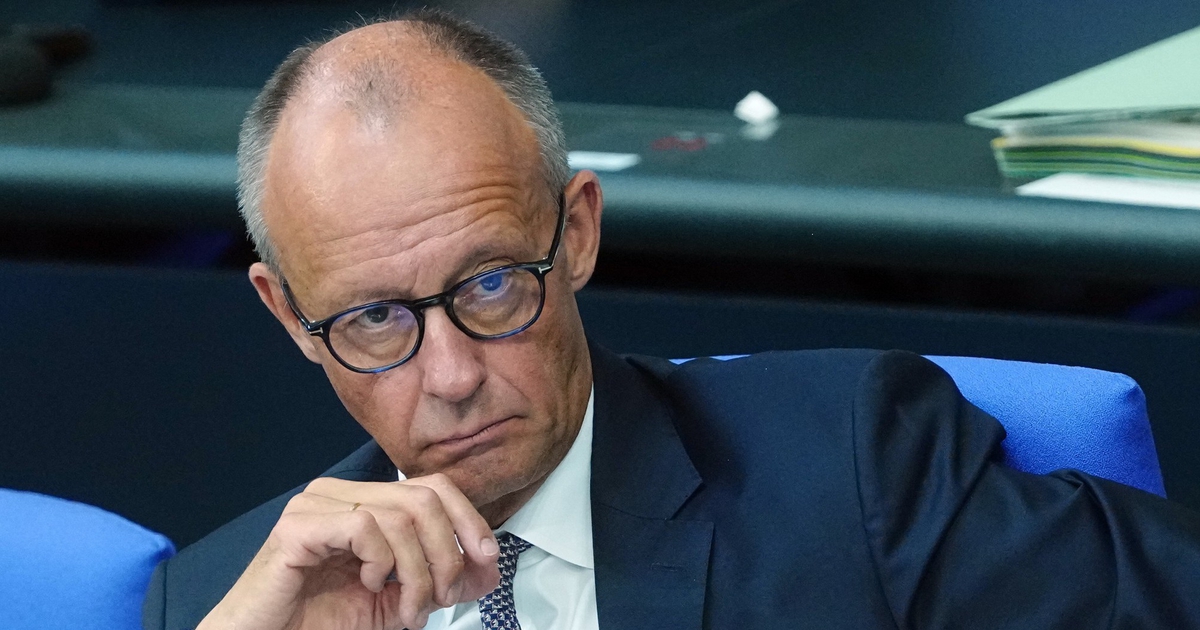
German Chancellor Friedrich Merz engages in a fiery debate with the far-right AfD party as political tensions reach a boiling point


The political landscape in Germany has entered a period of unprecedented volatility following a high-stakes confrontation between Chancellor Friedrich Merz and the leadership of the far-right Alternative for Germany (AfD). The public clash, which took place on September 8, 2026, centers on the AfD’s controversial "remigration" agenda, a policy platform that critics, including the Chancellor, have explicitly equated to state-sponsored ethnic cleansing based on race and origin. This ideological collision arrives in the wake of a historic electoral surge for the AfD in the state of Saxony-Anhalt, where the party secured nearly 44% of the vote, signaling a seismic shift in the German electorate’s sentiment.
The Core of the Dispute: Remigration vs. Economic Reality
At the heart of the controversy is the AfD’s signature policy of "remigration," a term that has become a lightning rod for national debate. During the legislative session in Berlin, Chancellor Merz dismantled the party’s rhetoric, arguing that the policy is a thin veil for mass deportation targeting individuals based on their ethnic backgrounds.
"If those who are currently contributing to the German economy are forced to leave under the guise of remigration, numerous highly skilled sectors will simply cease to function," Chancellor Merz asserted. He highlighted the precarious position of industries that rely heavily on foreign-born labor, including healthcare, geriatric care, and the hospitality sector. "Hospitals, nursing homes, and restaurants will face catastrophic consequences," he warned, characterizing the AfD’s proposal not merely as a social policy, but as an existential threat to Germany’s industrial and service-oriented economic stability.
The Saxony-Anhalt Electoral Shockwave
The tension between the ruling coalition and the AfD was catalyzed by the election results in Saxony-Anhalt on September 6, 2026. Securing 44% of the vote, the AfD achieved its strongest performance in any state-level election to date, falling just three seats short of an absolute majority. The surge has emboldened the party’s state leader, Ulrich Siegmund, who is now actively seeking to build a coalition or secure enough legislative support to become the Minister-President of the state.
This victory is part of a broader trend of rising populist sentiment in Germany. Recent polling suggests that the AfD is maintaining a national support base of between 28% and 29%, a figure that has sent shockwaves through the established political parties, particularly the Christian Democratic Union (CDU), led by Merz.
A Chronology of Growing Polarization
The current crisis did not emerge in a vacuum. The following timeline tracks the escalation of the rhetoric and the shifting political dynamics in Germany leading up to the September 2026 standoff:
- August 2025: German government officials officially acknowledge that the nation is grappling with a deep structural economic crisis, exacerbated by labor shortages and aging demographics.
- Early 2026: The AfD begins to gain significant traction by linking economic stagnation directly to immigration policy, introducing the "remigration" concept into the mainstream national discourse.
- September 6, 2026: The state election in Saxony-Anhalt results in a historic 44% showing for the AfD, creating a political earthquake in Berlin.
- September 8, 2026: Chancellor Merz holds his first formal, public debate with AfD leadership, labeling their platform a "destructive force" and explicitly rejecting the legality and morality of their immigration proposals.
Institutional Responses and the Legal Distinction
Chancellor Merz has taken a nuanced, albeit firm, stance regarding immigration. He acknowledges that the current system is under strain and that the government must expedite the deportation of individuals who do not meet the legal requirements for residency. However, he draws a sharp, non-negotiable line between these individuals and those who are legally employed and contributing to the German economy.
"We must distinguish between those who are working and contributing to the national wealth and those who lack a legal right to reside," Merz stated. This distinction is vital, as it seeks to address the legitimate concerns of the electorate regarding border control while simultaneously protecting the essential workforce that keeps Germany’s economy afloat.
The AfD Counter-Narrative
In response to the Chancellor’s criticisms, AfD leader Alice Weidel has pivoted to an aggressive counter-offensive. She accused the Christian Democratic Union (CDU) of being "shattered" by the results in Saxony-Anhalt, framing the electoral outcome as a referendum on the Chancellor’s leadership abilities. Weidel argued that the current government’s failure to manage migration has created a security and social crisis that the electorate is no longer willing to tolerate.
The AfD’s rhetoric continues to focus on the preservation of national identity, a message that has found resonance in rural and economically neglected areas. By labeling the current administration as "out of touch," the party is positioning itself as the only viable alternative for voters who feel abandoned by the traditional political establishment.
Economic and Societal Implications
The broader implications of this political divide are profound. Economists warn that if Germany, which is currently struggling with productivity, were to implement aggressive anti-immigration measures, the impact would be felt almost immediately in the labor market. Germany’s demographic crisis—characterized by a shrinking workforce and an aging population—makes the inclusion of foreign labor an economic necessity rather than a political choice.

Beyond the numbers, the debate has profound societal implications. The hardening of rhetoric risks further dividing the electorate and eroding the consensus-based politics that have defined the Federal Republic since its founding. When fundamental definitions of national identity and citizenship become the primary battleground of parliamentary debate, the risk of social fragmentation increases.
Looking Ahead: The September Test
The political temperature in Germany is unlikely to cool anytime soon. With upcoming state elections in Berlin and Mecklenburg-Western Pomerania later this month, the debate over migration will remain the dominant theme. These elections will serve as a bellwether for the country, indicating whether the AfD’s momentum is a localized phenomenon or a permanent realignment of the German political map.
As the Chancellor prepares to defend his policies, the opposition is clearly preparing to use the immigration issue as a wedge to dismantle the current governing coalition. The coming weeks will test the resilience of Germany’s democratic institutions and the ability of its political leaders to address the legitimate grievances of the population without succumbing to the divisive tactics of the far-right.
In this climate, the ability of mainstream parties to articulate a coherent and effective policy that addresses both security and economic needs will be the deciding factor in the future of the nation’s governance. For now, the confrontation between Merz and the AfD serves as a stark reminder that the challenges of the 21st century—globalization, labor migration, and identity politics—are reshaping the internal dynamics of even the most stable European economies.