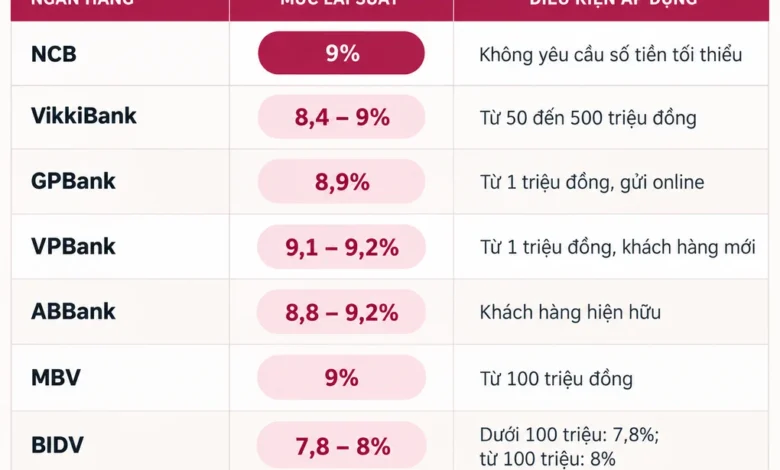
The Vietnamese banking landscape is currently undergoing a significant period of recalibration as financial institutions adjust their deposit interest rate policies in strict alignment with recent directives from the State Bank of Vietnam (SBV). As of late October, the industry is witnessing a cooling effect on the once-aggressive competition for liquidity, though interest rates remain elevated within the 8-9% per annum range for many retail depositors. This shift represents a calculated response to regulatory pressure aimed at stabilizing the national economy and managing credit growth.
The Regulatory Landscape and Recent Directives
The current climate in the banking sector has been largely shaped by a series of administrative interventions by the State Bank of Vietnam. Recognizing the inflationary pressures and the potential for systemic risk if deposit rates were to spiral unchecked, the SBV issued formal guidance on October 18, mandating that commercial banks reduce their deposit interest rates by at least 0.5 percentage points for tenures of six months or longer. This directive was not merely a suggestion but a clear signal that the central bank intends to maintain tighter control over the credit growth trajectory.
Historically, the period leading up to late October was marked by a "rate war" where banks competed aggressively for capital. However, the recent intervention has forced a shift in strategy. While official website listings—often the baseline for public transparency—suggest that rates for most banks are now hovering at or below 7% per annum, these figures represent only a portion of the actual market reality.
The Disparity Between Listed Rates and Actual Yields
A critical analysis of the current market reveals a clear dichotomy: the "posted" or "listed" rates on official bank websites often differ significantly from the "actual" or "effective" rates offered to customers through digital applications and promotional vouchers. This strategy allows banks to comply with regulatory directives on paper while still attracting the liquidity they require to satisfy credit demand.
Many financial institutions, including major players like Vietcombank, MB, SHB, and NCB, have transitioned toward using digital-only incentives. By utilizing mobile banking applications, these banks offer "bonus interest" vouchers that do not always require a high minimum deposit. In some instances, a deposit of just a few million VND can unlock significantly higher yields than those advertised for traditional over-the-counter transactions.
For example, at Vietcombank, while the listed online rate for a 6-to-12-month tenure may appear modest—ranging between 3% and 5.4%—customers opting for digital deposits above a 3 million VND threshold can access effective rates reaching up to 6.8%. Similarly, SHB, which lists a maximum online rate of around 6%, has been observed offering digital-only yields of 8.1% to 8.3% for deposits starting from just one million VND. These promotional structures are designed to incentivize the shift toward digital banking while keeping the headline rates within the parameters expected by the central bank.
Market Chronology: The Cooling of the Rate War
The cooling trend is quantifiable when comparing the current landscape to the market conditions of early October. Just two weeks prior, the industry was characterized by aggressive bidding, with some banks offering rates approaching 9.5%. The subsequent reduction, while not uniform, has brought the market to a more stable, albeit still high, equilibrium of 8-9% per annum.

The following timeline highlights the progression of these adjustments:
- Early October: Intense competition among commercial banks leads to aggressive rate hikes, with some institutions offering upwards of 9.5% to attract depositors.
- October 18: The State Bank of Vietnam issues a formal directive requiring a minimum 0.5% reduction in deposit rates for tenures of six months or longer to curb credit growth.
- October 19–25: Commercial banks begin internal policy reviews to reconcile their need for capital with the SBV’s regulatory expectations.
- October 26: Market survey confirms that while listed rates are lower, banks are utilizing promotional "vouchers" and digital-only interest rate bonuses to maintain competitive yields for customers, effectively keeping the market within the 8-9% range.
Institutional Responses and Competitive Strategies
Despite the regulatory push to lower rates, the competitive spirit within the banking sector remains robust. Branch employees are still actively sourcing deposits through personal networks and specialized group programs. These programs often include "loyalty bonuses," "birthday vouchers," or "referral rewards" that bypass the standard rate-setting protocols.
For instance, at VPBank, staff members have been observed quoting rates of 9.1% for 6-month terms and 9.2% for 12-month terms for new customers with deposits as low as one million VND. GPBank and Vikki Bank have similarly maintained high-yield offerings, with rates between 8.4% and 9% for various mid-term deposits. Even state-owned banks like BIDV have engaged in this competitive landscape, offering tiered rates—such as 7.8% for deposits under 100 million VND and 8% for higher amounts—complemented by additional gift incentives.
Economic Implications and Future Outlook
Financial analysts, including those from Dragon Capital (VDSC), suggest that the current interest rate environment is likely to reach a plateau for the remainder of the year. The control over deposit rate competition is being managed more strictly than in previous quarters, particularly as many large-scale banks are already nearing their credit growth caps. This saturation in lending capacity naturally reduces the urgency for banks to aggressively solicit new deposits, thereby alleviating some of the upward pressure on interest rates.
However, the outlook for 2025 remains complex. Experts caution against the expectation of a significant, long-term drop in deposit rates. The structural demand for medium- and long-term capital within the Vietnamese economy remains substantial. Furthermore, the mismatch between the growth of deposit mobilization and the sustained demand for credit implies that the liquidity environment will remain tight for the foreseeable future.
Broader Macroeconomic Context
The balancing act performed by the State Bank of Vietnam is designed to reconcile the need for economic stimulation with the imperative of financial stability. By forcing a reduction in deposit rates, the regulator aims to lower the cost of capital for businesses, thereby facilitating easier access to credit for productive sectors of the economy. However, the persistence of 8-9% rates indicates that the market still perceives significant risk and high demand for liquidity.
For the individual saver, the landscape is one of nuance. While headline rates may seem lower, the digital-first approach of modern banking provides opportunities to secure higher returns. Consumers are increasingly encouraged to look beyond the static interest rate tables published on bank websites and instead engage with the specific digital banking products and promotional campaigns that define the current era of Vietnamese retail finance.
In conclusion, while the "hot" phase of the interest rate race has been dampened by regulatory oversight, the market has not returned to a low-interest environment. The current stability is a result of a carefully managed transition, where banks prioritize compliant, transparent headline rates while utilizing sophisticated, digital-led incentives to maintain the liquidity necessary to power their ongoing operations. As the year concludes, the focus for both regulators and financial institutions will be to ensure that this delicate balance supports sustainable economic growth without triggering volatility in the credit market.