Vietnam Ushers in a New Era of Semiconductor Autonomy with Landmark Strategic Policy and Industrial Investment


Vietnam has officially embarked on a transformative path toward technological sovereignty, as the government recently ratified a comprehensive strategy for the development of the semiconductor industry through 2030, with a visionary outlook extending to 2050. This landmark initiative marks the first time the Southeast Asian nation has adopted a long-term, high-level blueprint dedicated to establishing a robust domestic semiconductor ecosystem. By integrating legislative support with targeted industrial projects, Vietnam is positioning itself to shift from a traditional assembly-oriented economy to a sophisticated hub for research, design, and high-tech manufacturing.
A Strategic Pivot Toward Technological Independence
The initiative, spearheaded by the Ministry of Information and Communications (MIC), underscores an urgent need for Vietnam to master core technologies. According to Nguyen Khac Lich, Director of the Authority of Information Technology and Communications Industry, the nation must transcend its current role as a mere processor or assembly point for foreign components.
The strategy emphasizes the importance of geopolitical positioning, leveraging Vietnam’s stable environment to attract high-value foreign direct investment (FDI). More importantly, it focuses on building the necessary infrastructure and legal frameworks to foster domestic innovation. The core objective is to reduce reliance on external supply chains, thereby fortifying national security and defense against global logistical disruptions—a critical lesson learned from the semiconductor shortages that plagued global industries between 2020 and 2022.
Legislative Milestones and Financial Incentives
Central to this industrial evolution is the recent passage of Resolution 57 by the National Assembly. This resolution introduces a suite of special mechanisms designed to catalyze breakthroughs in science, technology, and innovation. Crucially, it provides a legal pathway for direct state financial support for the construction of the nation’s first pilot semiconductor fabrication plant (fab).
Under the terms of the resolution, the government is authorized to subsidize up to 30% of the total project investment from the central budget. To qualify for this support, a facility must be operational by December 31, 2030, with a total grant cap of 10 trillion VND (approximately $400 million USD). Furthermore, the government has introduced flexible land-use policies, exempting developers from standard land-lease payments and bidding requirements for projects deemed essential to national technological development.
This move is historic. Minister of Information and Communications Nguyen Manh Hung noted that this is the first time the Vietnamese state has directly intervened to subsidize private-sector research and production laboratories, signaling a profound shift in the government’s approach to public-private partnerships in high-tech sectors.
The Rise of Domestic Champions: The Viettel Example
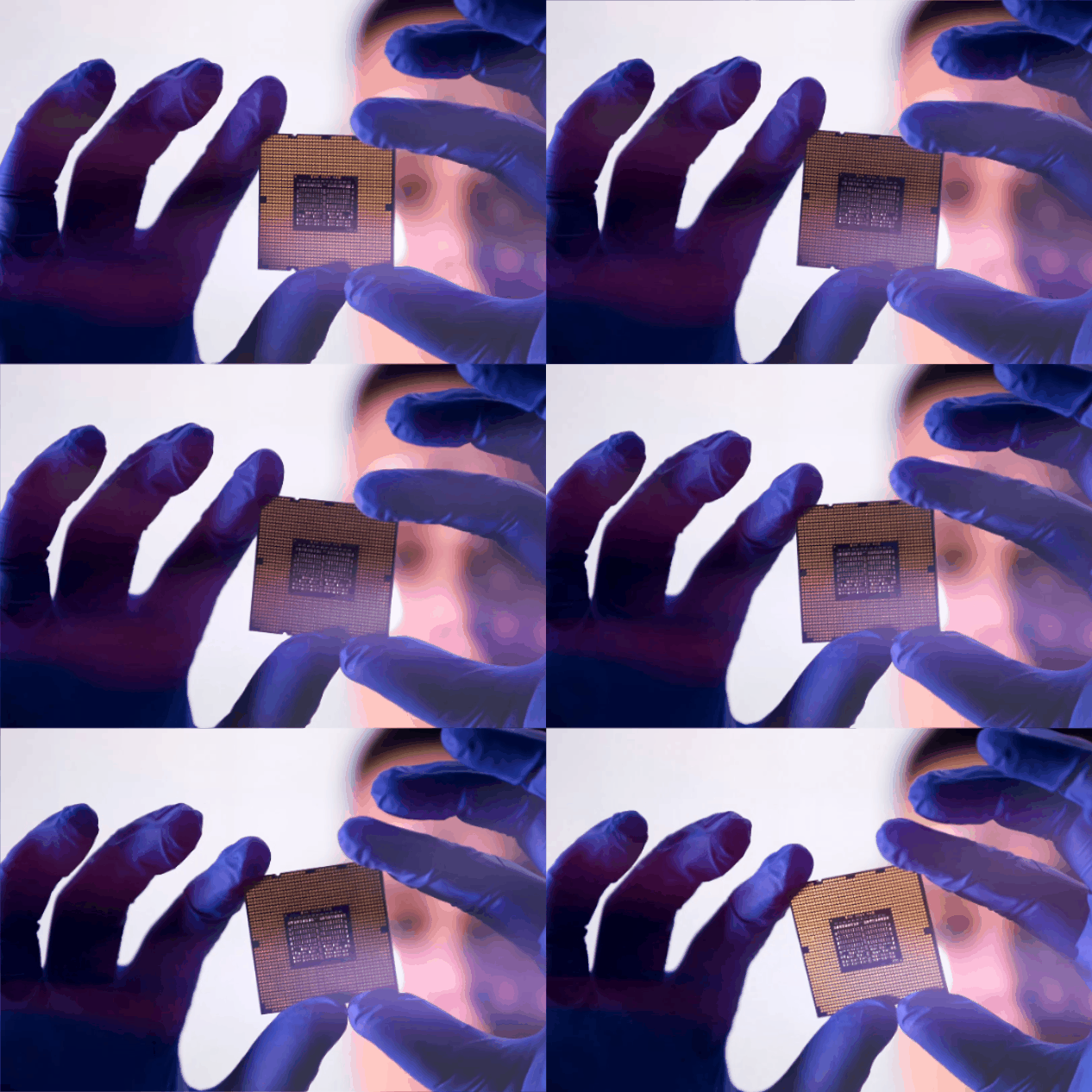
While the policy framework is new, the foundation for Vietnam’s semiconductor capability is already being laid by industry leaders like Viettel and FPT. Viettel, in particular, has demonstrated its prowess by successfully designing the 5G DFE (Digital Front End) chip. This component is arguably the most complex integrated circuit designed in Southeast Asia to date.
The 5G DFE chip is designed to handle signal processing for 5G base stations, capable of executing over 1,000 trillion operations per second. Given that modern telecommunications infrastructure requires hundreds of millions of these transceiver units, mastering the design and production of these chips is a significant step toward achieving total network infrastructure independence.
Dr. Nguyen Trung Kien, Deputy Head of the Semiconductor Technology Department at Viettel, explained that the venture into semiconductors was a logical progression for the group. "The semiconductor industry is an incredibly demanding field that requires deep knowledge in research, design, and system integration. These are the very challenges we have set for ourselves over the years, and it is precisely why we possess the foundation required to enter this sector," he stated.

A Global Context: Geopolitics and Opportunity
The global semiconductor landscape is currently undergoing a massive structural shift. Amidst ongoing trade tensions between major economic powers, many multinational corporations are adopting "China Plus One" strategies, seeking to diversify their supply chains. Vietnam is increasingly viewed as an ideal destination due to its proximity to major manufacturing hubs, a growing pool of engineering talent, and a neutral, stable diplomatic stance.
Le Quang Dam, CEO of Marvell Technology Vietnam, described the current moment as a "once-in-a-hundred-years opportunity." He emphasized that the semiconductor industry is not just a commercial venture but a national imperative. "Vietnam is standing before a tremendous opportunity. This opportunity will not come to us; we must create it," Dam asserted. He highlighted that the synergy between government policy, the return of skilled Vietnamese engineers from abroad, and the presence of global firms like Marvell will be critical in building a value-added chain that benefits the entire nation.
Chronology of Development and Future Roadmap
The roadmap to 2030 and beyond is structured into distinct phases:
- Phase I (2025–2027): Foundation Building. Focus on finalizing legal frameworks, establishing the first pilot fab, and accelerating the training of human resources. The goal is to integrate Vietnamese talent into the global R&D ecosystem.
- Phase II (2028–2030): Scaling and Infrastructure. The operation of the pilot fab and the initiation of specialized chip production for domestic telecommunications, automotive, and defense needs.
- Phase III (2030–2050): Ecosystem Maturity. Transitioning from pilot projects to large-scale commercial production, moving up the value chain toward advanced node manufacturing and global market integration.
Challenges and Economic Implications
Despite the optimism, the path forward is not without hurdles. The semiconductor industry is capital-intensive and requires a highly specialized workforce. Vietnam currently faces a shortage of high-level semiconductor engineers—a gap that the government intends to address through partnerships with top-tier universities and international research institutions.
From an economic standpoint, the development of a domestic semiconductor industry is expected to boost GDP growth and increase the complexity of Vietnam’s exports. By moving away from low-margin assembly, the country hopes to capture a larger share of the global electronics value chain, which is projected to grow significantly as AI and IoT (Internet of Things) devices become ubiquitous.
Furthermore, the focus on "specialized chips"—as opposed to chasing the mass-market consumer chip production currently dominated by TSMC or Intel—is a prudent strategy. By focusing on niche areas like 5G, IoT, and industrial automation, Vietnam can carve out a sustainable market share that aligns with its existing technological strengths.
Official Stance and Long-term Vision
The government’s message remains consistent: the goal is to build a self-reliant economy capable of navigating the volatile shifts in global technology markets. Major General Nguyen Dinh Chien, Deputy General Director of the Viettel Group, summarized the sentiment during a recent industry forum: "We recognize that this is a long journey. We need a rational, step-by-step approach that balances research with commercial viability. Developing and producing chips that meet the needs of domestic businesses and national security is the bedrock for developing even more advanced technologies in the future."
As Vietnam continues to refine its legislative tools and incentivize private investment, the country is clearly signaling to the world that it is open for high-tech business. By fostering an environment where domestic giants like Viettel and FPT can collaborate with global firms, Vietnam is not just hoping to participate in the global semiconductor market—it is preparing to lead.
The successful implementation of this strategy will require sustained political will, consistent investment in human capital, and the ability to adapt to the rapidly changing technological landscape. If realized, Vietnam’s transition could serve as a template for other emerging economies seeking to leverage high-tech industrialization to achieve middle-to-high-income status.
Related posts: