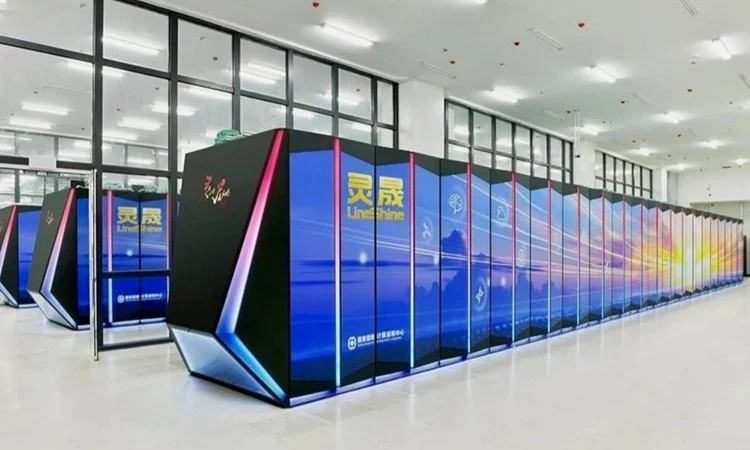
The landscape of global high-performance computing (HPC) has reached a new milestone as China’s LineShine supercomputer continues to assert its dominance, securing the top position on both the prestigious TOP500 and the High-Performance Conjugate Gradient (HPCG) rankings. The results, officially announced on November 16 at the SC26 conference in Chicago, underscore a significant shift in computational capabilities, as LineShine successfully outperformed the formidable El Capitan system from the United States.
Located at the National Supercomputing Center in Shenzhen, Guangdong province, LineShine has achieved a staggering performance level of 2.198 exaflops. This metric represents the system’s ability to perform over two quintillion floating-point operations per second. By maintaining its lead, China has demonstrated a resilient trajectory in hardware engineering, particularly in the development of independent, sovereign technological ecosystems.
A Technological Marvel Built on Homegrown Innovation
Industry analysts from Network World have highlighted that LineShine’s architecture represents a departure from reliance on conventional, globally sourced GPU-accelerated clusters. Instead, the system relies on custom-designed LX2 CPU architecture. The interconnection of these processors is managed through the proprietary LingQi networking technology, a critical component that facilitates the massive data throughput required for exascale computing.
The system’s achievement is particularly notable because it reached the exascale threshold—defined as the capability to perform at least one exaflop—using a CPU-only design. This architectural choice challenges the prevailing industry assumption that extreme performance is exclusively the domain of massive GPU-accelerated clusters. By avoiding the common reliance on high-end, export-restricted AI chips, China has signaled a significant degree of technological self-sufficiency.
Comparison with Global Contenders
While LineShine currently holds the crown, the global competition remains intense. The U.S.-based El Capitan system, situated at the Lawrence Livermore National Laboratory, occupies the second spot on the TOP500 list with a performance of 1.809 exaflops. Following close behind are other notable exascale machines, including Frontier, Aurora, and the Jupiter Booster system from Germany.
The November 2026 ranking marks a historic moment, as these systems represent the vanguard of the exascale era, where computing power is measured in quintillions of operations per second. However, the contrast between the top-tier systems and the broader market is growing. Data from Tom’s Hardware reveals that only 27 new supercomputers entered the TOP500 list in November, representing the lowest entry rate since the project’s inception in 1993. The most powerful of these newcomers, the South Korean "Hanggang" system located at KISTI, debuted at 12th place with 614.7 petaflops.
Understanding the Benchmarking Metrics
To understand why LineShine’s victory is multifaceted, one must differentiate between the two primary benchmarking methodologies used at SC26:
- TOP500 (HPL Benchmark): This measures the system’s performance in solving dense linear algebra equations. It serves as a standard indicator of peak raw processing power. LineShine’s 2.198 exaflops confirm its supremacy in sheer computational speed.
- HPCG (High-Performance Conjugate Gradient): This benchmark evaluates how a supercomputer handles data processing in complex, irregular patterns. These patterns are more reflective of real-world scientific applications, such as climate modeling, molecular biology, and astrophysics. LineShine’s lead here—22 petaflops compared to El Capitan’s 17.41 petaflops—suggests that the Chinese machine is not only fast in raw math but also highly efficient at managing the chaotic, memory-intensive workloads that characterize modern scientific discovery.
Scientific Applications and Real-World Impact
The computational power provided by LineShine is not merely for record-breaking; it is actively supporting cutting-edge scientific research. According to the National Supercomputing Center in China, the system has already been utilized for complex simulations that were previously computationally prohibitive.
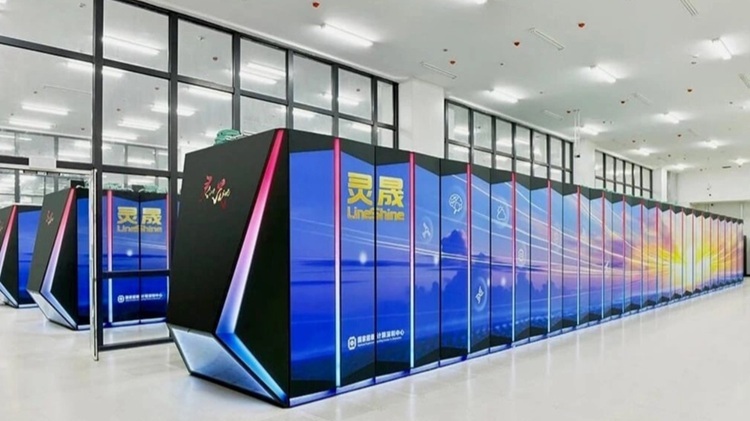
Recent projects have included the simulation of the movement of 200 million silicon atoms and the detailed analysis of the electronic structure of solid-state batteries involving over 10 million atoms. These simulations are vital for the advancement of material science, energy storage, and semiconductor development. By providing researchers with the ability to model atomic-level interactions at scale, LineShine is accelerating the pace of innovation in sectors that are critical to the future of the global economy.
Industry Trends and Future Outlook
The relative scarcity of new systems in the TOP500 list, combined with the rising power of existing supercomputers, indicates a structural shift in the industry. As the complexity of high-performance computing infrastructure increases, the cost and technical expertise required to develop these systems have become a significant barrier to entry.
Furthermore, analysts at Epoch AI have noted a dramatic shift in how global computing power is being allocated. While the total volume of compute is growing at a rate of 2.5 times per year, the focus of the industry has pivoted away from building specialized scientific machines toward creating massive, scalable infrastructure specifically designed for artificial intelligence.
This trend toward AI-optimized infrastructure poses a long-term question for the future of the TOP500. As the demand for training large-scale generative models dominates the market, the definition of a "supercomputer" is beginning to evolve. Systems like LineShine, which balance traditional scientific modeling with high-throughput architecture, may eventually need to be measured against a new generation of AI-native clusters that prioritize interconnect speed and memory bandwidth over traditional floating-point performance.
A New Era of Global Competition
The continued success of LineShine, first appearing at the top of the list in June 2026, marks the first time a Chinese supercomputer has held the number-one spot since the Sunway TaihuLight in 2017. This resurgence is viewed by geopolitical observers as a testament to the effectiveness of China’s long-term investment in national supercomputing infrastructure.
While the United States and European Union continue to pour billions into their own exascale initiatives—such as the Aurora and Jupiter projects—the competition is no longer just about who can build the fastest machine. It is about who can best leverage that power to solve the most pressing challenges in climate science, genomics, and national security.
For the international scientific community, the existence of multiple exascale-class systems across the globe is generally viewed as a positive development. Increased access to high-performance computing resources allows for broader, more collaborative research efforts that transcend national borders. As these machines push the boundaries of what is possible, they pave the way for the next generation of breakthroughs in artificial intelligence, clean energy, and fundamental physics.
As the industry looks toward the next iteration of the TOP500 list, the focus will likely remain on whether current architectural designs can continue to scale in the face of cooling, power, and memory bottlenecks. LineShine’s ability to stay at the forefront, despite the shifting sands of global technology policy, suggests that the race for computational supremacy will remain a defining feature of the 21st-century technological landscape.