Upcoming Dividend Wave on Vietnam Stock Market Focuses Spotlight on 21 Enterprises in Late September and Early October

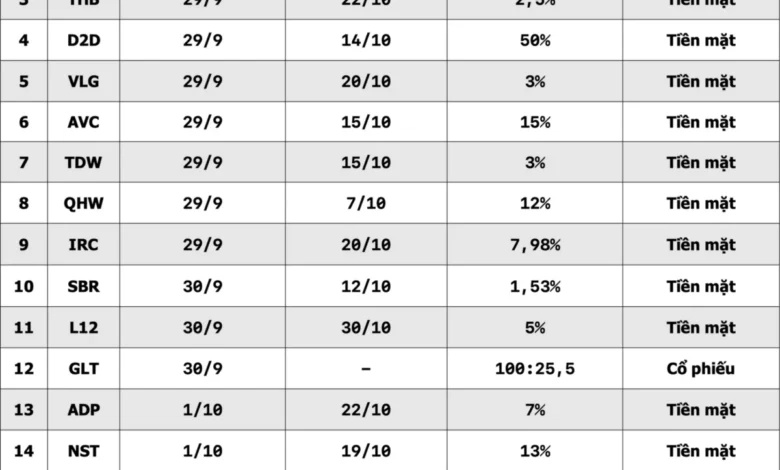
The Vietnamese stock market is bracing for a significant influx of corporate actions as 21 enterprises prepare to trade ex-rights for dividend distributions and share issuances between September 28 and October 2, 2026. This upcoming corporate calendar highlights a diverse mix of cash and stock payouts spanning various sectors, drawing keen interest from retail and institutional investors alike seeking yield in a fluctuating macroeconomic environment.
Corporate actions of this nature remain a critical barometer of financial health for listed companies, offering tangible returns to shareholders while reflecting management confidence in ongoing cash flow generation and profitability. As the third quarter draws to a close, market participants are closely monitoring the definitive registration dates and payout schedules for several prominent firms, including major players in industrial real estate, maritime shipping, and electrical engineering.
Industrial Real Estate and Shipping Giants Lead Cash Dividend Schedules
Among the cohort of companies returning capital entirely in cash, CTCP Phát triển Đô thị Công nghiệp số 2 (Ticker: D2D) stands out by offering the highest payout ratio of the week. D2D has announced a 50% cash dividend for the 2025 financial year, translating to VND 5,000 per share.
With approximately 30 million shares currently circulating in the market, D2D is slated to disburse roughly VND 152 billion to satisfy the dividend obligation. The ex-rights date is scheduled for September 28, with the final registration date following on September 30. Shareholders can expect the cash to hit their brokerage accounts around October 14.
The financial implications of this payout extend significantly to major shareholders. Sonadezi Corporation (Ticker: SNZ), the parent company and primary institutional stakeholder holding nearly 57.9% of D2D’s charter capital, is projected to collect approximately VND 88 billion from this single corporate action. This substantial cash injection bolsters Sonadezi’s liquidity profile, aligning with broader trends of state-backed and affiliated enterprises optimizing capital allocation across regional industrial zones.
Parallel to the industrial real estate sector, the maritime transportation sector is also witnessing notable liquidity returns. CTCP Vận Tải Biển Việt Nam (Vosco, Ticker: VOS) has officially promulgated its plan to distribute a cash dividend at a rate of 9%, equating to VND 900 per share.
With 140 million shares outstanding, Vosco’s total payout amounts to approximately VND 126 billion. The operational timeline specifies October 1 as the ex-rights date, followed by the final registration date on October 2, with payment execution targeted for October 26.
According to governance reports from the first half of 2026, Vietnam National Shipping Lines (VIMC, Ticker: MVN), the parent entity holding a 51% controlling stake in Vosco, stands to receive upwards of VND 64 billion. This revenue stream supports VIMC’s consolidated cash flow as global maritime logistics navigate fluctuating freight rates and evolving supply chain dynamics.

Stock Dividend Strategies Focus on Long-Term Capital Retention
While cash dividends offer immediate liquidity, several enterprises continue to utilize stock dividends to capitalize retained earnings and expand equity bases. A prominent example within this category is CTCP Kỹ thuật Điện Toàn Cầu (Ticker: GLT), which has designated September 30 as its ex-rights date and October 1 as the final registration date for an upcoming stock dividend distribution.
GLT’s distribution plan entails issuing shares at a ratio of 25.5%, meaning investors owning 100 shares will receive 25.5 new shares. The issuance is funded directly through undistributed after-tax profits, as recorded in the company’s audited financial statements for the fiscal year ending March 31, 2026.
By opting for stock dividends rather than cash, GLT preserves operational liquidity to fund ongoing engineering ventures and technological scaling. This strategy is frequently favored by mid-sized industrial enterprises seeking to strengthen their balance sheets and enhance share liquidity over the medium to long term without depleting cash reserves.
Broader Market Context and Diversified Payout Structures
Beyond the headline-grabbing distributions from D2D, Vosco, and GLT, the broader market will witness numerous other listed corporations executing corporate actions throughout the upcoming week. Payout ratios across these secondary participants range from 2% to 16%, utilizing cash, additional shares, or hybrid models combining both forms of remuneration.
These scheduled events are part of a seasonal pattern where enterprises finalize corporate resolutions passed during earlier Annual General Meetings (AGMs). The dispersion of capital across sectors such as logistics, manufacturing, technology, and real estate underscores a resilient corporate earnings baseline despite macroeconomic headwinds witnessed earlier in the year.
Market analysts note that dividend plays typically experience heightened volatility in the days leading up to the ex-rights date, driven by short-term traders attempting to capture the entitlement before the share price adjusts downward to account for the payout. Conversely, long-term investors frequently use these adjustment periods to accumulate positions in fundamentally sound companies backed by predictable dividend histories.
Strategic Implications for Investors and Market Liquidity
The concentration of 21 corporate actions within a single week serves as a reminder of the evolving maturity of Vietnam’s capital markets. Regular dividend distributions enhance the appeal of equities relative to alternative asset classes, particularly in an environment where interest rates and fixed-income yields remain subjects of close scrutiny by retail participants.
For institutional funds, predictable cash flows derived from portfolio dividends provide vital liquidity to meet operational requirements or reallocate capital into high-growth sectors. As the market transitions into the final quarter of 2026, the performance of these dividend-paying stocks will likely offer crucial insights into investor sentiment and institutional positioning strategies heading toward the year-end financial reporting cycle.
Related posts: