Ho Chi Minh City Approves Massive 49,000 Billion VND Urban Renewal Project for South Kenh Doi Embankment

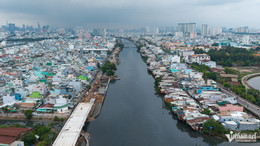
The People’s Council of Ho Chi Minh City has officially approved four major investment projects aimed at comprehensively upgrading and rehabilitating the South Kenh Doi (Doi Canal) embankment located in District 8, utilizing municipal budget allocations. The total investment for this sweeping urban renewal initiative is estimated at approximately 49,000 billion VND. Notably, the financial allocation designated for site clearance, land compensation, resettlement support, and housing policies accounts for nearly 39,800 billion VND, representing roughly 81 percent of the entire financial package. This monumental undertaking marks one of the most ambitious urban upgrading programs in the city’s recent history, specifically designed to fundamentally transform the living conditions of thousands of households residing along the canal banks while concurrently completing vital transport infrastructure and creating a fresh, modern urban landscape for the southwestern sector of Ho Chi Minh City.
Strategic Division and Segment-by-Segment Implementation Plan
To ensure systemic efficiency and structured execution, the vast South Kenh Doi urban renewal project has been methodically divided into four distinct geographical segments. Each segment features tailored financial planning and clearly defined resettlement targets designed to address the unique complexities of densely populated riverside corridors.
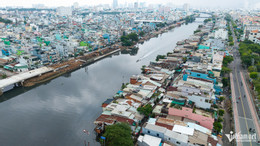
The first segment stretches from Rach Ong Bridge to Mat Bridge, covering a distance of 1.2 kilometers. This section carries an estimated capital requirement of 6,870 billion VND and directly involves the relocation of 860 households. Moving further along the waterway, the second segment spans from Mat Bridge to Hiep An Bridge over a 2.1-kilometer stretch. This particular portion commands the highest financial allocation and presents the most complex relocation challenge of the entire master plan, requiring a budget of approximately 13,608 billion VND to manage the displacement of 2,042 households.
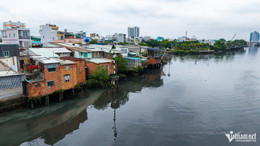
The third segment extends from Hiep An Bridge to Ba Tang Bridge, measuring 2.6 kilometers in length. The projected investment for this zone stands at 10,634 billion VND, with plans to relocate 1,278 households. Finally, the terminal segment reaches from Ba Tang Bridge to the very end of the South Kenh Doi embankment, spanning 2.9 kilometers. This concluding section requires the largest individual capital injection of approximately 17,903 billion VND and involves the relocation of 1,627 households. In total, the massive infrastructure program necessitates the acquisition of roughly 49.2 hectares of land and impacts 7,161 cases, out of which 5,807 households face complete relocation, while the remaining properties will experience partial clearance.
Living Realities in Aging Riverside Communities
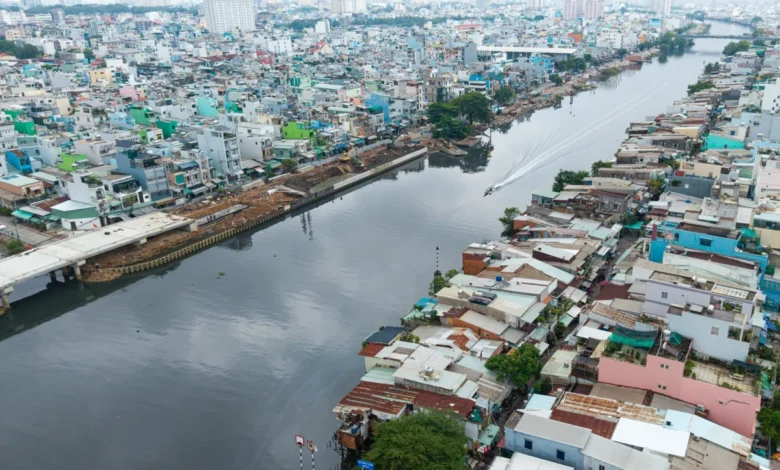
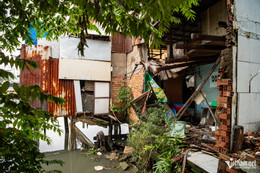
Field observations along the embankment corridors—particularly underneath the Hiep An 1 Bridge and deep within Alley 1172 on Pham The Hien Street in Ward 7—reveal an unsettling picture of structural decay and urban deterioration. Numerous houses perched precariously along the canal edge exhibit severe structural degradation, cracked foundations, and advanced physical wear. Many of these dwellings feature extremely cramped living spaces, with some properties so diminutive that residents struggle to stretch out fully when lying down.
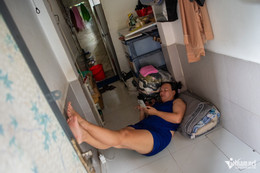
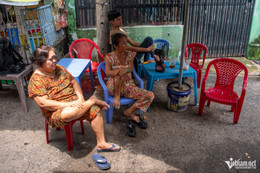
Local residents who have spent decades tied to the banks of the Doi Canal share a complex mixture of emotional attachment, pragmatic acceptance, and lingering anxiety regarding the impending transition. Mrs. Nguyen Thi Lan, a long-term resident of Ward 7, noted that her family has lived by the canal for multiple generations, making the prospect of moving both saddening and nostalgic. Nevertheless, she expressed complete alignment with state policies and a strong desire to see the neighborhood modernized into a clean, spacious, and civilized urban district. Her family home measures roughly three to four meters in width and eighteen meters in length, but it has fallen into severe disrepair without any financial means for the household to undertake structural renovations. Mrs. Lan expressed hope that the compensation package would prove sufficient to enable her family to purchase a modest apartment or small house, allowing them to reunite and stabilize their lives in a new resettlement location.
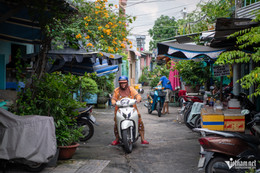
Approximately one hundred meters away, the home of 68-year-old Dinh Thi Nen shares a similarly precarious fate. Having resided in the area since the mid-1960s, Mrs. Nen and her family have endured decades of chronic tidal flooding. Whenever heavy rains coincide with high tides, water regularly spills directly into the living quarters, turning daily life into an ongoing struggle against the elements. Despite the structural fatigue of her dwelling and the continuous intrusion of water, financial constraints have forced her family to remain in place year after year.
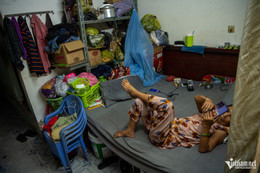
Community Bonds and Environmental Challenges
For populations that have anchored their lives to the South Kenh Doi embankment for over half a century, the impending clearance brings deep psychological turbulence. While optimism surrounds the promise of better living conditions, sanitation, and safety, anxieties concerning livelihood stability and community dislocation remain palpable. Yet, the traditional spirit of neighborhood solidarity persists. In casual daily conversations, residents frequently express a humorous yet determined resolve: if forced to relocate, they will endeavor to purchase new properties close to one another so that long-standing neighborly ties can be preserved in their eventual resettlement areas.
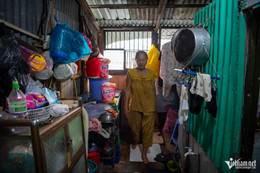
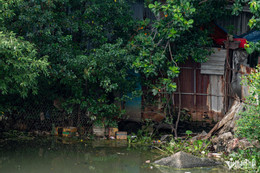
Beyond housing displacement, the environmental degradation of the canal has long plagued the community. In sectors near Ba Tang Bridge and Mat Bridge, household refuse carried along by water currents accumulates directly in front of riverfront homes, severely compromising local aesthetics and public health. Although local authorities have erected protective iron mesh barriers at vulnerable spots along the waterfront and bridge structures to deter illegal dumping, trash originating from upstream areas continues to drift down and collect outside residential thresholds. Mr. Nguyen Huu Phuoc, a resident of Ward 7 with over twenty years of local residency, remarked that enduring the daily sight and odor of riverfront garbage has unfortunately become a permanent fixture of daily existence for families living along the banks.
Broader Infrastructure Upgrades and Municipal Vision
The urban renewal blueprint extends far beyond residential relocation and embankment stabilization. Alongside the clearance of riverside structures, the initiative involves the construction of a reinforced concrete embankment along the southern bank of Kenh Doi and the significant widening of Pham The Hien Street to a standardized width of 30 meters. Comprehensive technical infrastructure, modern lighting systems, urban greenery parks, and recreational sports grounds along the canal are slated for synchronized investment, which will collectively overhaul the microclimate, environmental conditions, and visual appeal of the district.
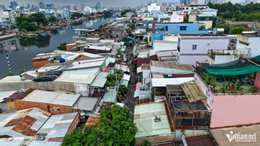
This southern transformation contrasts starkly with the northern bank of Kenh Doi, where similar embankment and roadway construction projects have already been underway for nearly a year, establishing a clear visual dichotomy between the two sides of the waterway.
According to Tran Quang Lam, Director of the Ho Chi Minh City Department of Construction, the municipal government has established a decisive strategic framework for the 2025–2030 period. The city aims to successfully deploy 117 distinct urban beautification and renovation projects targeting riverside and canal-side zones across 53 wards and communes, encompassing a total scale of approximately 41,540 houses. This monumental municipal push reflects a broader, long-term administrative commitment to eradicate dilapidated urban pockets, resolve chronic inner-city flooding, enhance urban connectivity, and elevate the overall quality of life for millions of urban residents across Ho Chi Minh City.