Tragic Multivehicle Crash on Sheikh Khalifa bin Zayed Highway Leaves 14 Dead and 30 Injured in Fujairah, UAE

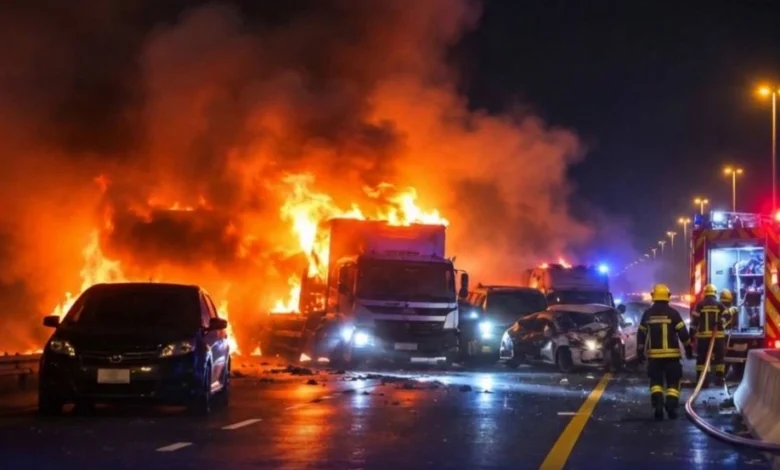
A catastrophic multivehicle collision occurred late on the evening of November 11 along a major thoroughfare in the United Arab Emirates, resulting in 14 fatalities and 30 injuries. According to local law enforcement and international news agencies, including Reuters, the accident ranks among the most severe traffic disasters in the nation’s modern history. The incident paralyzed a key section of the highway near the gateway to the Emirate of Fujairah, triggering a massive emergency response involving dozens
of police units, firefighting teams, and medical personnel.
The disaster highlights ongoing concerns regarding heavy-vehicle safety, highway congestion management, and the cascading dangers of high-speed collisions on major regional corridors. As transportation authorities and forensic investigators continue their comprehensive inquiry into the root causes of the crash, the community and nation mourn the loss of both local citizens and foreign nationals affected by the tragedy.
Chronology of the Incident and Sequence of Events
Preliminary investigations conducted by the Fujairah Police Department establish that the sequence of events began shortly before midnight on November 11. The designated stretch of the Sheikh Khalifa bin Zayed Highway—a critical artery connecting interior regions to the coastal emirate of Fujairah—was experiencing heavy traffic congestion at the time.
A heavy freight truck, operating near the gateway into Fujairah, suddenly lost control for reasons that remain under official investigation. Initial impact data indicates that the out-of-control truck collided squarely with a passenger automobile traveling ahead of it. The kinetic energy of the initial impact caused the heavy vehicle to slew violently sideways, turning perpendicular to the flow of traffic.
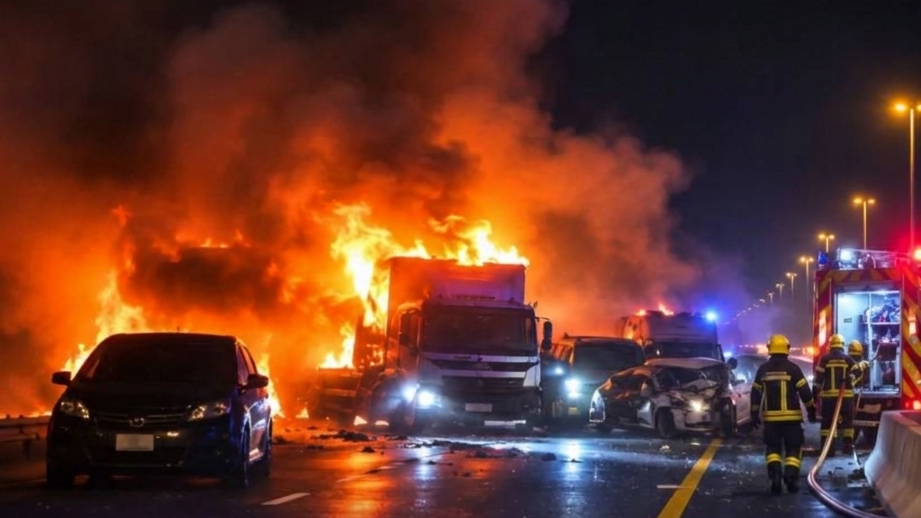
Because traffic was densely packed due to the existing congestion, the skidding truck acted as a catastrophic physical barrier across multiple lanes. It initiated a continuous, violent chain-reaction collision with numerous surrounding vehicles that were either moving slowly or standing at a standstill. In total, 23 separate vehicles were directly or indirectly involved in the pileup, comprising 18 passenger cars and 5 heavy trucks.
Compounding the disaster, the violent impact ruptured the fuel lines of the initial runaway truck, sparking an intense fire. The blaze ignited rapidly, feeding on leaked fuel and the combustible materials of the surrounding crushed automobiles. The fire spread with alarming speed through the wreckage, engulfing a large number of the trapped vehicles before firefighters could establish a perimeter and deploy extinguishing agents.
Casualties and Emergency Response Efforts
The human toll of the disaster became immediately apparent as emergency services flooded the scene. Fujairah Police and national emergency medical services confirmed that 14 individuals lost their lives at the scene or shortly thereafter due to impact trauma and severe burns. Among the deceased are citizens of the United Arab Emirates as well as several expatriate residents, reflecting the diverse demographic composition of the region’s workforce and population.
Of the 30 individuals who sustained injuries ranging from moderate to critical, rapid triage by paramedics ensured that those in the most urgent condition were evacuated to regional medical centers via ground ambulances and emergency air support. According to updated hospital reports released by local authorities, 15 of the injured victims have responded well to treatment and have since been discharged. The remaining 15 patients continue to receive specialized medical care in intensive care units and specialized wards for burns and trauma.
The firefighting and rescue operation proved exceptionally complex due to the sheer volume of wrecked vehicles and the intense heat generated by the multi-car fire. Civil defense teams worked through the night to extinguish the flames, extricate trapped occupants from severely deformed metal frames, and clear hazardous debris from the asphalt to allow forensic teams access to the site.
Background Context on UAE Highway Infrastructure and Traffic Safety
The United Arab Emirates boasts a world-class road infrastructure network, featuring expansive multi-lane highways designed to handle high volumes of passenger and commercial traffic daily. Arterial routes like the Sheikh Khalifa bin Zayed Highway are engineered to strict international standards, connecting remote economic hubs with major urban centers. However, the high speed limits permitted on these open stretches—often ranging from 100 to 140 kilometers per hour—demand rigorous attention and adherence to safety protocols from all motorists.
Commercial freight transport plays a vital role in the UAE’s booming logistics and supply chain economy. Thousands of heavy trucks transit interstate highways every day to move goods between seaports, industrial zones, and major cities. While the regulatory framework governing commercial transport is stringent—incorporating mandatory rest periods, weight limits, and vehicle inspections—incidents involving mechanical failure, driver fatigue, or lapses in situational awareness continue to pose significant risks on high-speed corridors.
Traffic congestion, particularly during peak commuting hours or near major city entrances, creates vulnerable bottlenecks where sudden reductions in speed can catch drivers off guard. When heavy commercial vehicles, which require significantly longer stopping distances than passenger cars, experience unexpected control issues in congested zones, the potential for catastrophic multi-vehicle accidents increases exponentially.
Official Responses and Law Enforcement Warnings
In the wake of the tragedy, senior officials from the Fujairah Police Department and the Ministry of Interior expressed deep condolences to the families of the victims. Authorities have pledged a thorough, transparent investigation to determine the exact mechanical and human factors that led to the truck driver losing control. Forensic engineers are analyzing the truck’s braking systems, electronic control modules, and tire integrity to rule out or confirm mechanical failure.
Concurrently, law enforcement agencies across the Emirates have intensified public safety campaigns. Police have issued renewed, urgent calls for all motorists—particularly commercial truck drivers—to exercise extreme caution, strictly adhere to posted speed limits, and maintain adequate following distances, especially when navigating heavy traffic, inclines, or approaching urban gateways.
Authorities emphasized that defensive driving techniques and heightened situational awareness are the primary defenses against secondary collisions during highway incidents. Drivers have been reminded of the critical importance of immediately moving to the shoulder or exiting vehicles safely in the event of minor breakdowns to avoid becoming victims of subsequent chain-reaction crashes.
Broader Impact and Implications for Future Road Safety
The Fujairah highway disaster has reignited national conversations regarding intelligent transportation systems, commercial vehicle monitoring, and highway safety policy in the UAE. Transportation experts and urban planners are evaluating potential technological upgrades to mitigate similar risks in the future.
Key areas of focus for policy implications and infrastructure enhancement include:
- Advanced Driver Assistance Systems (ADAS): Proponents argue for the mandatory integration of autonomous emergency braking (AEB) and collision avoidance systems in all heavy commercial vehicles operating on national highways.
- Intelligent Speed Adaptation (ISA): Expanding the use of geo-fenced speed limiters on commercial fleets to automatically restrict vehicle speeds in high-density or accident-prone zones.
- Congestion Warning Infrastructure: Upgrading digital overhead gantry signage with real-time, automated hazard detection systems that alert approaching motorists to sudden slowdowns or accidents far in advance.
- Enhanced Driver Fatigue Monitoring: Implementing stricter enforcement and technological monitoring of driving hours for long-haul freight operators to combat driver fatigue during overnight shifts.
As the nation processes the grief of this unprecedented loss of life, the incident serves as a grim reminder of the fragile balance between high-speed economic connectivity and highway safety. The lessons learned from the Sheikh Khalifa bin Zayed Highway disaster are expected to shape regulatory reforms and engineering standards designed to protect road users across the United Arab Emirates for years to come.