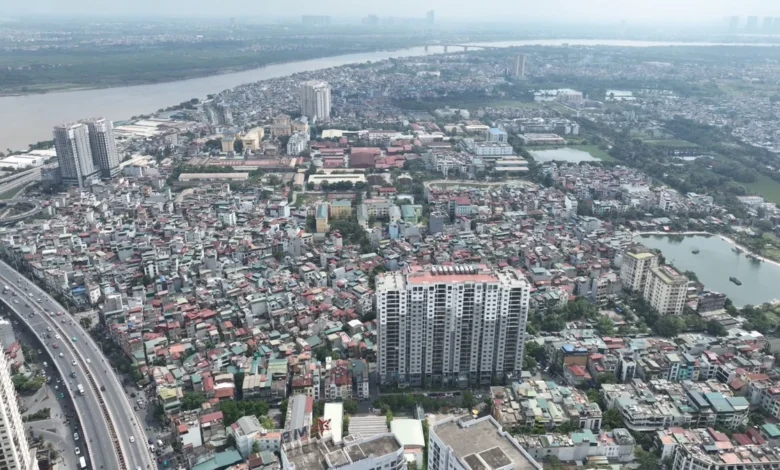
The landscape of Hanoi’s industrial real estate is undergoing a significant transformation as Pristie Real Estate Joint Stock Company (formerly known as Textaco) officially transitions from textile manufacturing to high-end residential development. In a decisive strategic shift, the company has ceased its garment production operations at its prime land holdings in the Vinh Tuy area, signaling a broader trend of industrial enterprises in the capital city capitalizing on their land assets to pivot toward the lucrative real estate market.
The move marks the end of a nearly 70-year legacy in the textile sector for the firm, which was established in May 1957. By shuttering its facility at 79 Lac Trung, the company is preparing to clear the way for the development of a 26-story mixed-use residential complex, a project with an estimated total investment exceeding 3,000 billion VND.
A Strategic Pivot from Textiles to Real Estate
The decision to terminate manufacturing activities at the 79 Lac Trung site, effective September 22, was finalized by the Board of Directors of Pristie Real Estate. This facility, spanning over 1.2 hectares near the strategic Ring Road 2 and the Vinh Tuy Bridge, has long been viewed as a prime piece of "golden land."
For decades, the site served as the production heart of the Northern Textile and Garment Company (Textaco). However, in recent years, the company reported that its textile operations were struggling with small-scale output, a lack of major clients, and significant inventory backlogs. Consequently, the manufacturing arm remained largely inefficient, prompting the company to seek higher-value utilization of its land assets.
The transition is part of a larger corporate restructuring that saw the company officially rebrand to Pristie Real Estate in July 2026. This rebranding was not merely cosmetic; it served as the formal declaration of the company’s exit from the textile industry and its entry into the property development sector.
Chronology of the Transformation
The evolution of the company from a state-owned textile giant to a private real estate player is a reflection of Vietnam’s economic shift over the last seven decades.
- May 1957: The General Textile and Garment Company is established under the Ministry of Industry and Trade.
- 1995: The firm is renamed the Northern Textile and Garment Company (Textaco).
- July 2005: The company transitions into a joint-stock entity.
- April 2010: The company officially lists its shares on the Hanoi Stock Exchange (HNX).
- June 30, 2026: Operations cease at the Viet Hung (Duc Giang) facility to make way for the Duc Giang Residences project.
- July 2026: The company rebrands to Pristie Real Estate Joint Stock Company.
- September 22, 2026: Manufacturing operations at the 79 Lac Trung facility are officially terminated.
Project Details and Investment Scope
Pristie Real Estate is currently moving forward with two major residential projects in Hanoi, categorized under the city’s land usage policy as defined by Resolution 171.
- Pristie Lac Trung: Located at 79 Lac Trung, this project features a 26-story tower atop three basement levels. The project is designed to provide approximately 650 luxury apartments. With an investment of over 3,000 billion VND, the funding structure is composed of 20% equity from share issuance and 80% from debt and capital mobilization.
- Duc Giang Residences: Located at 26 Lane 53, Duc Giang Street, Viet Hung Ward, this development spans 2.5 hectares. The project has an estimated investment of 2,600 billion VND and is intended to become a high-end residential and commercial hub.
While the projects hold significant potential, management has acknowledged that the transition is complex. As of the 2026 Annual General Meeting, the company confirmed that both projects are currently in the pre-investment phase, with the necessary project investment policies yet to receive final state approval.
Labor Relations and Corporate Responsibility
A critical component of this transition is the handling of the workforce. As manufacturing operations wind down, the company is mandated to uphold all labor rights and benefits for its employees until September 30, 2026. The General Director has been tasked with overseeing the liquidation of supply contracts and managing the disposal of machinery and equipment, which will be inventoried and sealed to ensure transparency during the transition process.
Given the substantial costs associated with severance packages, settling liabilities, and initiating development, the company has refrained from setting specific revenue and profit targets for the 2026 fiscal year. In the previous year, the company reported a modest revenue of 23 billion VND, with a net profit of approximately 10 billion VND, highlighting the stark contrast between its legacy manufacturing income and the projected valuations of its future real estate developments.
Economic Implications for Hanoi
The case of Pristie Real Estate is symptomatic of a larger phenomenon occurring across urban centers in Vietnam. Many industrial facilities that were historically located on the outskirts of cities have found themselves absorbed into rapidly expanding urban cores. As real estate values in these areas skyrocket, companies often find that the land they occupy is significantly more valuable than the products they manufacture.
However, this transition is not without challenges. Urban planners and local authorities in Hanoi are increasingly focused on ensuring that the conversion of industrial land into residential zones adheres to strict density requirements and infrastructure capacity. The transformation of "golden land" sites often triggers debates regarding the loss of manufacturing capacity and the increased pressure on local traffic and public services.
For Pristie Real Estate, the primary challenge remains the regulatory hurdle. With the projects still awaiting final investment policy approval, the company faces a period of financial uncertainty. The shift from a stable—albeit low-margin—manufacturing business to a capital-intensive, long-gestation real estate business carries inherent risks, particularly in a market sensitive to interest rates and changing housing demand.
Future Outlook
As the company looks to move beyond its textile roots, its success will depend on its ability to navigate the complex legal and financial requirements of large-scale property development in Hanoi. The liquidation of assets, such as the machinery at the Lac Trung facility, will provide initial liquidity, but the long-term viability of the firm rests on its capacity to secure financing and complete its high-end residential projects on schedule.
Investors and stakeholders will be watching closely as the company enters this new chapter. The transition from Textaco to Pristie represents a definitive closing of an era in the Northern textile industry, yet it also mirrors the ambition of many traditional firms attempting to modernize and capture the growth potential of Vietnam’s urban real estate market.
While the company currently faces a year of transition without concrete profit targets, the scale of the proposed projects—totaling over 5,600 billion VND in combined investment—positions Pristie as a significant new entrant in the residential real estate sector. The coming months will be decisive as the company moves to secure the necessary approvals to break ground on what it hopes will be the flagship developments of its new corporate identity.